


Ready to make your e-commerce data AI-ready?

Integrate now
A Alumio vivid purple arrow pointing to the right, a visual representation of how to access more page material when clicking on it.
Go back

AI in e-commerce runs on data quality, not model choice

By
Saad Merchant
Published on
June 12, 2026
Updated on
June 12, 2026
IN CONVERSATION WITH
Email icon
Email icon

Every major e-commerce platform now ships with AI built in: product recommendations, demand forecasting, generative search, and shopping assistants are a subscription away for any storefront. Access to algorithms has stopped being a differentiator, because every business is drawing on the same models. AI in e-commerce succeeds or fails on something less glamorous: the quality of the product, inventory, and customer data feeding it. A recommendation engine trained on inconsistent attributes recommends poorly. A shopping assistant reading last night's inventory sync promises stock that sold out at noon. The pattern repeats wherever data is incomplete, inconsistent, or stale, and the AI gets blamed for what the data did. Fixing it is an integration problem: connecting commerce, ERP, and PIM systems through one integration layer so the data AI consumes is complete, consistent, and current. Businesses that treat data quality as the first phase of their AI strategy see the returns their competitors keep chasing, because that is what AI in e-commerce actually runs on.

Why AI in e-commerce is a data problem first

AI already sits throughout the e-commerce stack. Search ranking, product recommendations, pricing, demand forecasting, and customer-facing assistants all run on machine learning, and most of it arrives embedded in platforms businesses already use rather than as separate projects.

That embedding changed the competitive math. The models behind these features are available to everyone through the same vendors and APIs, so two competing storefronts can deploy identical recommendation technology in the same week. The algorithm is no longer the scarce ingredient.

What still differs between those storefronts is the data. AI systems learn from and act on operational records: catalogs, stock levels, order history, and customer profiles. When those records disagree across systems, the model inherits the disagreement. This is why two businesses with identical AI tools routinely get opposite results.

What does poor data quality do to e-commerce AI?

It turns every AI feature into an amplifier of existing data problems. Models do not correct inconsistent inputs. They scale them.

The failures are concrete. A recommendation engine working from product attributes that differ between the PIM and the storefront matches customers to the wrong items, and returns climb. A shopping assistant reading inventory that syncs overnight promises stock that sold out by noon, and support inherits the fallout. A demand forecast trained only on webshop orders, blind to marketplace channels, sends purchasing in the wrong direction with full confidence.

Customer data carries the same risk. When one shopper exists as three duplicate records, AI personalization treats a loyal customer like three strangers. Each of these failures traces back to the data, but the AI takes the blame, and the initiative loses internal support before the real problem is ever named.

How does agentic commerce raise the stakes for product data?

Because AI shopping agents evaluate product data programmatically, incomplete or inconsistent catalogs no longer just convert worse. They drop out of consideration entirely. Agentic commerce is shopping carried out by AI assistants on a customer's behalf: tools such as ChatGPT and Google's AI shopping experiences parse a request, query product catalogs and availability feeds, and recommend or prepare the purchase.

A human shopper might forgive a thin description or an unlabeled size chart. An agent compares structured attributes across every candidate and skips listings with missing identifiers, conflicting prices, or stale stock data. Persuasive product pages do not help, because the agent never sees the page the way a person does.

Commerce platforms and AI providers are now standardizing how agents read catalogs and complete purchases. As that channel grows, machine-readable, current product data shifts from an optimization to a requirement for being found at all.

Building an AI-ready data foundation

AI-ready data in e-commerce comes down to four properties. Complete: attributes, identifiers, and descriptions filled rather than patchy. Consistent: the same values in the PIM, the ERP, and the storefront. Current: inventory and pricing that reflect now, not last night. Connected: order and customer history unified across channels instead of fragmented by them. The broader case that AI is only as smart as your data is well established. How AI can take over the product data work itself, from description generation to attribute enrichment, is covered in AI product data management. The harder direction is the reverse: making sure the data that recommendations, forecasts, and assistants consume holds those four properties everywhere it lives.

The structural challenge is that modern commerce stacks are composable, with specialized systems each holding a different slice of the truth. The fix is not another tool but the layer between them. This is why businesses route their commerce data through an integration platform-as-a-service (iPaaS), a cloud platform that connects systems through one central hub and keeps data synchronized across all of them.


Turn AI ambition into action

Portrait of Leonie Becher Merli, Business Development Manager at Alumio

Get a free assessment of your integration needs and next steps

Portrait of Leonie Becher Merli, Business Development Manager at Alumio

Ready to give your AI tools data they can actually work with?

Ready to give your AI tools data they can actually work with?

Keeping e-commerce data AI-ready with the Alumio iPaaS

In this use case, the Alumio iPaaS synchronizes product, inventory, pricing, and order data across PIM, ERP, and commerce platforms. Configurable transformations validate, deduplicate, and normalize records in transit, so inconsistencies get corrected in the flow instead of accumulating in the systems AI reads from.

That groundwork is what AGU, a Dutch cycling wholesaler distributing 25,000+ products across B2B and B2C channels, built by connecting its Centric ERP, Akeneo PIM, and Adobe Commerce storefront. Normalizing its data entities means any tool added later, AI included, plugs into consistent data rather than a fresh cleanup project.

Timing matters as much as structure. Synchronous flows handle live checks such as real-time inventory, so assistants and product feeds answer from current stock rather than an overnight batch. And dashboards, error logs, and audit trails show exactly what data flowed where, which becomes essential the moment AI outputs start facing scrutiny.

Data quality decides who wins with AI in e-commerce

The algorithms have been equalized. The data has not. Businesses that fix the data layer first get AI features that work at launch, while everyone else funds pilots that quietly stall on inputs nobody audited.

The payoff compounds across every feature that follows. Recommendations convert because attributes agree everywhere. Forecasts hold because they see every sales channel. Assistants promise only what is actually in stock, and AI shopping agents can finally read the catalog. Each new AI capability lands on a foundation instead of starting with a cleanup.

As more shopping moves through AI-mediated channels, data quality stops being hygiene and becomes distribution. The storefronts that win the next phase of e-commerce will not have better algorithms than their competitors, but better data underneath the same ones.

No items found.

FAQ

Integration Platform-ipaas-slider-right
What does data quality mean in e-commerce?

Data quality in e-commerce means product, inventory, order, and customer records that are complete, consistent across systems, and up to date. In practice, the product attributes in the PIM match the storefront, stock levels reflect reality, and customer histories are unified rather than duplicated. Poor data quality shows up as wrong recommendations, overselling, and unreliable forecasts.

Integration Platform-ipaas-slider-right
What is agentic commerce?

Agentic commerce is online shopping carried out by AI assistants acting on a customer's behalf. Instead of browsing a storefront, the customer describes what they want, and the AI agent searches product catalogs, compares structured data such as prices, attributes, and availability, and recommends or prepares the purchase. It makes machine-readable product data a condition for being considered.

Integration Platform-ipaas-slider-right
How do businesses prepare their e-commerce data for AI?

Preparation starts with an audit of where product, inventory, and customer data lives and where versions of it disagree. From there, businesses define which system owns each data type, normalize attributes and identifiers, and automate synchronization between systems so consistency holds without manual cleanup. An integration platform typically handles that ongoing synchronization.

Integration Platform-ipaas-slider-right
How does product data stay consistent across PIM, ERP, and commerce platforms?

Consistency comes from a single synchronized data flow rather than separate point-to-point connections. Each data type gets one source of truth, and changes propagate automatically to every connected system, with validation and transformation applied in transit. This prevents the gradual drift that happens when systems are updated independently.

Integration Platform-ipaas-slider-right
Should businesses invest in AI tools or data quality first?

Data quality first, in most cases. AI features are already included in major commerce platforms, so tooling is rarely the bottleneck, and any model amplifies the quality of the data it receives. Investing in AI on top of fragmented data tends to produce visible failures that undermine support for the entire initiative.

Integration Platform-ipaas-slider-right
How can a business tell if its data is AI-ready?

A practical test is whether two systems give the same answer to the same question: does the ERP agree with the storefront on stock, and does the PIM agree with the webshop on attributes? Frequent manual corrections, duplicate customer records, and overnight-only syncs are signs the data is not ready. AI-ready data is consistent, current, and connected without human intervention.

Get a free assessment of your integration needs

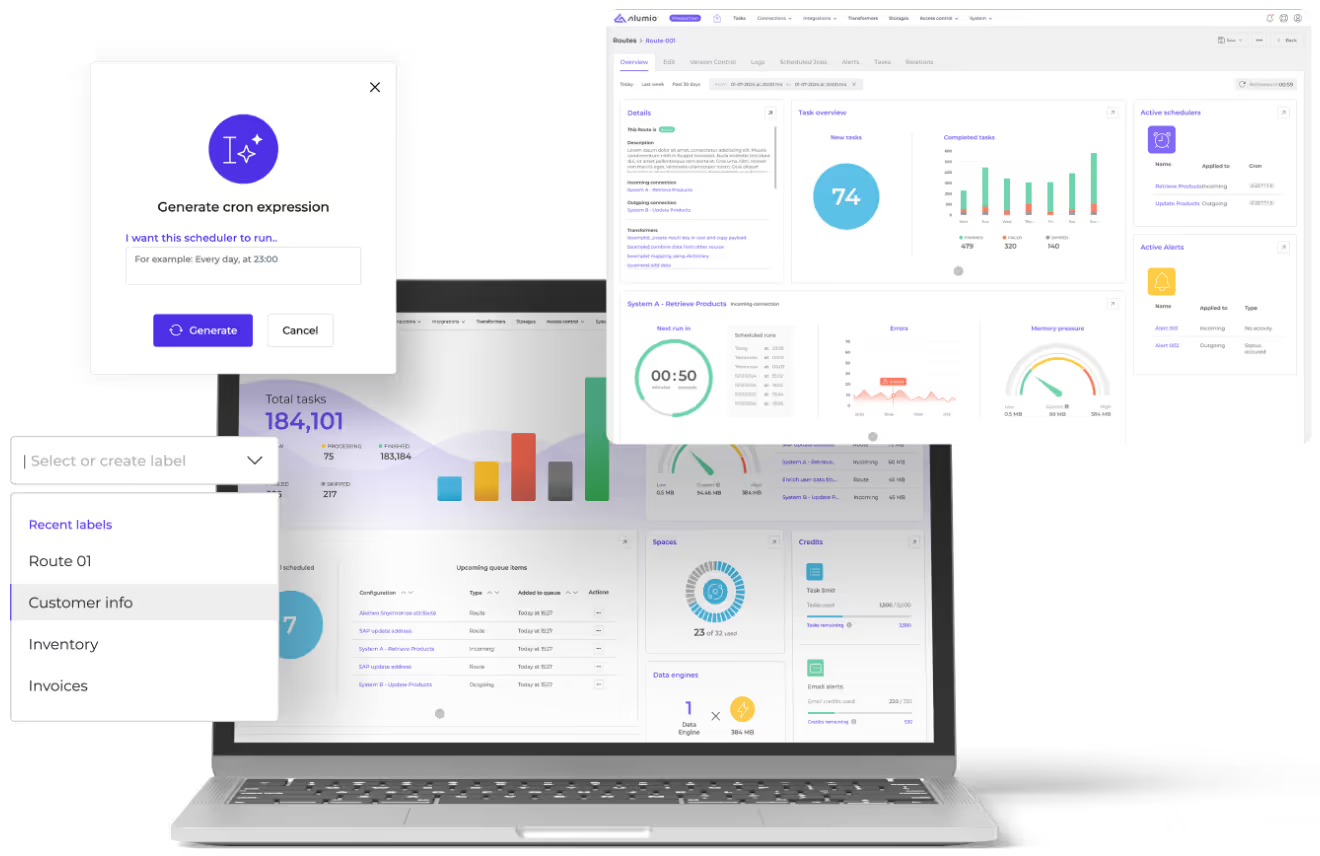
Laptop screen displaying the Alumio iPaaS dashboard, alongside pop-up windows for generating cron expressions, selecting labels and route overview.