


Start building a modular data backbone for yor organizations.

Explore plans
A Alumio vivid purple arrow pointing to the right, a visual representation of how to access more page material when clicking on it.
Go back

Why e-commerce architectures are moving from platforms to data backbones

By
Saad Merchant
Published on
March 20, 2026
Updated on
March 23, 2026
IN CONVERSATION WITH
Email icon
Email icon

For over a decade, the "platform" was the center of the e-commerce universe. Businesses selected a monolithic solution - whether Magento, Salesforce Commerce Cloud, or SAP - and forced every operational process to orbit around it. This model served a purpose when digital commerce was a single channel with limited complexity. However, as customer touchpoints multiply and data volume explodes, the platform-centric model is reaching a breaking point. Modern enterprises now find that a rigid central platform cannot move fast enough to support AI, hyper-personalization, and unified commerce. The solution is a fundamental architectural shift: moving from a platform-centric model to a "data backbone." This approach decentralizes applications while centralizing data flow, creating a flexible, resilient nervous system for the enterprise. This article explores why this transition is necessary, how it unlocks new capabilities, and the critical role of integration in building a functional data backbone.

The limitations of the platform-centric model

In a traditional e-commerce architecture, the web shop acts as the master record for products, customers, and orders. While this provides a sense of simplicity, it creates significant long-term liabilities.

  • Data silos: When the commerce platform holds the data, other critical systems like the ERP (Enterprise Resource Planning), CRM (Customer Relationship Management), and PIM (Product Information Management) often struggle to access real-time information. This leads to synchronization delays and data discrepancies.
  • Operational rigidity: Monolithic platforms are notoriously difficult to customize. Modifying a core process often requires expensive development work that risks destabilizing the entire system.
  • Scalability bottlenecks: As transaction volumes grow, the central platform becomes a performance bottleneck. Scaling a monolithic platform to handle peak traffic is inefficient and costly compared to scaling specific microservices.

These limitations prevent businesses from adopting modern strategies like composable commerce, where best-of-breed applications replace the all-in-one suite.

Defining the data backbone

A data backbone is not a single software application; it is an architectural strategy. In this model, no single platform "owns" the data. Instead, a centralized integration infrastructure facilitates the continuous, real-time flow of data between all applications.

The data backbone acts as the organization's central nervous system. It ensures that when a customer updates their address in the mobile app, that change is instantly reflected in the CRM, the ERP, and the shipping provider's system. The applications (the "platforms") become interchangeable nodes on the network, while the data flow (the "backbone") remains the constant source of truth.

Key characteristics of a data backbone

  1. Decoupled systems: Applications operate independently. A failure in the frontend storefront does not crash the backend inventory system.
  2. Real-time synchronization: Data moves instantly between systems via APIs and webhooks, rather than waiting for nightly batch updates.
  3. Standardized data models: Data is transformed into a standardized format within the backbone, ensuring that different systems can "speak" the same language.

Why the shift is happening now

Three primary drivers are forcing CTOs and e-commerce directors to abandon platform-centric architectures in favor of data backbones.

1. The demand for composable commerce

Enterprises increasingly prefer best-of-breed solutions vs all-in-one suites. They want a specialized search engine like Algolia, a dedicated checkout solution, and a best-in-class CMS like Contentful. A platform-centric model cannot easily support this modularity. A data backbone, however, is designed for it. It allows businesses to plug new tools into the infrastructure without disrupting existing operations.

2. The rise of AI and predictive analytics

Artificial intelligence requires vast amounts of clean, structured, and real-time data. A monolithic platform locks data inside proprietary tables, making it difficult for AI engines to access and analyze. A data backbone ensures that data is accessible and normalized, feeding AI tools the high-quality fuel they need to generate insights, personalize content, and predict demand.

3. The necessity of unified commerce

Customers expect a seamless experience whether they are shopping on Instagram, a mobile app, or in a physical store. This requires a unified view of inventory and customer history that a single e-commerce platform rarely possesses. A data backbone connects the POS (Point of Sale), the e-commerce store, and social marketplaces into a single data stream, ensuring accurate inventory visibility across all channels.


Turn AI ambition into action

Portrait of Leonie Becher Merli, Business Development Manager at Alumio

Get a free assessment of your integration needs and next steps

Portrait of Leonie Becher Merli, Business Development Manager at Alumio

Want to get free assessment of your integration landscape and requirements?

Want to get free assessment of your integration landscape and requirements?

Building the backbone with an integration platform

Constructing a data backbone requires robust infrastructure. This is where an integration platform-as-a-service (iPaaS) becomes essential. An iPaaS serves as the technological foundation of the data backbone, providing the tools to connect applications, map data fields, and automate workflows.

Alumio offers a cloud-native integration platform specifically designed to act as this central hub. By using Alumio, businesses can avoid the "spaghetti code" of custom point-to-point integrations. Instead, they build a structured, manageable, and secure data highway.

How the Alumio iPaaS delivers a scalable data backbone

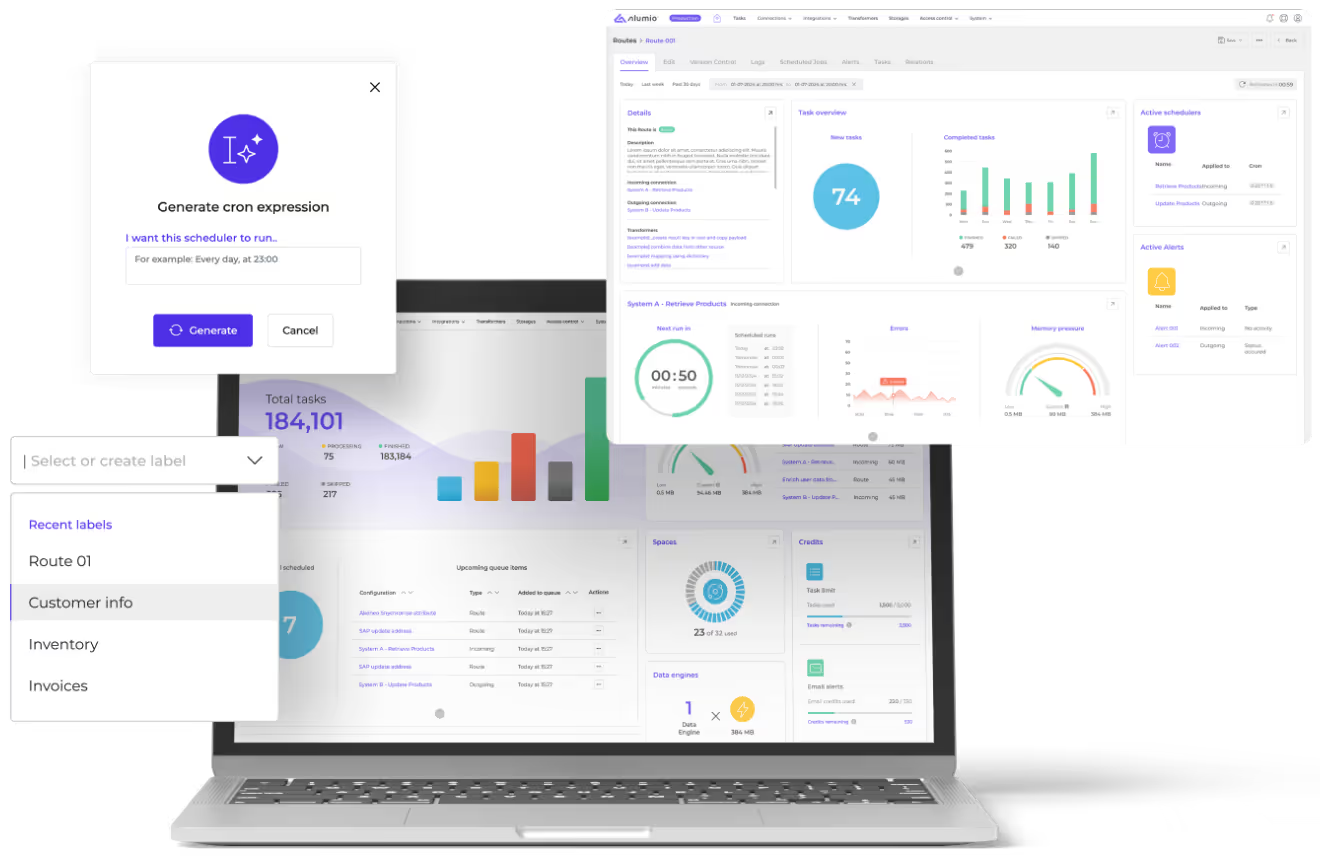
  • Centralized monitoring: Alumio provides a complete overview of all data flows. IT teams can monitor integrations, detect errors, and track performance from a single dashboard.
  • Data transformation: The platform allows users to transform data as it moves between systems. For example, it can reformat a date field from a US format in Shopify to a European format for an SAP ERP.
  • Future-proofing: Because the integrations are managed within Alumio, swapping out an endpoint, such as changing from Magento to BigCommerce, does not require rebuilding the entire network. You simply reconfigure the connector in Alumio.

Strategic benefits of a data-centric architecture

Moving to a data backbone delivers measurable business value beyond technical efficiency.

Enhanced agility and speed to market

When the data layer is decoupled from the application layer, businesses can launch new features faster. Marketing teams can deploy a new loyalty program or a new localized storefront without waiting for a massive backend migration. The data backbone ensures the new tool is immediately connected to the necessary customer and product data.

Improved data governance and security

In a platform-centric model, data is often duplicated across various systems, leading to compliance risks. A data backbone centralizes control. With a platform like Alumio, businesses can enforce data governance policies, audit data access, and ensure compliance with regulations like GDPR and CCPA. The integration platform acts as a secure gatekeeper for data transit.

360-Degree customer insights

A data backbone unifies customer signals from support tickets, transaction history, marketing engagement, and in-store visits. This creates a true 360-degree view of the customer, enabling marketing teams to execute highly targeted campaigns and support teams to resolve issues with full context.

Why e-commerce architectures need data backbones

The era of platform-first e-commerce is fading because one platform can’t be the place where every system, channel, and innovation request connects. Businesses need a model where applications can change without destabilizing operations, and where data can move reliably enough to support unified commerce and AI.

A data backbone delivers that model by centralizing data flow rather than centralizing the platform. The practical way to build it is to treat integration as infrastructure. An iPaaS like Alumio provides the connective layer to standardize, orchestrate, and monitor data across a modular commerce ecosystem, turning best-of-breed from an integration risk into a scalable operating model.

No items found.

FAQ

Integration Platform-ipaas-slider-right
What is the difference between an e-commerce platform and a data backbone?

An e-commerce platform is a software application that manages the storefront and order processing (e.g., Shopify, Magento). A data backbone is an architectural infrastructure, typically enabled by an iPaaS, that connects all applications (ERP, CRM, PIM, and the e-commerce platform) to ensure data flows freely and accurately between them in real-time.

Integration Platform-ipaas-slider-right
Why is a data backbone essential for AI adoption in e-commerce?

AI and machine learning models require large volumes of clean, structured, and real-time data to function effectively. A data backbone eliminates data silos and standardizes data formats, ensuring that AI tools have immediate access to the high-quality information needed for personalization, forecasting, and automation.

Integration Platform-ipaas-slider-right
Does a data backbone architecture replace my ERP system?

No, it does not replace the ERP. The ERP remains the system of record for finance and operations. The data backbone connects the ERP to other systems, ensuring that the financial data within the ERP is synchronized with sales data from the webstore and customer data from the CRM.

Integration Platform-ipaas-slider-right
How does an iPaaS like Alumio facilitate a data backbone?

Alumio provides scalable middleware infrastructure that can be used to implement an integration backbone for an organization. It offers pre-built connectors, data transformation tools, and monitoring capabilities that allow businesses to integrate disparate systems without writing custom code. It acts as the central hub that manages the traffic and logic of data flow across the enterprise.

Integration Platform-ipaas-slider-right
Is a data backbone approach suitable for B2B e-commerce?

Yes, it is highly relevant for B2B. B2B commerce often involves complex data requirements, such as customer-specific pricing, credit limits, and approval workflows. A data backbone ensures this complex data is synchronized accurately between the ERP and the B2B portal, providing a seamless self-service experience for business buyers.

Integration Platform-ipaas-slider-right
Does moving to a data backbone improve website performance?

Yes. By decoupling the frontend presentation layer from the backend data logic, a data backbone reduces the load on the e-commerce storefront. The storefront can focus on rendering content quickly, while the backbone handles heavy data processing and synchronization tasks in the background, leading to faster page load times and a better user experience.

Get a free assessment of your integration needs

Laptop screen displaying the Alumio iPaaS dashboard, alongside pop-up windows for generating cron expressions, selecting labels and route overview.