

Start enabling composable commerce with Alumio

Get in touch
A Alumio vivid purple arrow pointing to the right, a visual representation of how to access more page material when clicking on it.
Go back

The best-of-breed advantage: composable commerce

By
Saad Merchant
Published on
March 16, 2026
Updated on
March 16, 2026
IN CONVERSATION WITH
Email icon
Email icon

Commerce used to be about managing channels. Businesses launched a webshop, added marketplaces, and sometimes built mobile apps, often treating each as a separate operational stream. That approach becomes limiting as complexity grows. Today, commerce depends less on adding more storefronts and more on connecting the systems behind them, from e-commerce platforms and ERP to PIM, CRM, payments, and fulfillment. This is why many businesses are moving away from rigid all-in-one setups and toward composable commerce: a modular, best-of-breed approach that allows them to build a connected ecosystem around their specific needs. But choosing the right tools is only half the story. To make composable commerce work in practice, businesses need a reliable way to integrate and orchestrate all those moving parts.

How commerce is moving from channels to ecosystems

For years, growth in commerce meant adding more customer touchpoints. The more places customers could buy, the more opportunity a business created. But expanding channels without properly connecting the systems behind them often leads to operational friction instead of real scalability.

When channels operate in silos, product information becomes inconsistent, inventory updates lag, customer data gets fragmented, and teams spend more time fixing errors than improving performance. A promotion might appear on one channel but not another. Stock data may not sync quickly enough between the storefront and the ERP. Customer service teams may lack visibility into orders, returns, or support history.

An ecosystem approach changes this. Instead of treating each channel as a standalone operation, businesses connect the full technology landscape behind the customer experience. In this model, channels are simply one layer. The real value comes from how well the backend systems exchange data and support each other.

What composable commerce means in practice

Composable commerce is a modular approach to digital commerce. Instead of relying on one platform to handle every business function, businesses combine specialized solutions for capabilities such as storefronts, product information, search, pricing, customer data, and order management.

This gives businesses more flexibility to shape their stack around their real operational needs. A retailer might use one platform for digital storefronts, another for product information management, a separate ERP for financial and operational processes, and a dedicated CRM for customer engagement. Rather than forcing the business to adapt to one vendor’s limitations, composable commerce makes it possible to build around the tools that fit best.

All-in-one platforms versus best-of-breed commerce

All-in-one platforms can be a practical starting point. They often simplify implementation and vendor management, especially for businesses with relatively standard requirements. But as complexity increases, the trade-offs become harder to ignore.

One platform may handle storefront management well while offering weaker capabilities for product enrichment, localization, advanced promotions, or supply chain flexibility. A best-of-breed approach gives businesses more room to choose the right tool for each function, which usually means greater adaptability and stronger specialization over time.

That said, best-of-breed only works when the systems are properly connected. Without integration, it is just a disconnected set of tools.

Why integration is essential in composable commerce

Composable commerce only creates value when data can move reliably between systems. Orders, inventory data, customer information, pricing logic, product updates, and fulfillment status all need to stay aligned across the ecosystem.

Some businesses try to manage this through direct point-to-point integrations. That can work at a small scale, but it usually becomes harder to maintain as more systems and workflows are added. Every extra connection increases complexity and makes future changes more disruptive.

A central integration layer solves this by connecting systems more efficiently, routing and transforming data between them, and reducing dependency between applications. Instead of building a fragile web of custom connections, businesses can create a more stable architecture that is easier to manage and evolve.


Turn AI ambition into action

Portrait of Leonie Becher Merli, Business Development Manager at Alumio

Get a free assessment of your integration needs and next steps

Portrait of Leonie Becher Merli, Business Development Manager at Alumio

Explore how the Alumio iPaaS enables best-of-breed ecosystems.

Explore how the Alumio iPaaS enables best-of-breed ecosystems.

How an integration platform supports composable commerce

Alumio is an integration platform-as-a-service (iPaaS) helps businesses connect e-commerce platforms, ERP systems, PIM solutions, CRM tools, marketplaces, and other applications through one central layer.

That makes it easier to synchronize data, reduce dependency on point-to-point integrations, and maintain visibility across the ecosystem. It also supports one of the main promises of composable commerce: flexibility. If a business wants to replace a search tool, add a new marketplace, or connect a new payment provider, Alumio helps make those changes easier without disrupting the wider architecture.

In that sense, Alumio does not replace best-of-breed commerce. It supports it by making the ecosystem easier to connect, manage, and scale.

Common composable commerce integration scenarios

The value of a connected ecosystem becomes clearer in practice.

Connecting e-commerce with ERP

When an e-commerce platform is integrated with an ERP, businesses can synchronize orders, inventory, customer data, and financial information more reliably. This helps reduce stock issues, delays, and manual order handling.

Synchronizing PIM and storefront data

A PIM centralizes and enriches product information, but that data still needs to flow accurately into webshops, marketplaces, and other sales channels. Integration helps keep product content consistent across touchpoints.

Linking CRM and customer-facing channels

Connecting CRM systems with commerce platforms gives businesses a clearer view of customer interactions, order history, and engagement data, helping improve service and marketing execution.

Why the future of commerce depends on flexibility

Commerce does not stand still. New customer expectations emerge, channels evolve, and businesses need the freedom to improve their stack over time. A rigid platform can slow that down. A connected ecosystem makes it easier to adapt.

That is why commerce is moving beyond isolated channels and toward composable ecosystems. Businesses want the freedom to choose the solutions that fit, replace systems when needed, and avoid being locked into one platform model. But that flexibility only works when the ecosystem is properly integrated. With Alumio as the integration layer, businesses can connect best-of-breed solutions in a more scalable and manageable way, helping turn composable commerce into a practical long-term strategy.

No items found.

FAQ

Integration Platform-ipaas-slider-right
What is composable commerce?

Composable commerce is a modular approach to digital architecture. It allows businesses to select specialized, best-of-breed software components—such as a PIM, ERP, and CRM—and connect them to build a highly customized, scalable technology stack tailored to exact business requirements.

Integration Platform-ipaas-slider-right
How does a commerce ecosystem differ from multichannel commerce?

Multichannel commerce focuses on managing separate, siloed sales channels independently. A commerce ecosystem connects all backend and frontend systems through centralized data flows, ensuring that every tool and channel shares accurate, real-time information across the entire organization.

Integration Platform-ipaas-slider-right
Why do growing businesses outgrow all-in-one platforms?

As businesses scale, their operational processes become more complex. All-in-one platforms generally provide standard, generalized features that fail to support advanced requirements, such as complex global tax rules, multi-warehouse inventory routing, or multi-language product catalogs.

Integration Platform-ipaas-slider-right
What is a best-of-breed approach in digital commerce?

A best-of-breed approach involves selecting the premier software application available for each specific business function, rather than relying on a single vendor's suite of mediocre tools. This ensures deep functionality and high performance across all departments.

Integration Platform-ipaas-slider-right
How important is integration in a composable architecture?

Integration is the essential backbone of composable commerce. Without a centralized integration platform to route, translate, and synchronize data, specialized software tools become isolated silos, resulting in manual data entry and operational inefficiencies.

Integration Platform-ipaas-slider-right
Can an organization transition to composable commerce gradually?

Yes. A phased approach is highly effective. Businesses can implement a central integration layer first, and then gradually replace individual monolithic components with specialized best-of-breed solutions over time, mitigating risk and preventing operational downtime.

Get a free assessment of your integration needs

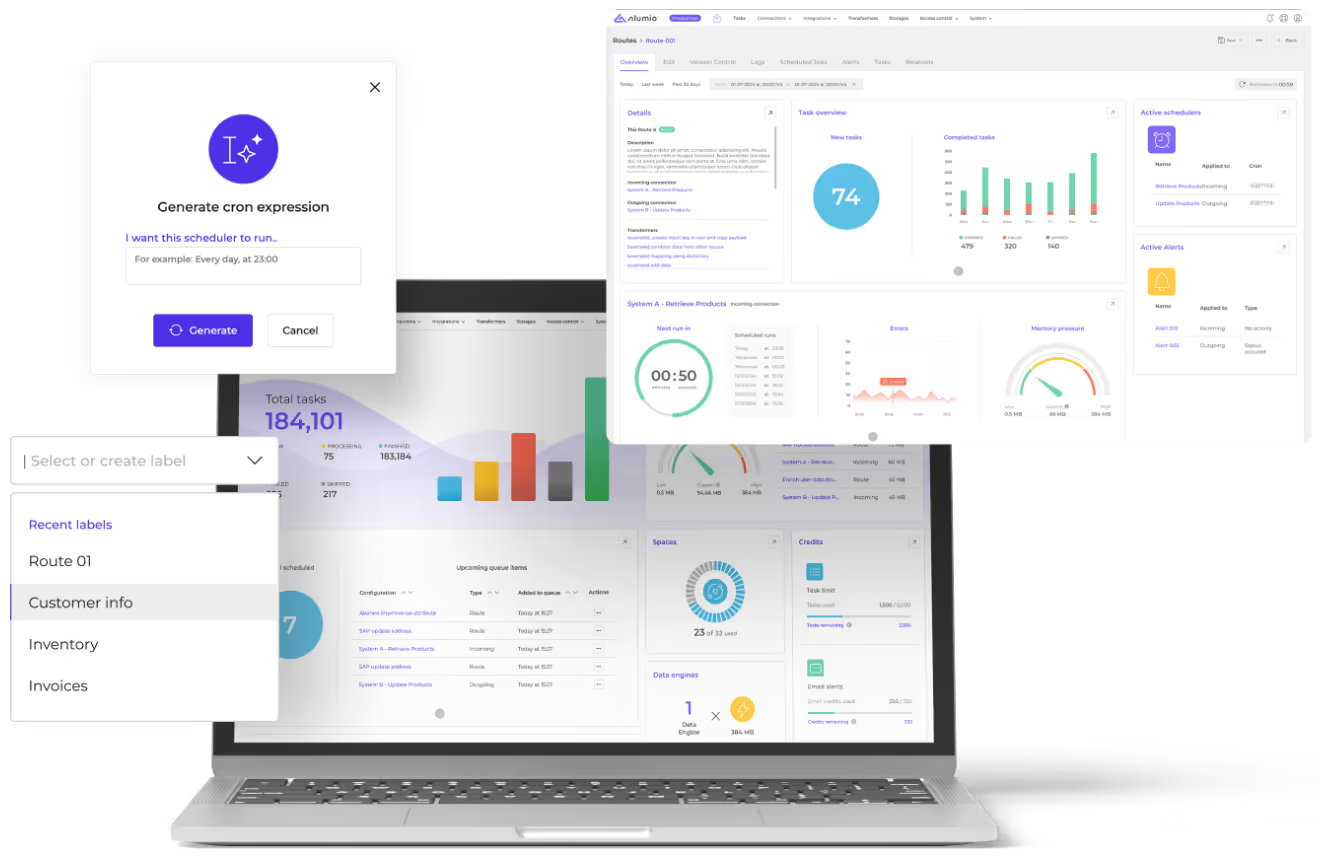
Laptop screen displaying the Alumio iPaaS dashboard, alongside pop-up windows for generating cron expressions, selecting labels and route overview.