Understanding zero party data vs first party data
Zero party data is what a customer tells a business outright. Their size, their budget, the occasion they are shopping for, how often they want to be contacted, the brands they will not buy. It is gathered through preference centers, product-finder quizzes, onboarding questions, and post-purchase surveys, and it arrives with intent already attached.
The comparison is worth making because most retailers have already built for first party data, which is the behavior a business observes about its own customers: pages viewed, items bought, emails opened. Behavioral tracking is running, the customer data platform is in place, and the email tool reads from it. That data is abundant and automatic, but it is inferential. A retailer watching someone browse three pairs of running shoes still has to guess whether that is a purchase or a gift for someone else.
Zero party data removes the guess. A customer who states their size, their budget, or their preferred fit has already answered the question a behavioral model spends its budget estimating. It also arrives with consent attached, which counts for more as third-party cookies disappear and regulators narrow what qualifies as legitimate interest. Most retailers are already collecting some of it. What is missing is everything that happens after collection.
What gets lost when a preference goes nowhere
A stated preference that never reaches the systems that could use it costs more than one missed campaign. Four things go wrong, roughly in this order:
- Repeat requests that annoy the customer: the storefront or service desk asks again for something already stated, because it never received the answer
- Personalization that misses: emails and recommendations keep running on browsing behavior instead of the size, budget, or occasion the customer actually named
- Falling survey completion: customers stop answering preference questions once they notice nothing changes as a result
- Trust that is hard to rebuild: ignoring a stated preference reads as not listening, which lands harder than a behavioral guess that simply misses
Why does zero party data stop at the tool that collected it?
The tool that asks the question is rarely the tool that needs the answer. Preference centers, quizzes, and surveys are usually run by marketing on a platform chosen for how easily it builds a form, not for how well it distributes what it captures.
So the preference sits in one system while every system that could use it carries on unaware. The storefront still merchandises the full catalog. The email platform still sends the default segment. The service agent handling a return has no idea the customer already mentioned their size runs small.
This is the same pattern as CRM and CDP implementation, where the platform gets bought, populated, and then left disconnected from the systems that would make it useful. Collection is a project with a budget and an owner. Distribution has neither.
The systems a stated preference has to reach
Turning a collected preference into an advantage means putting it everywhere the customer meets the brand, not just where it was captured.
- Email or messaging platform: so segmentation reflects what the customer asked for rather than what they last clicked
- Storefront: so category defaults, size filters, and recommendations open on the stated preference
- Customer data platform: so the preference joins the unified profile instead of forming a separate island
- Service desk: so an agent sees the same preferences the marketing team is acting on
- ERP or order system: where the preference affects fulfillment, such as packaging, delivery windows, or gift handling
Very few businesses need all five on day one. The order usually follows where the mismatch is most visible to the customer, which for most is email, because that is where an ignored preference lands in the inbox with the brand's name on it.
Getting a preference to those systems happens one of three ways. Someone can export and re-import it by hand, which holds until the volume or the number of destinations grows. The collection tool's own connectors can push it, which covers the one or two destinations that vendor happens to support and nothing else. Or it can travel through the layer that already connects those systems, where every destination is reachable and the rule is written once.
How an integration platform activates zero party data
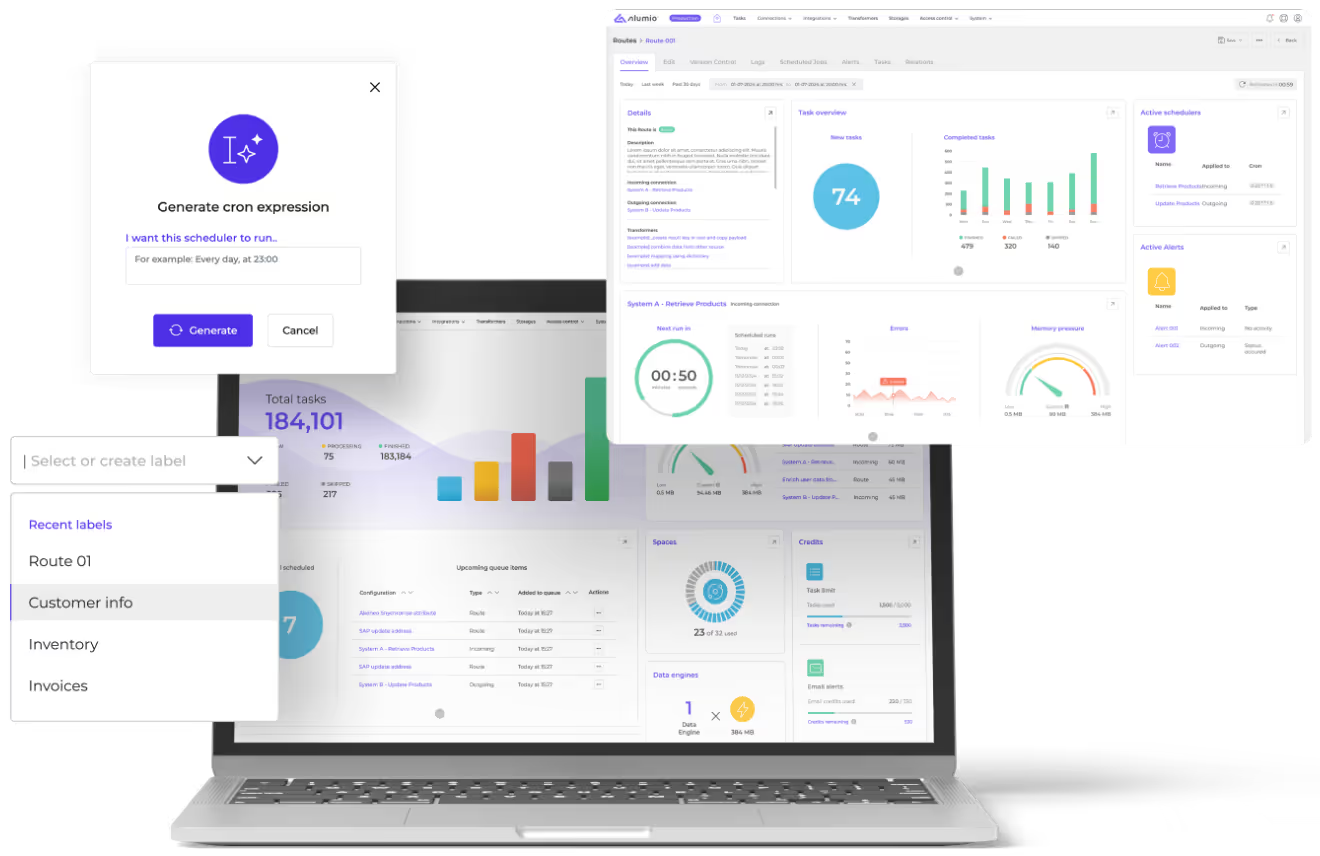
An integration platform-as-a-service (iPaaS) is built for that third route. It differs from a workflow automation tool in what it is designed to handle. A workflow tool moves a record between two apps and does that well. A preference reaching five systems needs a different structure for each destination, somewhere to wait when one of them is unavailable, and a record of what arrived where. On the Alumio iPaaS that work splits into four jobs:
- Delivered on submission, not overnight: an event-driven Route moves the preference the moment the customer states it, so the next email they receive already reflects it
- Reshaped for each destination: a Transformer converts the same size preference into a customer attribute in the CDP, a segment condition in the email platform, and a display default on the storefront, without anyone maintaining three separate mappings
- Held safely when a destination is down: built-in Storage queues the preference and replays it once the system is back, rather than losing it permanently
- Auditable per customer: logging records which system received which preference and when, which is what makes a consent withdrawal or deletion request answerable rather than an investigation
Because those flows are configured rather than hand-built per destination, with the Code Transformer available where configuration cannot express a rule, adding a channel reuses the existing distribution instead of rebuilding it.
What zero party data delivers once it moves
The instinct when personalization underperforms is to collect more data. That is usually the wrong move, because the constraint is rarely how much the business knows and almost always how far that knowledge travels. A better first step is to audit one preference. Pick something customers already tell you, trace it through every system that should act on it, and count how many actually do. Most businesses find the answer is one.
Closing that gap is an integration problem rather than a collection one, and an integration platform is what closes it. What the business gets back is personalization built on what customers actually said instead of what their clicks implied. Fewer repeat questions stop a brand looking like it was not paying attention, and a preference center keeps earning answers because customers can see the last one mattered. That is what separates a working customer data strategy from one that stalls at collection.





.svg)








.svg)
.svg)
.svg)
.svg)
.svg)
.svg)
