

A Alumio vivid purple arrow pointing to the right, a visual representation of how to access more page material when clicking on it.
Go back

Why the Alumio integration platform is the best bet

By
Carla Hetherington
Published on
November 15, 2022
Updated on
June 24, 2026
IN CONVERSATION WITH
Email icon
Email icon

With so many integration platforms on the market, finding the right fit for your organization can be a challenging task, to say the least. So, how can businesses go about selecting the appropriate integration tool that aligns with their business goals and objectives? It all starts with understanding your needs and what solutions different integration platforms offer to cater to them. Among the popular integration platforms out there, Alumio stands out as a versatile and flexible choice for retailers, manufacturers, agencies, and system integrators looking to enhance their operational agility through efficient integrations. Keep on reading to discover what makes Alumio the best bet!

What is the Alumio iPaaS?

The Alumio iPaaS (integration Platform as a Service) is a cloud-native, low-code integration platform that helps connect multiple systems, SaaS, cloud apps, and data sources across on-premises and cloud environments. It provides a user-friendly web interface that developers and business users can collaborate on to create, monitor, and manage integrations and data flows without the need for custom code.

With automated monitoring and logging features, the Alumio iPaaS provides a visual overview of all system integrations and data flows and detects real-time integration errors, empowering users to have ownership over their integrations.

As a low-code platform, the Alumio iPaaS caters to both technical and non-technical users, ensuring that even non-developers like CTOs, project managers, and data experts can manage integrations independently. Simultaneously, the platform provides advanced integration features for developers, including mappers, custom transformers, and workflow automation, making it flexible enough to adapt to virtually any use case.

The Alumio iPaaS was designed to bypass and supersede common problems associated with the traditional way of integrating systems, apps, or software. This method involves writing custom code and plugins, long and expensive projects, high maintenance costs, and third-party dependency.

What does the Alumio iPaaS help integrate?

Whether it is B2B or B2C businesses looking to integrate the latest software solutions, or agencies and system integrators looking to unlock digital growth for their customers, the Alumio iPaaS helps integrate any cloud apps or SaaS solutions, including ERP systems, e-commerce platforms, PIM, POS, CRM, WMS systems, channel marketing systems, and more.

To facilitate and speed up the integration of all these systems, the Alumio iPaaS provides a rich library of pre-built integrations and connectors that help build faster integrations with popular software.

Who is the Alumio iPaaS for?

The Alumio iPaaS is for any kind of modern business looking to accelerate digital transformation and business automation in a scalable, secure, and future-proof way. This includes retailers, manufacturers, agencies, and system integrators:

As a retailer, your main concerns probably include ensuring your company's agility in adopting new solutions, improving customer experience and order fulfillment efficiency, and building omnichannel retail experiences.

As a manufacturer, you are most likely looking to adopt new technologies to scale your business operation efficiency, incorporating sustainability into your business model, automate your supply chain, build supply chain, and itegrate all your customer and supplier data with EDI, among other things.

As a system integrator or agency, it's a choice between creating an integration solution from scratch for each of your customers or having one central integration solution to manage all your customer integrations. As such, you likely prioritize having a flexible platform that outperforms monolithic models and is able to keep up with increasingly complicated systems, flexible data transformation, and customizable integration capabilities, robust monitoring and logging, and data security and compliance with privacy regulation.

The Alumio iPaaS caters to the unique needs of these diverse users seamlessly, offering a comprehensive and flexible platform that addresses the specific challenges faced by retailers, manufacturers, and system integrators or agencies.Whether it's enhancing customer experiences, streamlining supply chains, or managing complex integrations, Alumio provides a scalable, secure, and future-proof solution that empowers businesses to achieve their digital transformation goals efficiently.

Why should you choose Alumio as your integration platform?

In one word: flexibility. Above all, the Alumio iPaaS provides users with unparalleled flexibility regarding platform usability, integration capabilities, and scalability.

Alumio strives to make integrations simple for developers and non-developers in a world of ever-evolving technology. As mentioned above, the platform includes advanced features and allows for the creation of custom integrations based on specific business needs while at the same time being user-friendly enough to be accessible to non-technical professionals. The simple interface, combined with its extensive integration capabilities, make it a suitable choice for users of all technical levels and backgrounds.

Speaking of integration capabilities, the Alumio iPaaS offers a wide variety of integration features that allow for extensive integration flexibility, such as transformers that turn data into desired formats to customize integrations limitlessly. Additionally, the platform is constantly updated with new and improved features to enhance usability and agility. Check out the Alumio 2024 feature roadmap to discover all the upcoming features we will release this year.

The flexibility relating to the scalable nature of the platform is reflected in an adaptable pricing model that offers a wide range of features at a competitive price. Alumio's flexible subscription plans are based on the number of tasks, data engines, and database and storage size required, meaning the platform adapts to users' evolving needs and not the other way around. Whether your integration needs are simple or complex, whether your business is small or an enterprise, Alumio accommodates all integration requirements and can guide you every step of your integration journey.

Want to see how Alumio compares to other iPaaS solutions on the market? Check out our compare pages for a side-by-side comparison of Alumio and popular iPaaS vendors.


Turn AI ambition into action

Portrait of Leonie Becher Merli, Business Development Manager at Alumio

Get a free assessment of your integration needs and next steps

Portrait of Leonie Becher Merli, Business Development Manager at Alumio

No items found.
Topics in this blog:
No items found.

FAQ

Integration Platform-ipaas-slider-right
What makes Alumio the best integration platform for mid-market digital commerce?

Alumio stands out for mid-market digital commerce through the combination of: deep connector coverage for the specific systems common in European e-commerce and manufacturing (SAP, Dynamics 365, Akeneo, Shopware, Adobe Commerce), a config-first architecture that reduces specialist middleware dependency for routine management, ISO 27001:2022 certification for enterprise-grade data security, competitive mid-market pricing that makes iPaaS governance accessible below enterprise scale, and a strong European partner network of certified e-commerce agencies and system integrators who deliver implementations with domain expertise. The platform is purpose-built for the mid-market complexity range where most digital commerce integration investment is made.

Integration Platform-ipaas-slider-right
How should businesses evaluate integration platforms to find the right fit?

Integration platform evaluation should focus on: connector coverage for the exact systems in the organization's landscape (not just generally popular systems), governance features matching the operational requirements (monitoring, audit logging, access control, error handling), the total cost of ownership at expected data volumes and integration count, security certification matching the organization's compliance requirements, the quality and depth of the implementation partner ecosystem in the organization's industry and region, and references from organizations with genuinely comparable system landscapes and integration use cases. A proof-of-concept on an actual integration requirement with realistic data is the most reliable evaluation method: platform demonstrations on curated examples do not reveal the complexity handling that production integration requires.

Integration Platform-ipaas-slider-right
What makes Alumio's connector library particularly valuable for European businesses?

Alumio's connector library reflects the specific systems most common in the European digital commerce and manufacturing markets: SAP (dominant in European manufacturing and distribution), Microsoft Dynamics 365 and Business Central (strong in European mid-market), Shopware (the leading e-commerce platform in German-speaking markets), Akeneo (a French PIM vendor with strong European adoption), and connectors for European marketplace and payment platforms (Bol.com, Mollie, iDEAL). European businesses evaluating iPaaS platforms from US-headquartered vendors often find connector gaps for these European-specific systems that Alumio's European market focus has addressed. The same advantage applies to GDPR compliance and EU data residency requirements.

Integration Platform-ipaas-slider-right
How does Alumio compare to larger iPaaS platforms like MuleSoft or Boomi?

MuleSoft and Boomi are enterprise-scale platforms with broad feature sets designed for large IT organizations with dedicated integration teams. Alumio is purpose-built for mid-market digital commerce and manufacturing, with: a tighter and more accessible config-first interface (less specialist expertise required for routine management), connector library depth for European systems that global platforms sometimes lack, ISO 27001:2022 certification meeting enterprise security requirements, competitive pricing for mid-market organizations that makes governance accessible below the scale where MuleSoft and Boomi are typically adopted, and a European partner ecosystem with domain expertise in e-commerce and manufacturing integration. For organizations at mid-market scale, Alumio frequently offers better fit than large enterprise platforms whose complexity and pricing exceed what mid-market integration requirements justify.

Integration Platform-ipaas-slider-right
What is Alumio's pricing model and how does it scale?

Alumio's pricing scales with the number of integrations, not data volume; there are no transaction fees and no volume penalties, and the subscription covers the platform, connector library, monitoring, and connector maintenance. Exact pricing is shared in a discovery call, structured around your operational starting point. The model is designed to give predictable integration infrastructure cost, rather than the variable, hard-to-forecast cost of custom development where each new integration and each maintenance cycle generates unpredictable developer time.

Integration Platform-ipaas-slider-right
What is the typical timeline for going live with a first integration on Alumio?

The timeline to first production integration on Alumio depends on the complexity of the use case and whether a prebuilt connector template exists for both connected systems. For common combinations with prebuilt connectors (Shopify to SAP, Akeneo to Adobe Commerce), a first integration covering the primary data flows (orders, inventory, products) can typically be configured and tested in two to four weeks, with go-live in four to six weeks including UAT and parallel-run validation. For custom or less-documented system connections, timelines extend based on the connector build requirement. Alumio's Solutions Engineering team provides scoping support to define realistic timelines for specific integration combinations before the project begins.

Get a free assessment of your integration needs

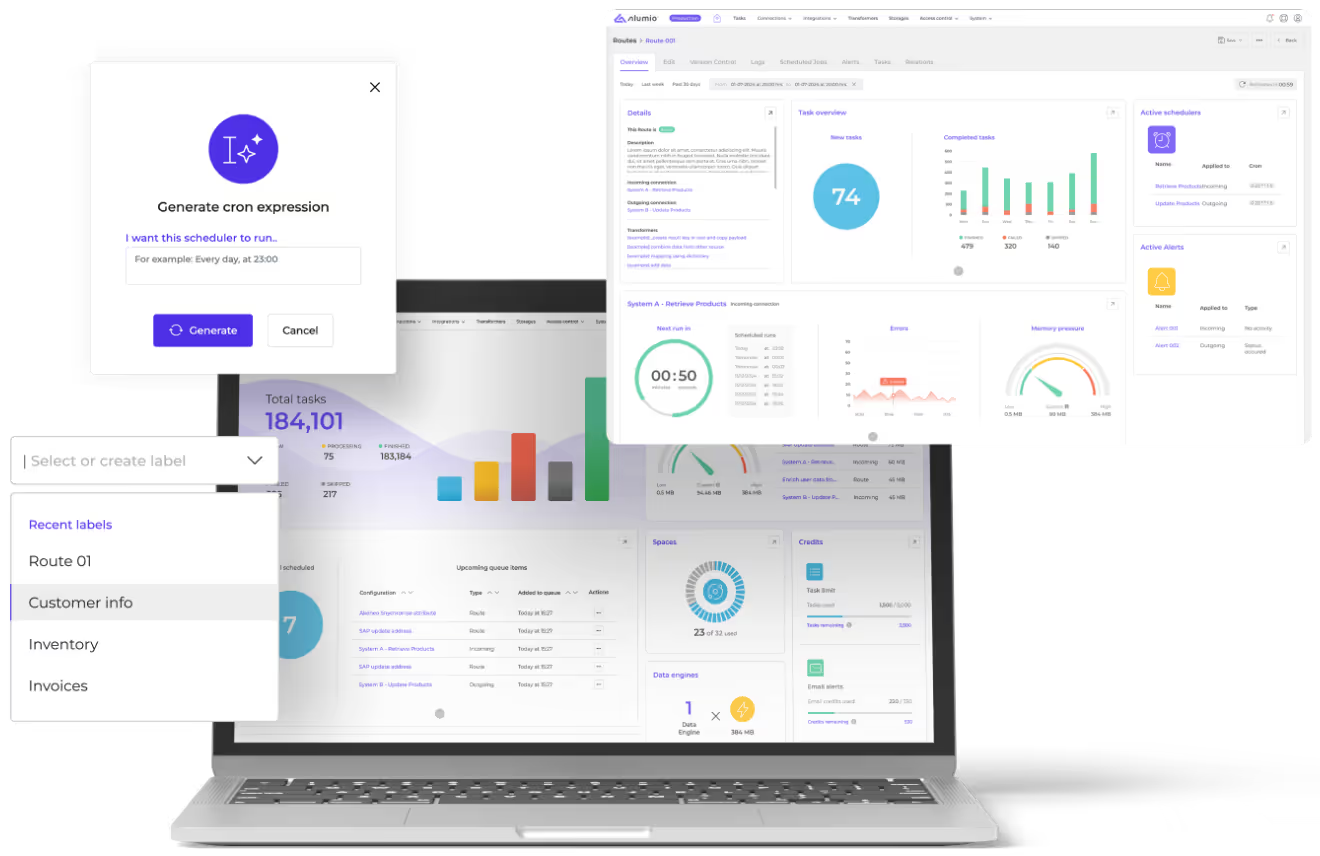
Laptop screen displaying the Alumio iPaaS dashboard, alongside pop-up windows for generating cron expressions, selecting labels and route overview.