


A Alumio vivid purple arrow pointing to the right, a visual representation of how to access more page material when clicking on it.
Go back
External blog
5 min read

What is SAP Business One (B1)?

By
Published on
March 28, 2025
Updated on
June 24, 2026
IN CONVERSATION WITH
Email icon
Email icon

When most people hear “SAP,” they immediately think of big enterprise applications designed for large global corporations. Yet, SAP Business One (B1) is an affordable, integrated Enterprise Resource Planning (ERP) solution designed specifically for small to mid-sized businesses and subsidiaries of large enterprises. It delivers a powerful tool for SMEs to manage finances, sales, purchasing, inventory, and customer relationships—all from one central platform. Let's delve into what SAP Business One (B1) is, its key features, and how it can benefit your business.

What is SAP Business One (B1)?

SAP Business One (B1) is an integrated business management solution that’s designed to help small to medium-sized enterprises (SMEs) streamline and automate their core business processes. Available for on-premise and cloud deployment, it provides a unified platform for managing financials, sales, purchasing, inventory, manufacturing, and customer relationships (CRM).

Unlike enterprise-level ERP systems that are often complex and expensive, SAP B1 is tailored to the specific needs and budgets of smaller businesses. With real-time data visibility and customizable tools, SAP B1 empowers businesses to automate processes, reduce costs, and scale efficiently.

How has SAP Business One evolved?

Originally launched as “TopManage” in Israel, SAP Business One was acquired and rebranded by SAP in 2002. Since then, it has evolved into a comprehensive ERP solution that now supports over 78,000 customers worldwide. Designed to run on both Microsoft SQL Server and SAP HANA, SAP Business One caters to businesses seeking to streamline operations while keeping costs in check.

What are the key features of SAP Business One?

SAP Business One provides a holistic collection of features to help drive profitable business growth with streamlined processes, greater insight, and strategic decision-making based on real-time information. These features include:

  • Financial management: SAP B1 automates core accounting functions such as journal entries, accounts receivable/payable, and bank reconciliation. It enhances precise cash flow management, fixed asset tracking, and budgeting, while providing real-time financial insights to drive better decision-making.
  • Sales and Customer Relationship Management (CRM): Manage the entire sales journey from lead generation to post-sale support with an integrated approach. SAP Business One helps you monitor sales opportunities, optimize marketing campaigns, and centralize customer data, ensuring every interaction is tracked and leveraged. Real-time mobile access enables your sales teams to respond quickly and effectively, driving higher customer satisfaction and revenue.
  • Procurement and inventory control: Optimize your order-to-pay cycle with tools that automate purchase orders, goods receipts, and invoice processing. The platform centralizes master data to streamline procurement, while real-time synchronization between warehouses and accounting systems ensures accurate inventory management. This cohesive approach controls costs and enhances supply chain efficiency.
  • Business intelligence and analytics: Transform raw data into actionable insights with robust analytics and reporting tools. SAP Business One enables you to build custom reports and interactive dashboards, offering multiple perspectives on your business performance. With intuitive drill-down features, predefined KPIs, and seamless integration with tools like Microsoft Excel, you can quickly identify trends and make data-driven decisions that propel growth.
  • Advanced access and performance: Stay connected with powerful mobile applications and a flexible web client that allow you to manage operations from anywhere. The in-memory platform enhances system performance, ensuring rapid data processing and real-time report generation, all while maintaining a streamlined IT environment.


Turn AI ambition into action

Portrait of Leonie Becher Merli, Business Development Manager at Alumio

Get a free assessment of your integration needs and next steps

Portrait of Leonie Becher Merli, Business Development Manager at Alumio

Industry-specific benefits of SAP Business One

SAP Business One delivers tailored ERP solutions, equipping industries with integrated tools and best practices to boost efficiency and fuel growth. Here’s how it transforms key sectors:

  • Manufacturing: By shortening cycle times, minimizing waste, and boosting overall efficiency, SAP Business One enables manufacturers to meet demand swiftly while uncovering new revenue streams. It helps enhance your production workflows with streamlined processes and reduces supply chain costs.
  • Retail: SAP Business One enables retailers to optimize inventory management and deliver personalized shopping experiences, ensuring that your operations are responsive to customer needs. It helps leverage real-time insights from point-of-sale (POS) systems and customer data to gain a competitive advantage.
  • Consumer products: SAP Business One helps align production and distribution with shifting consumer preferences, ensuring that you consistently supply the goods customers demand. It helps leverage real-time data and analytics to forecast demand and optimize product delivery.
  • Professional services: With robust resource planning, project management, and billing capabilities, SAP Business One empowers service providers to maintain high-quality standards and drive profitability. It helps improve service delivery with repeatable, scalable processes.
  • Wholesale distribution: SAP Business One provides the flexibility to adapt to both customer and supplier demands, fostering a tightly integrated process that helps wholesalers improve their supply chain connectivity, from planning and inventory management to logistics.

Conclusion: fast-track your integrations with the Alumio iPaaS

With tens of thousands of customers worldwide, SAP Business One is a proven choice for SMEs looking for an affordable yet comprehensive and scalable ERP solution. Its user-friendly interface ensures quick adoption, while automation reduces errors and streamlines operations across departments. By centralizing business processes and providing real-time insights, it empowers decision-makers with accurate data to drive efficiency and profitability. Helping build a unified system without the complexity of enterprise-grade solutions, SAP Business One delivers a practical, scalable approach to managing day-to-day operations.

Is your business looking to integrate SAP Business One with other applications? The Alumio iPaaS provides an SAP Business One Connector that enables faster and more flexible SAP B1 integrations. Find out more →

No items found.
Topics in this blog:
No items found.

FAQ

Integration Platform-ipaas-slider-right
What is SAP Business One and who is it designed for?

SAP Business One (SAP B1) is an integrated ERP solution designed specifically for small to mid-sized businesses and subsidiaries of larger enterprises. Unlike SAP's flagship enterprise products (ECC, S/4HANA), Business One is designed for accessibility and faster implementation: covering finance, sales, purchasing, inventory, production, and project management in a unified application that mid-market teams can operate without dedicated SAP basis administration. It is used across manufacturing, distribution, retail, and services industries by businesses that need ERP functionality without the complexity and cost of enterprise SAP implementations.

Integration Platform-ipaas-slider-right
How does Alumio integrate SAP Business One with e-commerce and other systems?

Alumio integrates SAP Business One through its SAP B1 connector, which handles the Service Layer API (the REST-based integration interface introduced in SAP B1 version 9.x) and the older DI API (the COM-based interface for older B1 versions). Integration teams configure data mapping between SAP B1 business objects (sales orders, business partners, items, inventory) and the connected system's format (Shopify orders, WooCommerce products, Akeneo attributes) in Alumio's Transformer components. This allows SAP B1 users to benefit from the same iPaaS governance and monitoring as larger SAP ECC or S/4HANA users, at the scale and price point appropriate for mid-market businesses.

Integration Platform-ipaas-slider-right
What are the most common integration challenges for SAP Business One users?

Common SAP B1 integration challenges are: API evolution (older B1 installations use the DI API, which requires COM-based or DI Server access rather than REST, adding complexity), multi-company setups (SAP B1 supports multiple company databases per server, and integrations must correctly route data to the right company), custom fields and user-defined tables (SAP B1 is highly customizable and integrations must accommodate customer-specific data model extensions), and performance at scale (the Service Layer API can be slower than enterprise SAP APIs for high-volume synchronization use cases). Alumio's SAP B1 connector handles the API communication layer for both Service Layer and DI Server interfaces, abstracting these complexities from the integration configuration.

Integration Platform-ipaas-slider-right
What data flows are most valuable to automate for SAP Business One users?

The most valuable automated flows for SAP B1 users are: e-commerce orders flowing automatically into SAP B1 sales orders (eliminating manual order entry that is one of the highest-volume manual processes for growing e-commerce businesses), inventory levels from SAP B1 flowing to e-commerce storefronts in near real time (preventing overselling), item master data from SAP B1 flowing to e-commerce for catalog management, business partner data synchronization between SAP B1 and CRM, and purchase order confirmations from suppliers flowing into SAP B1 receipts. Each automation converts a manual, error-prone process into a governed, monitored data flow.

Integration Platform-ipaas-slider-right
How does SAP Business One serve as an ERP for growing e-commerce businesses?

SAP Business One serves growing e-commerce businesses by providing: unified financial management across all revenue channels, inventory management with lot and serial number tracking for businesses with traceability requirements, purchase order and supplier management, multi-currency support for international operations, and production management for businesses that manufacture alongside selling. The combination of these capabilities at mid-market accessibility and price point makes SAP B1 a strong choice for e-commerce businesses that have outgrown accounting software and need genuine ERP functionality without committing to enterprise SAP complexity. Integration with e-commerce via Alumio is what makes the ERP investment operationally realizable rather than creating new manual handoff requirements.

Integration Platform-ipaas-slider-right
When should a SAP Business One customer consider upgrading to SAP S/4HANA?

A SAP Business One customer should consider upgrading to S/4HANA when: transaction volumes exceed what B1 can process efficiently (typically above 1,000 daily transactions for complex scenarios), multi-entity or multi-country requirements require the consolidation capabilities that B1 lacks, manufacturing complexity (process manufacturing, advanced planning, complex BOMs) exceeds B1's production management, or the organization's growth trajectory indicates that enterprise ERP capabilities will be needed within a three to five year horizon. The integration platform decision should precede or accompany this upgrade planning: organizations using Alumio for SAP B1 integration can adapt their Routes to S/4HANA using the S/4HANA connector when the upgrade is made, rather than rebuilding integrations from scratch.

Get a free assessment of your integration needs

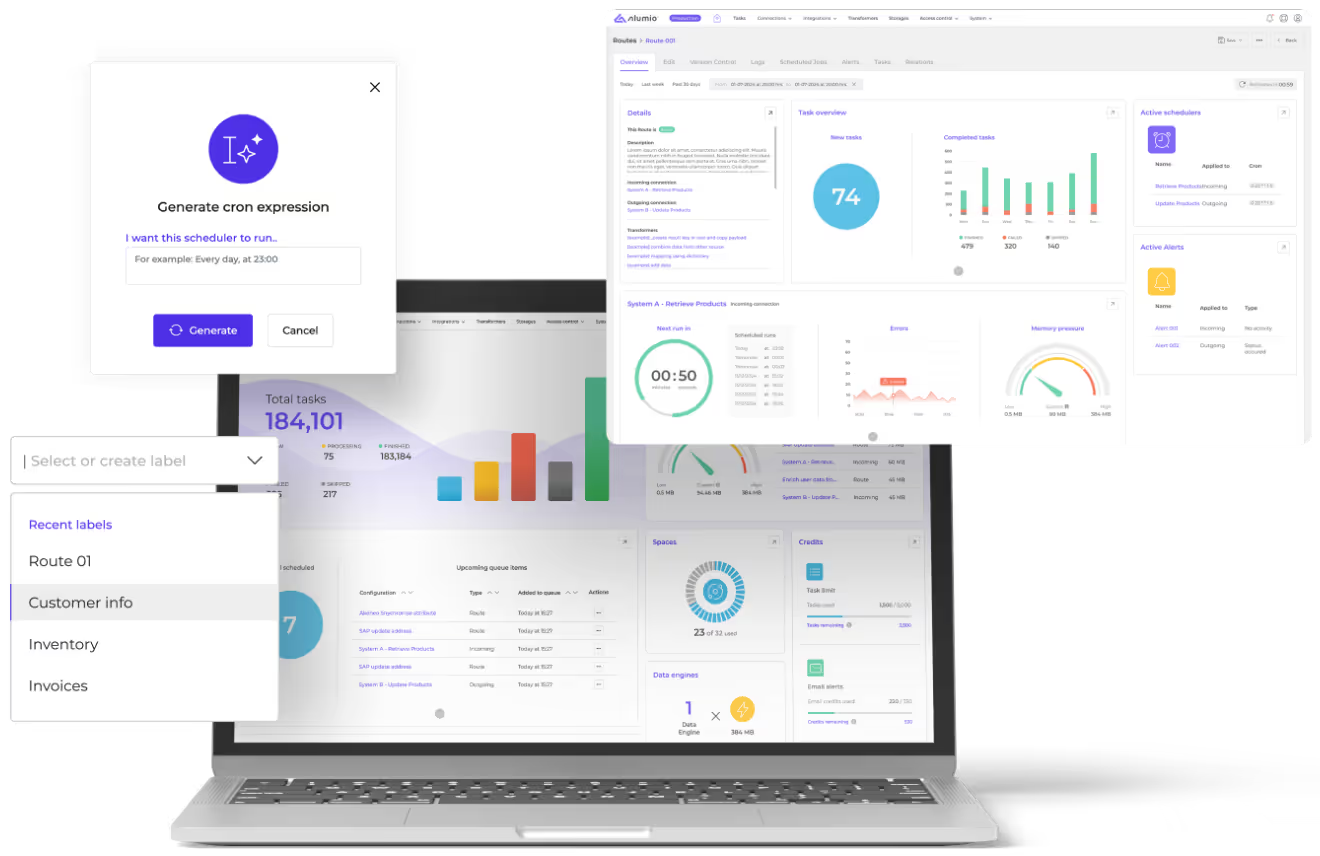
Laptop screen displaying the Alumio iPaaS dashboard, alongside pop-up windows for generating cron expressions, selecting labels and route overview.