


A Alumio vivid purple arrow pointing to the right, a visual representation of how to access more page material when clicking on it.
Go back

Business benefits of Artificial Intelligence, Machine Learning, and Business Intelligence

By
Carla Hetherington
Published on
May 24, 2023
Updated on
June 24, 2026
IN CONVERSATION WITH
Email icon
Email icon

With the emergence of new technologies, modern companies invest in solutions that can precisely provide valuable data insights to drive business growth. Among these solutions are AI (Artificial Intelligence), ML (Machine Learning), and BI (Business Intelligence). The data intelligence provided by these solutions can be combined with contextual information to be mined and applied to numerous use cases across industries. The ultimate objective is to improve an organization's business activities by leveraging pertinent data to make more informed decisions that boost productivity and revenue. This, in turn, drives accelerated business expansion and greater profitability. Want to discover how to reap the benefits of AI, ML, and BI and take your business to the next level? Keep on reading!

The rise of AI

In recent months, Artificial Intelligence has created waves with new emerging tools such as ChatGPT, AutoGPT, and many others. These AI tools will enhance customer experiences, enable business automation, and promote growth. Future-thinking companies are already using them to their advantage since, in an ever-changing e-commerce landscape, innovation is the key to staying relevant.

What are the business benefits of AI?

The benefits of implementing AI technologies in your business are manifold. Most modern businesses implement a next-gen middleware solution called iPaaS (integration Platform as a Service) to integrate AI with their techn stack seamlessly. Once you have an iPaaS like Alumio set in place, you can enjoy the benefits of connecting AI to your business, which, among them, are:

  • Data Integration: Alumio helps businesses integrate data from various sources, including internal databases, external APIs, and third-party applications. Thanks to AI, businesses can then analyze this data and gain insights that can help them improve operations, make better decisions, and identify new opportunities.

As a side note, AI systems are only limited in their intelligence by the amount and quality of data available for access. Read our white paper to discover how Alumio ensures the seamless synchronization and highest data quality that AI systems need to operate efficiently.

  • Personalization: AI-powered solutions can help businesses personalize customer interactions by providing insights into customer preferences and behaviors.
  • Intelligent Automation: By integrating AI with their business via Alumio, businesses can automate repetitive tasks and streamline workflows to improve efficiency and reduce errors.
  • Predictive Analytics: An iPaaS with AI capabilities can help businesses predict future trends and behaviors. By analyzing historical data, businesses can identify patterns and use this information to predict future outcomes. This can help businesses make more informed decisions and develop better strategies.

Discover many other business benefits of connecting OpenAI to your e-commerce →

What are the business benefits of ML?

Before we delve into the benefits, it is essential to know that Machine Learning refers to the area of Artificial Intelligence and computer science that emphasizes using algorithms and data to simulate how humans learn to enhance their precision over time. As such, the algorithms used in Machine Learning are constantly changing to improve their predictive and analytical capacities.

As a branch of AI, the business benefits of ML are the same, with the ultimate goal in mind to adapt more quickly to unforeseen shifting market trends and enhance overall business performance. A couple of benefits worth highlighting are:

  • Real-time analysis: Alumio can help businesses analyze real-time data using ML models. By utilizing ML to analyze customer behavior in real-time and adjusting pricing or promotions accordingly, businesses can accelerate their decision-making process and promptly adapt to changing circumstances.
  • Predictive Analytics: Alumio can assist businesses in employing ML for forecasting future patterns and actions, such as customer demand, detecting possible fraudulent activities, or projecting revenue growth. These prognoses can enable businesses to make better-informed decisions and devise improved strategies.

Read more about the benefits of data synchronization →

What is the importance of Business Intelligence?

Business Intelligence is the technology-driven process of collecting and analyzing data from internal and external sources to help business users make informed decisions and plan strategies. With Business Intelligence, organizations can leverage data-driven decision-making effectively. As a result, executives and employees primarily rely on alternative factors, such as accumulated knowledge, past experiences, intuition, and instinct, when making critical business choices. While these approaches can yield positive outcomes, they are also susceptible to errors and misjudgments due to the absence of data-driven foundations.

What are the business benefits of BI?

The benefits of Business Intelligence are manifold and, for the most part, shared with AI and ML. Here are some additional benefits of BI companies can enjoy via the Alumio iPaaS:

  • Data warehousing: Alumio offers a solution that enables businesses to conveniently store, handle, and oversee vast amounts of data, facilitating analysis and generating valuable insights.
  • Data Analysis: Alumio equips businesses with various data analysis capabilities, such as data visualization, dashboard creation, and reporting. These tools allow businesses to obtain valuable operational insights, detect patterns, and track essential performance metrics.

Learn more about the data security benefits of an integration platform →

Conclusion

Artificial Intelligence, Machine Learning, and Business Intelligence applications are increasing daily. However, when it comes to slowing down AI, ML, and BI, poor data quality is the numero uno factor. Therefore, ensuring that data can be modified and transformed on the go is essential. There is no better approach to deploying a capable iPaaS with bespoke data transformation, data mapping capabilities, data normalization, and extensive monitoring and logging features. In this way, an iPaaS like Alumio is the key to connecting everything and providing the high-quality data required to benefit from these technologies.

If you'd like to get a first-hand experience of how our next-gen, low-code integration platform can seamlessly integrate software solutions, apps, or data sources to prepare your business for growth: GET A FREE DEMO.

Are you ready to integrate the future with Alumio?

Turn AI ambition into action

Portrait of Leonie Becher Merli, Business Development Manager at Alumio

Get a free assessment of your integration needs and next steps

Portrait of Leonie Becher Merli, Business Development Manager at Alumio

No items found.
Topics in this blog:
No items found.

FAQ

Integration Platform-ipaas-slider-right
What is the difference between AI, Machine Learning, and Business Intelligence?

Business Intelligence (BI) analyzes historical data to produce dashboards and reports that describe what has happened. Machine Learning (ML) uses statistical models trained on data to identify patterns and make predictions without being explicitly programmed for each scenario. Artificial Intelligence (AI) is the broader field encompassing ML and other techniques that enable software to perform tasks that require human-like reasoning. BI tells you what happened; ML predicts what will happen; AI can act on those predictions automatically.

Integration Platform-ipaas-slider-right
How can AI, ML, and BI work together to drive business growth?

The combination is most effective when each layer uses the outputs of the others: BI provides historical context that informs ML model training (what patterns have mattered in the past), ML produces predictions that BI tools visualize for decision-makers (next-period demand forecasts on a dashboard), and AI acts on those predictions automatically (adjusting inventory orders or marketing spend without manual intervention). The integration layer connecting the business systems that generate raw data to the AI, ML, and BI tools is what makes this combination operational rather than theoretical.

Integration Platform-ipaas-slider-right
What data infrastructure is required for AI, ML, and BI to deliver business value?

All three technologies require data that is complete, current, and consistent across the source systems that generate it. This means the integration infrastructure connecting ERP, e-commerce, CRM, and PIM to the analytics and AI layer must synchronize data reliably and in real time. Gaps in data (missing order records, stale inventory levels, incomplete customer profiles) create systematic errors in ML models and BI reports that cannot be corrected by algorithmic sophistication alone. Organizations that invest in integration infrastructure first consistently get better outcomes from their AI and analytics investments.

Integration Platform-ipaas-slider-right
What are the most impactful AI and ML use cases for e-commerce and manufacturing?

For e-commerce: personalized product recommendations (ML trained on purchase and browse history), dynamic pricing (ML responding to competitor pricing and demand signals), demand forecasting (ML predicting SKU-level demand for inventory optimization), and customer churn prediction (ML identifying at-risk customers before they leave). For manufacturing: predictive maintenance (ML on sensor data to predict equipment failures), production yield optimization (ML on process data to reduce defects), and demand-driven production scheduling (ML integrating demand forecasts into MRP systems).

Integration Platform-ipaas-slider-right
How does Alumio's integration backbone support AI and BI adoption?

Alumio ensures the data that AI and BI tools depend on flows reliably from source systems (ERP, e-commerce, PIM, CRM) to the analytics and AI layer. By governing and logging all data exchanges, Alumio provides the data lineage and quality assurance that makes AI model training and BI reporting trustworthy. The Alumio Power BI connector and OpenAI connector extend this to direct integration between the Alumio backbone and specific AI and BI platforms, enabling operational data to flow into analytics and AI pipelines without building separate data extraction pipelines per source system.

Integration Platform-ipaas-slider-right
What is the risk of deploying AI and ML without a governed data integration layer?

Deploying AI and ML without a governed data integration layer means models train and operate on incomplete, inconsistent data: an ML demand forecast trained on e-commerce orders but missing EDI or marketplace orders will systematically underestimate demand; a BI dashboard reporting revenue from the ERP but not from all e-commerce channels will show an incomplete picture. These errors compound over time: wrong forecasts drive wrong procurement decisions, and incomplete revenue reporting creates strategic blind spots. The integration layer is not an optional enhancement for AI and BI deployments; it is the prerequisite that determines whether insights are trustworthy.

Get a free assessment of your integration needs

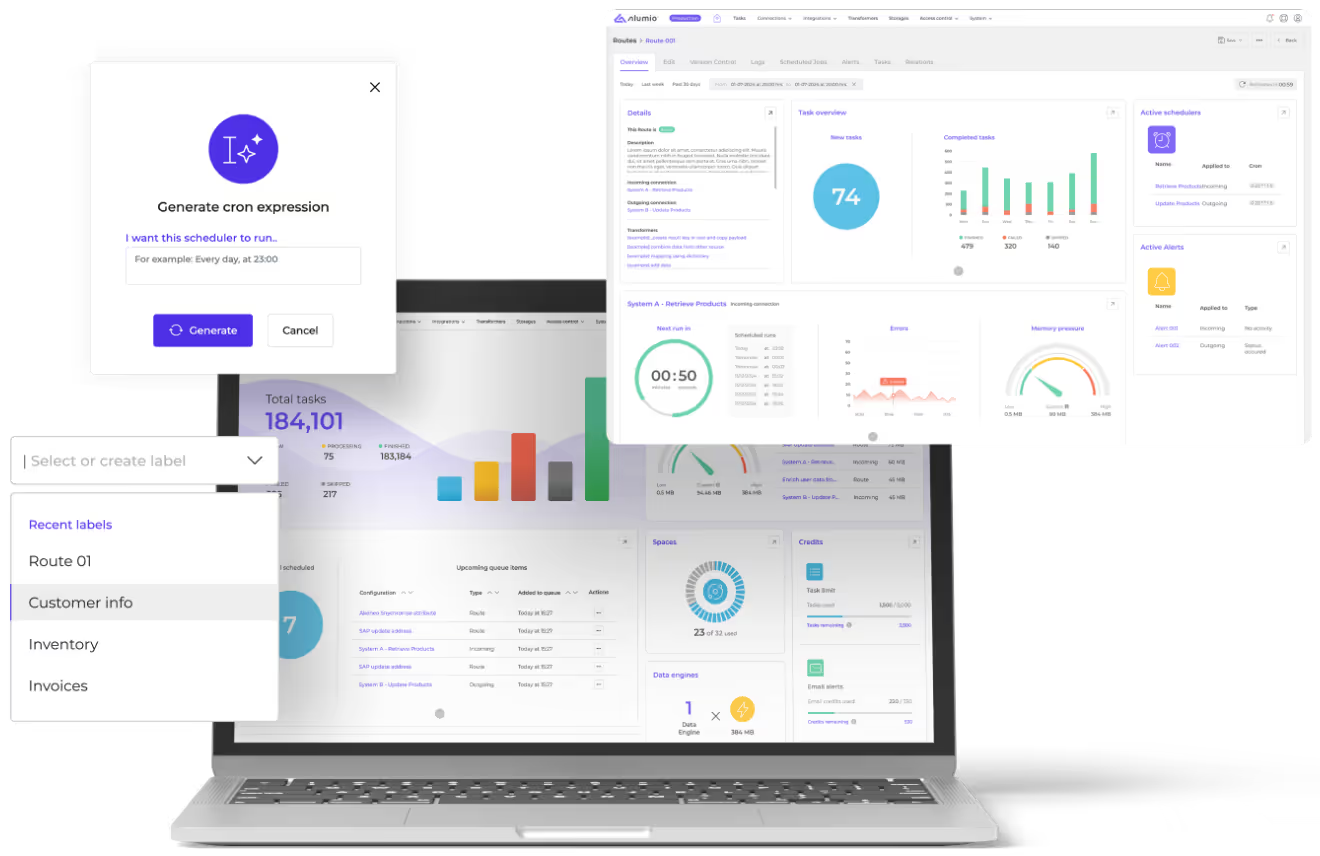
Laptop screen displaying the Alumio iPaaS dashboard, alongside pop-up windows for generating cron expressions, selecting labels and route overview.