

A Alumio vivid purple arrow pointing to the right, a visual representation of how to access more page material when clicking on it.
Go back

Integrating the future with OpenAI

By
Carla Hetherington
Published on
March 17, 2023
Updated on
June 24, 2026
IN CONVERSATION WITH
Email icon
Email icon

Nowadays, e-commerce businesses are constantly seeking innovative ways to optimize operations, enhance customer experiences, and drive growth. One emerging game-changer is the integration of AI, specifically OpenAI’s powerful tools, into e-commerce platforms. By harnessing AI-driven technologies like natural language processing, machine learning, and automation, businesses can streamline operations, personalize customer interactions, and make data-driven decisions faster than ever before. Keep on reading to find out how integrating OpenAI into your e-commerce ecosystem can unlock new levels of operational efficiency and deliver exceptional value to your customers, setting your business apart in an increasingly competitive market.

The rise of e-commerce and the role of AI

The e-commerce market is enormous and shows no signs of slowing down. As of 2024, global e-commerce sales are projected to reach an astounding $6.388 trillion, fueled by an ever-increasing shift toward online shopping. By 2040, experts predict that 95% of all sales will be conducted through e-commerce platforms, reflecting the rapid digital transformation of retail.

With over 2 billion active online shoppers globally, the demand for exceptional and personalized shopping experiences has never been higher. This surge in expectations is driving e-commerce businesses of all sizes to adopt advanced technologies like artificial intelligence (AI) to stay competitive and meet customer needs. One company at the forefront of this revolution is OpenAI, the creators of ChatGPT and other innovative AI tools that are reshaping how businesses operate.

What is OpenAI?

OpenAI is a leading AI research and deployment company known for creating state-of-the-art models like ChatGPT and DALL-E. Its mission is to ensure that artificial general intelligence (AGI) benefits all of humanity. For businesses, OpenAI provides cutting-edge AI solutions with vast capabilities, from natural language understanding to content generation and automation.

How OpenAI transforms e-commerce

AI has become integral to e-commerce success, and OpenAI’s suite of tools empowers businesses to elevate customer experiences, streamline processes, and unlock new revenue streams. Here’s how OpenAI can help:

  • Personalized shopping experience: OpenAI can analyze customer behavior and preferences in real-time, creating personalized product recommendations that drive higher conversion rates and customer satisfaction.
  • Smart customer support: ChatGPT-powered chatbots can respond to customer inquiries instantly, solving issues, offering recommendations, and ensuring 24/7 support without the need for a large customer service team.
  • Content generation: OpenAI’s GPT model can generate high-quality product descriptions, blog posts, social media content, and personalized email marketing campaigns at scale, while DALL-E creates visually compelling product images or promotional art from textual prompts.
  • Data-driven insights: By leveraging OpenAI’s machine learning algorithms, businesses can unlock powerful predictive analytics to identify trends, optimize marketing strategies, and anticipate customer demands.

Learn more about the benefits of connecting OpenAI to your e-commerce operations.

The Alumio OpenAI Connector

At Alumio, we embrace the power of cutting-edge technologies to help our clients thrive in an evolving digital landscape. That’s why we’ve developed the Alumio OpenAI Connector, designed to integrate seamlessly with existing systems and unlock endless possibilities for automation, personalization, and customer engagement in e-commerce.

With our OpenAI integration, e-commerce businesses can:

  • Automate business processes: From data analysis and website optimization to inventory management and email marketing, OpenAI enables businesses to automate tasks that once required significant manual effort, freeing up valuable resources.
  • Enhance personalization: Create personalized shopping experiences by leveraging AI-driven recommendations that cater to each customer’s unique preferences, boosting customer loyalty and repeat purchases.
  • Increase efficiency with AI-powered assistants: Virtual assistants powered by OpenAI can manage schedules, track orders, handle customer inquiries, and even complete transactions—helping businesses maintain efficiency and provide a seamless customer journey.
  • Multilingual support: OpenAI can swiftly translate product descriptions and customer communications, helping e-commerce businesses expand into global markets without the usual language barriers.

The bright future of e-commerce with OpenAI

The potential of OpenAI in the e-commerce sector is vast. From automating manual tasks and delivering personalized experiences to scaling content creation and enhancing customer support, AI-powered solutions like those offered by OpenAI are transforming how businesses operate. By integrating OpenAI through the Alumio OpenAI Connector, e-commerce businesses can unlock new levels of efficiency, personalization, and growth. Stay ahead of the curve by embracing AI-powered solutions, and take your business to the next level with Alumio.

Learn more about the Alumio OpenAI Connector.

Turn AI ambition into action

Portrait of Leonie Becher Merli, Business Development Manager at Alumio

Get a free assessment of your integration needs and next steps

Portrait of Leonie Becher Merli, Business Development Manager at Alumio

No items found.
Topics in this blog:
No items found.

FAQ

Integration Platform-ipaas-slider-right
How can e-commerce businesses integrate OpenAI into their operations?

E-commerce businesses integrate OpenAI by embedding OpenAI API calls as steps within their integration workflows: product data from a PIM passes through an OpenAI model for description generation before being published to the storefront, customer feedback data is classified by sentiment before being routed to the CRM, or incoming support tickets are processed by an AI model for suggested responses before reaching the customer service team. The Alumio OpenAI connector makes this integration available as a standard Route step rather than a separate custom pipeline, with the same governance and monitoring as any other integration flow.

Integration Platform-ipaas-slider-right
What are the most valuable OpenAI use cases for e-commerce businesses?

The most valuable e-commerce use cases for OpenAI are: automated product description generation from PIM attributes (high volume, measurable quality, direct impact on conversion), multilingual content translation for international storefronts (eliminates manual translation overhead at catalog scale), customer service response suggestion (reduces handling time for common queries), product categorization and tagging (automates a tedious catalog management task for large SKU counts), and personalized email content generation (enables individual-level personalization that template-based emails cannot achieve at scale).

Integration Platform-ipaas-slider-right
How does the Alumio OpenAI connector work within an integration Route?

The Alumio OpenAI connector is a Transformer-compatible component that makes an API call to OpenAI's API as a step within a broader Route. Input data (product attributes, customer feedback text, a support ticket body) is formatted into a prompt and sent to the specified OpenAI model; the model's response is received and parsed; and the output is passed to the next step in the Route (writing enriched content to the PIM, routing a classified ticket to a CRM queue). The same monitoring, error handling, and audit logging that applies to other Route steps applies to the OpenAI processing step.

Integration Platform-ipaas-slider-right
What data governance rules should apply when using OpenAI in e-commerce integration workflows?

Data governance rules for OpenAI in integration workflows should specify: which data categories may be sent to the OpenAI API (product data is generally low-risk; customer PII requires a DPA with OpenAI and careful assessment of GDPR legal basis), what data should be excluded from prompts (order IDs, customer names, email addresses should be removed from product enrichment prompts), how AI outputs should be validated before writing to production systems (a quality gate that prevents hallucinated or irrelevant content from being published), and logging requirements (each AI-processed record should have its input and output logged for auditability and quality monitoring).

Integration Platform-ipaas-slider-right
How does AI-augmented product content generation improve e-commerce competitiveness?

AI-augmented product content generation improves competitiveness by enabling richer, more consistent product content across larger catalogs than manual content teams could maintain at equivalent quality. Businesses that use AI to generate baseline descriptions from PIM attributes can publish new products within hours of creation rather than waiting days for manual content writing. They can also maintain more complete product data (all required SEO attributes, consistent style across all SKUs) at a lower cost per SKU than fully manual approaches. The competitive result is a better-ranking, better-converting product catalog that grows as fast as the business's product range does.

Integration Platform-ipaas-slider-right
What is the difference between using OpenAI as a standalone tool versus integrating it into operational workflows via Alumio?

Using OpenAI as a standalone tool (ChatGPT, the OpenAI playground) requires a human to manually pass data to the AI, review the output, and apply it to the right system for each task. Integrating OpenAI via Alumio means the AI processing happens automatically as data flows between systems, at the volume and frequency the business requires, with the outputs immediately available for the next step in the workflow. The integration-native approach is what makes AI automation scalable: it operates on tens of thousands of products or customer records without proportional human effort, which is the business case for AI investment in e-commerce operations.

Get a free assessment of your integration needs

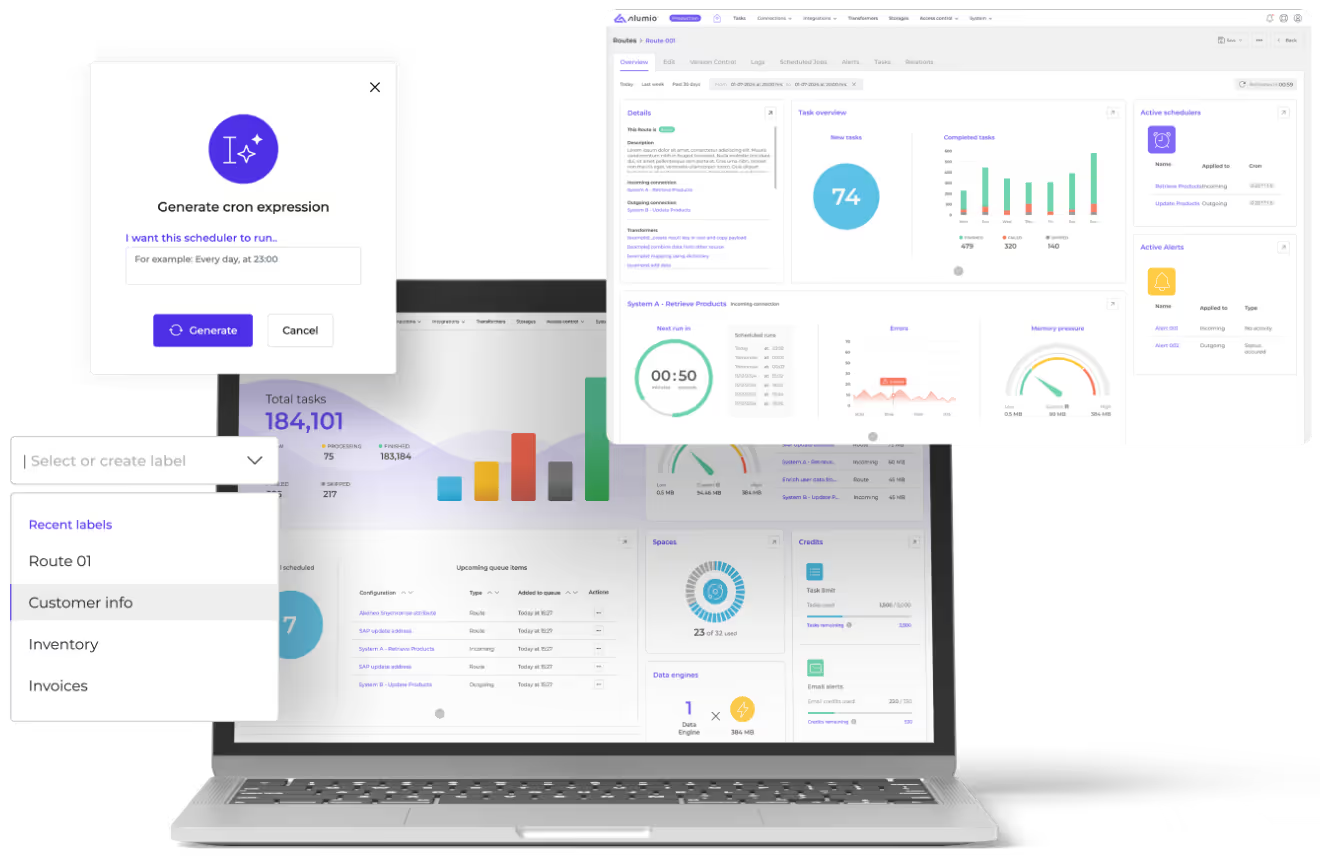
Laptop screen displaying the Alumio iPaaS dashboard, alongside pop-up windows for generating cron expressions, selecting labels and route overview.