

A Alumio vivid purple arrow pointing to the right, a visual representation of how to access more page material when clicking on it.
Go back

Software love stories - WooCommerce x Odoo

By
Carla Hetherington
Published on
January 25, 2023
Updated on
June 24, 2026
IN CONVERSATION WITH
Email icon
Email icon

At Alumio, we take every opportunity we can get to make the right connections, and what better time to celebrate togetherness than during the month of love itself? After all, true love looks like a streamlined connection.

In honor of Valentine’s Day, we are proud to introduce: Software Love Stories, a collection of tales featuring pairs of star-crossed software.

This particular tale follows the story of WooCommerce (the gallant wooer), Odoo (the dearly beloved), Mio (the matchmaker), and Alumio (the solution).

1. The gallant wooer

Meet WooCommerce, a leading open-source e-commerce plugin designed for small to large-sized online businesses using WordPress. With WooCommerce, users with WordPress-based websites can transform a regular website into a fully functioning, easy-to-manage e-commerce store. Arranging and customizing product displays, obtaining sales reports, handling orders, and welcoming multiple payment gateways has never been this easy, especially because no coding expertise is needed to manage the user-friendly interface.

With all these great attributes, the plugin was single and ready to mingle, and in steady pursuit of an ERP system, but not just any ERP system. Having set high standards, WooCommerce was picky and had a long-standing crush on Odoo, even though they had only just met in passing. Kind of a Laura and Petrarch situation…

2. The dearly beloved

Meet Odoo, an open-source ERP designed for all business sizes and types that allows users to manage all business departments from one place. Being a modular software solution, Odoo has applications that cater to almost any business need and varying consumer trends. These apps include valuable tools such as CRM, POS, website creation, inventory, sales, accounting, and much more!

As a flexibility enthusiast, Odoo was eager to meet a plugin to integrate with and, aware of WooCommerce’s adoration, decided to give the plugin a chance. In true Petrarchan fashion, WooCommerce wrote love letters to Odoo that spoke of all the wonderful things they could do together, such as enabling Woo-powered store users to develop, update, and synchronize inventory, invoices, prices, customer records, and coupons.

Thus, just like a peacock rattling and displaying its colorful feathers for potential mates to admire, WooCommerce flaunted all these great benefits in the hopes of wooing Odoo, but a proper introduction was needed to join the two…

3. The matchmaker

Meet Mio, an Alumio "iPaaS Advocate," "Integrations Influencer," and, of course, "Certified Software Matchmaker." As a champion of true love, Mio makes it his mission to match software with the ideal, compatible partner, ensuring a fruitful and prosperous relationship that always results in a positive business impact. Mio has enjoyed a successful career in the matchmaking business thanks to none other than Alumio: the secret weapon behind his unparalleled matchmaking abilities and the solution to lonely software.

4. The solution

Meet Alumio, a cloud-native, low-code iPaaS (integration Platform as a Service) that enables the seamless connection of Odoo to any e-commerce software. With Alumio, businesses can monitor, manage, and modify their connections via one central, user-friendly interface. More specifically, Alumio allows businesses to:

  • Have complete control over all their API data
  • Detect integration errors and API conflicts
  • Get 360-degree performance insights
  • Seamlessly transform data into the desired formats

As a middleware solution, Alumio is a cost-effective solution to integrate e-commerce to ERP software in a fast, flexible, and future-proof way, allowing customers to scale their company and fulfill their business needs anytime, anywhere. After all, a well-run business is a well-integrated business!

"Each integration between WooCommerce and Odoo differs in its nature, since each customer has different issues to address. However, the standard integrations available for webshops and Odoo lack the necessary flexibility to adapt to specific business needs, resulting in a waste of time and resources. The great thing about Alumio is that businesses can enjoy the flexibility to set up their own integrations and tailor them to their customer’s needs."

Bouke Steemers, owner and founder of BlueZebra.

Thus, thanks to Mio’s matchmaking powers and his solution, the two software lived happily ever after; Odoo was pursued and wooed, and, as a result, thousands of e-commerce businesses were improved! It would seem that the fourteenth-century love story of Laura and Petrarch does not hold a candle to the torrid romance between WooCommerce and Odoo. After all, theirs was a love story both magical and true!

Interested in knowing more about integrating WooCommerce with Odoo? Click here and find out more!


Want to discover more Software Love Stories powered by Alumio?

Turn AI ambition into action

Portrait of Leonie Becher Merli, Business Development Manager at Alumio

Get a free assessment of your integration needs and next steps

Portrait of Leonie Becher Merli, Business Development Manager at Alumio

No items found.
Topics in this blog:
No items found.

FAQ

Integration Platform-ipaas-slider-right
What makes WooCommerce and Odoo a practical integration combination?

WooCommerce and Odoo are a natural pairing for growing businesses because both are open-source, highly customizable, and widely adopted: WooCommerce provides a flexible e-commerce layer on top of WordPress, while Odoo provides an accessible all-in-one business suite (ERP, CRM, inventory, accounting) that mid-market businesses can configure to their needs. Connecting them via Alumio means WooCommerce orders flow automatically to Odoo for processing, Odoo inventory keeps WooCommerce accurate, and Odoo product data flows to WooCommerce for catalog management: creating a coherent operational ecosystem without requiring expensive proprietary software.

Integration Platform-ipaas-slider-right
What are the main data flows between WooCommerce and Odoo?

The primary flows are: orders from WooCommerce to Odoo for sales order creation, financial posting, and inventory management; inventory levels from Odoo back to WooCommerce in near real time to prevent overselling; product data and pricing from Odoo to WooCommerce for catalog management; customer records between WooCommerce and Odoo CRM for unified customer management; and shipping confirmations from Odoo WMS or third-party logistics back to WooCommerce for order status updates and customer notifications.

Integration Platform-ipaas-slider-right
What are the technical challenges of integrating WooCommerce with Odoo?

The main challenges are: reconciling WooCommerce's product variation model (configurable products with attribute combinations) with Odoo's product variant system (product templates with variant attributes), mapping WooCommerce's order structure to Odoo's sales order and accounting formats, handling WooCommerce's session-based cart and checkout data in a way that creates clean Odoo sales records, and managing synchronization frequency given that WooCommerce can generate high-volume order events that Odoo needs to process in manageable batches. Alumio's Transformer components and scheduling capabilities address each of these.

Integration Platform-ipaas-slider-right
Why use Alumio rather than a WooCommerce-Odoo plugin for this integration?

Plugin-based WooCommerce-Odoo integrations are limited to standard data flows and break when WooCommerce or Odoo updates their platforms or APIs. Alumio provides: custom transformation logic for non-standard data mapping requirements, central monitoring so failures are detected proactively rather than discovered through operational problems, maintenance window scheduling to handle Odoo update downtimes gracefully, and the ability to add additional systems (a PIM, a marketplace connector) to the same backbone without rebuilding the WooCommerce-Odoo connection. For businesses where this integration is operationally critical, the governance and reliability difference justifies the iPaaS investment over plugins.

Integration Platform-ipaas-slider-right
What types of businesses benefit most from the WooCommerce and Odoo combination?

Businesses that benefit most are growing mid-market businesses that have adopted WooCommerce for its accessibility and flexibility and Odoo for its cost-effective ERP capabilities: often businesses that have outgrown spreadsheet-based operations but are not yet at the scale where SAP or Dynamics 365 is justified. The open-source nature of both systems appeals to businesses that want control over their technology stack without high proprietary licensing costs, and the Alumio integration extends this philosophy to the integration layer: a governed, maintainable connection that the business owns rather than a locked-in custom integration.

Integration Platform-ipaas-slider-right
How does Alumio handle the data transformation between WooCommerce's and Odoo's data models?

Alumio handles the transformation through configured Transformer components that map WooCommerce's REST API order format to Odoo's XML-RPC or REST API format, converting WooCommerce product IDs to Odoo product references, mapping WooCommerce customer data to Odoo partner records, and applying the business rules that govern how WooCommerce order statuses correspond to Odoo sales order workflow stages. Because the transformation is configured rather than coded, it can be adjusted as either system's data model evolves without requiring a full integration rebuild.

Get a free assessment of your integration needs

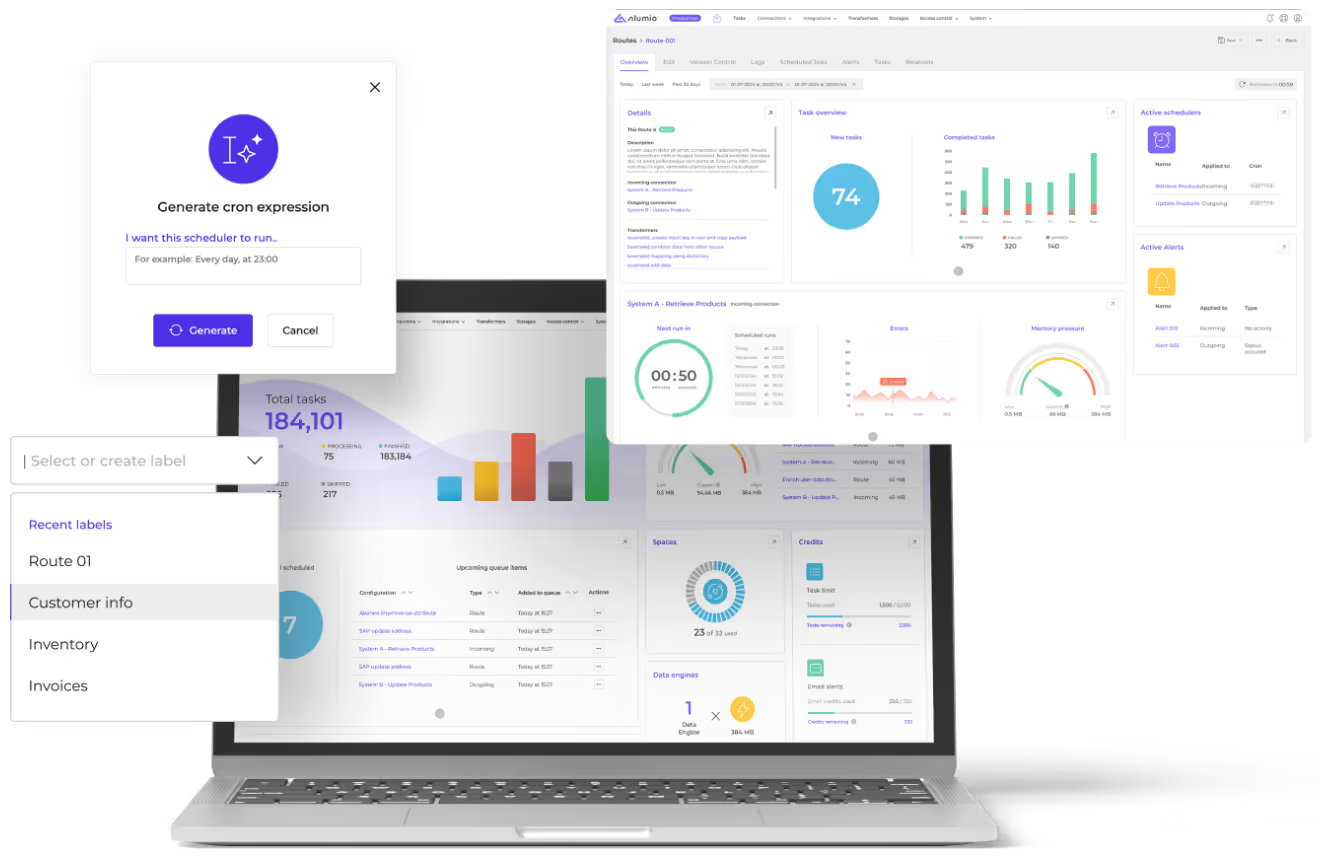
Laptop screen displaying the Alumio iPaaS dashboard, alongside pop-up windows for generating cron expressions, selecting labels and route overview.