

A Alumio vivid purple arrow pointing to the right, a visual representation of how to access more page material when clicking on it.
Go back

Software love stories - Dynamics x Shopify

By
Carla Hetherington
Published on
January 25, 2023
Updated on
June 24, 2026
IN CONVERSATION WITH
Email icon
Email icon

At Alumio, we take every opportunity we can get to make the right connections, and what better time to celebrate togetherness than during the month of love itself? After all, true love looks like a streamlined connection.

In honor of Valentine’s Day, we are proud to introduce: Software Love Stories, a collection of tales featuring pairs of star-crossed software.

This particular tale follows the story of Microsoft Dynamics 365 Business Central (the lonely bachelor), Shopify (the love interest), Mio (the matchmaker), and Alumio (the solution).

1. The lonely bachelor

Meet Microsoft Dynamics 365 Business Central (formerly known as Dynamics NAV and hereafter referred to as “Dynamics”), a comprehensive business management solution designed to meet the financial and operational needs of small and midsize enterprises. Although a bachelor, Dynamics was never scared of long-term commitments and provided businesses with multiple intelligent Microsoft cloud technologies to ensure their future through growth and scalability.

However, Dynamics, used to the single life, was unsure whether the right software to share commerce data with would ever come along. As far as Dynamics was concerned, finding the right connection in today’s e-commerce landscape was a complicated endeavor since the necessary platforms and B2B & B2C API points needed to integrate successfully with e-commerce software were scarce. Additionally, this would require the involvement of expensive consultants and bespoke, complex coding projects, and so Dynamics lost faith in ever finding the right match to successfully operate an e-commerce platform with.

This was surprising to everyone since Dynamics was quite a catch. Among other things, with Dynamics, customers could enjoy:

  • Flexible deployment and eradication of organizational silos
  • Enhanced financial and business performance  
  • Improved customer service
  • Streamlined inventory and supply chain management

2. The love interest

Meet Shopify, a subscription-based software that allows users to set up and customize an online store without the hassles of servers and expensive development projects present in self-hosted platforms. By providing the necessary technical infrastructure to run an online store, Shopify is popular among non-technical users as it makes adding products, applying discounts, and processing orders an easy task. Being an easy-going software, Shopify was content with life and extremely busy running successful online businesses, but there was something missing…

3. The matchmaker

Meet Mio, an Alumio "iPaaS Advocate," "Integrations Influencer," and, of course, "Certified Software Matchmaker." As a champion of true love, Mio makes it his mission to match software with their ideal, compatible partner, ensuring a fruitful and prosperous relationship that always results in a positive business impact. Mio has enjoyed a successful career in the matchmaking business thanks to none other than Alumio: the secret weapon behind his unparalleled matchmaking abilities and the solution to lonely software.

4. The solution

Meet Alumio, a cloud-native, low-code iPaaS (integration Platform as a Service) that enables the seamless connection of Dynamics to any e-commerce software. With Alumio, businesses can monitor, manage, and modify their connections via one central, user-friendly interface. More specifically, Alumio allows businesses to:

  • Have complete control over all their API data
  • Detect integration errors and API conflicts
  • Get 360-degree performance insights
  • Seamlessly transform data into the desired formats

As a middleware solution, Alumio can establish a bidirectional connection between Shopify and Dynamics, enabling the synchronization of data objects between the two. As such, it is a cost-effective solution to integrate Dynamics and e-commerce software in a fast, flexible, and future-proof way, allowing customers to scale their company and fulfill their business needs anytime, anywhere. After all, a well-run business is a well-integrated business!

Thus, the match between Dynamics and Shopify was made in the clouds, and, not surprisingly, it was love at first sight. Don’t believe in fairytales? Hear from one of our happy customers:

"We are using Alumio to connect Dynamics Navision with Shopify which allows us to synchronize inventory and orders. This is important to us because it saves us a lot of manual work and ensures a more updated Inventory in Shopify."

Umage

What started out as a pitiful tale ended in a successful connection and an up-to-date inventory perfectly synchronized with orders. Thanks to Mio’s matchmaking powers, Microsoft Dynamics 365 Business Central and Shopify lived happily ever after and, together, ensured the optimization of Umage’s (and many others) business processes. Shakespeare put it best when he said:

“All's well that ends well.”

Looking to connect your software with Microsoft Dynamics 365? Visit https://www.alumio.com/platforms/microsoft-dynamics-365, and discover a world of possibilities!

Want to discover more Software Love Stories powered by Alumio?

Turn AI ambition into action

Portrait of Leonie Becher Merli, Business Development Manager at Alumio

Get a free assessment of your integration needs and next steps

Portrait of Leonie Becher Merli, Business Development Manager at Alumio

No items found.
Topics in this blog:
No items found.

FAQ

Integration Platform-ipaas-slider-right
What makes Microsoft Dynamics 365 and Shopify a strong integration combination?

Microsoft Dynamics 365 and Shopify complement each other in the way that most effective platform pairs do: Dynamics 365 provides the enterprise ERP backbone (finance, inventory, supply chain, CRM) while Shopify provides a modern, conversion-optimized e-commerce storefront. Together they enable businesses to operate a sophisticated digital storefront while maintaining the operational and financial rigor that enterprise ERP provides. The integration between them is what makes each more valuable: Shopify orders flow to Dynamics for financial posting, Dynamics inventory flows to Shopify to prevent overselling, and Dynamics pricing flows to Shopify to keep the storefront current.

Integration Platform-ipaas-slider-right
What are the main data flows in a Dynamics 365 and Shopify integration via Alumio?

The primary data flows are: orders from Shopify to Dynamics 365 for financial posting, inventory management, and fulfillment processing; inventory levels from Dynamics 365 back to Shopify in near real time to keep stock accuracy on the storefront; product and pricing data from Dynamics 365 to Shopify to keep the catalog current; customer account data between Shopify and Dynamics CRM for unified customer relationship management; and fulfillment confirmations and tracking data from Dynamics 365 WMS or third-party 3PL back to Shopify for order status updates. Each flow requires transformation between Dynamics 365's OData-based schema and Shopify's REST API format.

Integration Platform-ipaas-slider-right
What challenges does integrating Dynamics 365 with Shopify typically involve?

The main challenges are: Dynamics 365's complex data model (customer accounts, order entities, and pricing structures are more complex than Shopify's consumer-oriented schema, requiring substantial transformation), handling Dynamics 365's B2B pricing capabilities (customer-specific pricing lists, trade agreements, and discount structures that must be reflected appropriately in a Shopify B2B or D2C context), real-time inventory synchronization at the speed Shopify's high-traffic storefronts require, managing the financial posting requirements of Dynamics 365 (ensuring Shopify orders create the correct journal entries in Dynamics), and keeping both systems in sync during Dynamics 365 update cycles that may introduce data model changes.

Integration Platform-ipaas-slider-right
How does Alumio's Dynamics 365 connector simplify Shopify integration?

Alumio's Dynamics 365 connector handles the OData API authentication, entity resolution, and API communication layer that would otherwise require .NET or Power Platform expertise to build. Integration teams configure the data mapping between Dynamics 365 entities (sales orders, inventory journals, customer records) and Shopify API objects (orders, inventory levels, products, customers) in Alumio's Transformer components rather than coding the mapping from scratch. When Microsoft updates Dynamics 365's API, the Alumio connector is updated at the platform level, protecting all integrations built on it from breaking changes without requiring individual project maintenance.

Integration Platform-ipaas-slider-right
What business profiles benefit most from combining Dynamics 365 with Shopify?

Businesses that benefit most are those already running Dynamics 365 as their ERP and CRM backbone who want to add a modern, scalable e-commerce capability without replacing their existing operational infrastructure. This includes: mid-market manufacturers and distributors expanding into D2C commerce while maintaining their B2B ERP operations, professional services firms adding digital product sales alongside their service business, and retail businesses that chose Dynamics for its Microsoft ecosystem integration and want Shopify's e-commerce UX without sacrificing Dynamics' operational capabilities. The Alumio integration makes this coexistence practical rather than requiring a compromise on either platform.

Integration Platform-ipaas-slider-right
What does a fully integrated Dynamics 365 and Shopify ecosystem enable for a growing business?

A fully integrated Dynamics 365 and Shopify ecosystem enables: automated order-to-cash (Shopify orders create Dynamics sales orders that flow through financial posting, fulfillment, and invoice generation without manual steps), accurate real-time inventory on the Shopify storefront reflecting Dynamics 365 warehouse management data, customer lifetime value visibility in Dynamics CRM that includes all Shopify purchase history, automated product catalog management where Dynamics 365 product master data keeps the Shopify catalog current, and unified financial reporting that reconciles Shopify payment data with Dynamics 365 ledger entries. Together these capabilities allow the business to scale Shopify's digital commerce operations without proportional increases in operational administration.

Get a free assessment of your integration needs

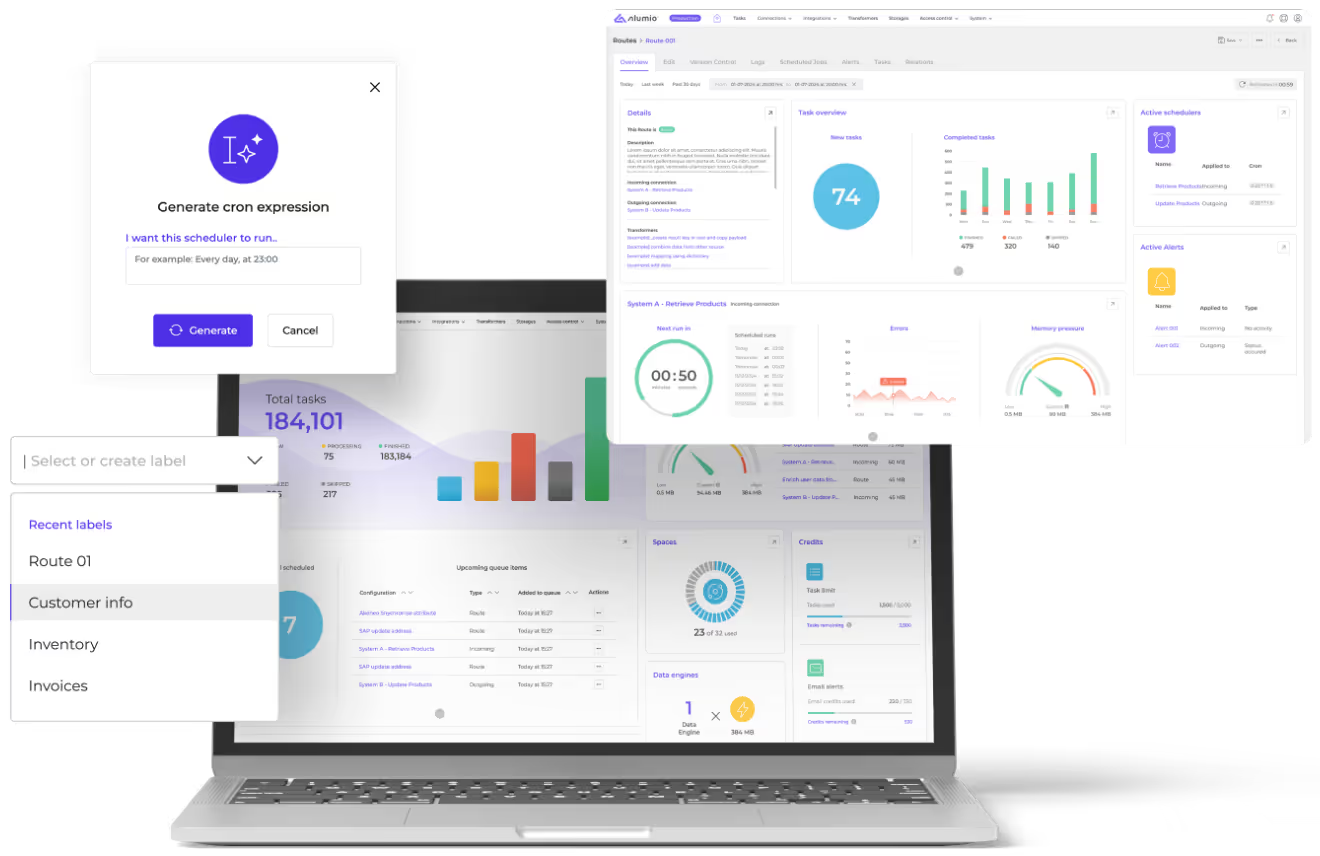
Laptop screen displaying the Alumio iPaaS dashboard, alongside pop-up windows for generating cron expressions, selecting labels and route overview.