

A Alumio vivid purple arrow pointing to the right, a visual representation of how to access more page material when clicking on it.
Go back

Migrating from Navision to Business Central: A seamless transition with Alumio

By
Published on
January 8, 2026
Updated on
January 15, 2026
IN CONVERSATION WITH
Email icon
Email icon

Migrating from Microsoft Dynamics NAV (Navision) to the cloud-based Dynamics 365 Business Central is becoming a strategic necessity for many businesses. This transition brings modern capabilities, greater scalability, and future-proof operations - but it can also be complex. Ensuring data integrity, preserving customizations, and maintaining third-party integrations requires a robust migration strategy. In this article, we explore the Navision-to-Business Central migration process and show how an integration platform like Alumio can make the transition seamless and secure.

Why migrate from Navision to Business Central?

The impetus for migrating from Navision is driven by the clear advantages offered by Business Central. While Navision was a powerful on-premise solution for its time, Business Central provides the flexibility and advanced functionality required for modern business operations.

Key benefits of Business Central:

  • Cloud-first architecture: Business Central is a cloud-native solution, eliminating the need for on-premise servers. This reduces hardware maintenance costs, improves accessibility from any device, and ensures automatic updates and security patches from Microsoft.
  • Enhanced functionality: It offers a more modern user interface and incorporates advanced features like AI-powered forecasting, improved financial management, and deeper integration with other Microsoft products like Power BI, Power Automate, and Microsoft 365.
  • Superior scalability: The cloud infrastructure allows businesses to scale resources up or down based on demand. This elasticity is critical for growing companies that need their ERP to adapt to changing transaction volumes and user counts without significant capital investment.
  • Unified ecosystem: Business Central acts as a central hub within the wider Dynamics 365 ecosystem, enabling seamless connections to CRM, sales, and service applications. This creates a single, unified view of the customer and business operations.

The challenge: Complexity of ERP migration

Migrating an ERP system is not a simple task. Navision environments are often heavily customized and integrated with numerous other systems, such as Warehouse Management Systems (WMS), e-commerce platforms, and third-party logistics (3PL) providers. A direct migration risks breaking these critical connections, leading to data loss, operational downtime, and significant business disruption.

Common challenges include:

  • Data mapping and transformation: Data structures often differ between Navision and Business Central, requiring careful mapping and transformation to ensure compatibility.
  • Customization replication: Custom code and business logic built into Navision must be replicated or replaced with standard functionality or extensions in Business Central.
  • Integration continuity: Point-to-point integrations built for Navision will not work with Business Central, requiring a complete overhaul of system connectivity.
  • Downtime minimization: Businesses cannot afford to halt operations for extended periods. The migration must be executed with minimal disruption to daily activities.

Facilitating the transition with Alumio's integration platform

An integration platform as a service (iPaaS) like Alumio provides the essential middleware to de-risk and accelerate the migration from Navision to Business Central. Instead of building brittle, custom-coded connections, Alumio creates a flexible and scalable integration layer that manages all data flows between Business Central and external systems.

Step 1: Mapping the integration landscape

The process begins with a comprehensive analysis of the existing Navision environment. Alumio helps identify all current integrations, data sources, and business workflows. This initial mapping phase is crucial for understanding the full scope of the migration and creating a detailed project plan. A central dashboard visualizes all connected systems, providing clarity and control.

Step 2: Decoupling systems with a central hub

Alumio acts as a central integration hub, decoupling Business Central from all other applications. Data from a WMS, for example, is sent to Alumio, which then transforms and routes it to Business Central. This architecture means that the WMS does not need a direct, native connection to the new ERP. If the WMS is ever replaced, only its connection to Alumio needs to be updated, leaving the Business Central integration untouched.


Turn AI ambition into action

Portrait of Leonie Becher Merli, Business Development Manager at Alumio

Get a free demo of the Alumio platform

Portrait of Leonie Becher Merli, Business Development Manager at Alumio

Looking to migrate from Navision to Business Central?

Step 3: Leveraging reusable templates and connectors

To accelerate the process, Alumio provides pre-built connectors and reusable integration templates for common endpoints like e-commerce platforms (Shopify, Adobe Commerce) and other ERPs. These templates can be quickly configured to handle standard data flows, such as synchronizing orders, inventory, and customer information. This significantly reduces development time compared to building integrations from scratch.

Step 4: Ensuring data integrity and synchronization

During the migration, maintaining data accuracy is paramount. Alumio’s platform includes powerful features to ensure a smooth transition:

  • Real-time data synchronization: Alumio can perform an initial bulk data transfer and then keep both Navision and Business Central synchronized in real-time during the transition phase. This allows for a phased rollout where both systems can run in parallel without creating data discrepancies.
  • Advanced data transformation: The platform's mapping tools allow developers to transform data from the Navision format to the one required by Business Central. This includes changing field names, modifying data types, and enriching data from other sources.
  • Automated error handling: If an error occurs during data transmission, Alumio automatically logs the issue, notifies administrators, and can be configured to retry the transfer. Its dead-letter queue (DLQ) functionality ensures that no data is lost, even if a system is temporarily unavailable.

Step 5: A phased go-live with zero downtime

By managing all integrations through a central platform, businesses can execute a phased migration strategy. For example, the finance department can transition to Business Central first while the warehouse continues to operate on Navision-connected systems. Alumio routes the data accordingly, ensuring seamless communication between old and new environments. This approach minimizes operational risk and eliminates the need for a high-stakes "big bang" go-live.

A real-world example is a manufacturing company that relied on a highly customized Navision setup. By using Alumio, they were able to migrate to Business Central in stages. The platform managed the complex data flows between their MES, WMS, and the two ERPs, ensuring production continued without interruption. The decoupling strategy allowed them to modernize their core ERP without having to simultaneously replace every other system in their technology stack.

The future of ERP: Composable and cloud-connected

Industry experts agree that the era of monolithic, all-in-one ERP systems is ending. The future belongs to "composable ERP" - an agile architecture where businesses select best-of-breed applications for specific functions and unite them through a central integration platform. This approach provides maximum flexibility and allows companies to innovate faster.

Migrating from Navision to Business Central is a foundational step toward building this composable future. However, success hinges on establishing a robust integration strategy from the outset. Relying on point-to-point connections only recreates the rigidity of the past. In contrast, using an iPaaS like Alumio provides the scalable and adaptable foundation needed to not only complete the current migration but also to prepare for future technological shifts.

In conclusion, the move from Navision to Business Central is a critical upgrade for any business looking to remain competitive. By leveraging an integration platform to manage the complexities of this transition, organizations can ensure data integrity, eliminate downtime, and build a connected, future-proof enterprise architecture.

Connect Microsoft Dynamics 365 Business Central with popular apps!

65d48cff9ccd7d785cf97a8c_mHSat-0PB2x-o8D9zq9JYFv4ke--8jVJ-Kh94cQezvo.avif679a3ad42ac50f87840fa26c_6785149065f512fa27b9978d_E2Mh9nJP6D2WpUUGn0jxPEOPRNF8eRY53yVMsROYNNI.png
6087ff717ba5c7b8232b8d65_6013aabba5b2b7cddbb5a87a_Logo_Mini_Shopify-192.avif679a3ad42ac50f87840fa26c_6785149065f512fa27b9978d_E2Mh9nJP6D2WpUUGn0jxPEOPRNF8eRY53yVMsROYNNI.png
679a3ad42ac50f87840fa26c_6785149065f512fa27b9978d_E2Mh9nJP6D2WpUUGn0jxPEOPRNF8eRY53yVMsROYNNI.png6785131b6fa9a6dbb2b8d64a_W62GF_84r805NRrqEZDCW32qEPOhgBRsZ4MwMgWIn-Q.png
67851057b61ddbb1a4fa2221_PlRHigPgYqW78n14znNTHJmlwSj1aC3eSxaAV1KMmWs.png679a3ad42ac50f87840fa26c_6785149065f512fa27b9978d_E2Mh9nJP6D2WpUUGn0jxPEOPRNF8eRY53yVMsROYNNI.png
Topics in this blog:

FAQ

Integration Platform-ipaas-slider-right
What are the main benefits of a Navision to Business Central migration?

Migrating from Microsoft Dynamics NAV (Navision) to Dynamics 365 Business Central offers significant advantages for modern enterprises. The primary benefit is the transition to a cloud-native architecture, which eliminates on-premise server maintenance and provides automatic security updates. Business Central also delivers enhanced scalability, allowing your ERP to grow with your business, and offers deeper integration with the Microsoft 365 ecosystem (including Power BI and Teams) for improved collaboration and real-time data visibility.

Integration Platform-ipaas-slider-right
How does the Alumio integration platform simplify ERP migration?

Alumio simplifies the migration process by acting as a central middleware layer that decouples your ERP from other business applications. Instead of building brittle point-to-point connections, Alumio manages data flows through a flexible integration hub. This allows you to connect your existing systems (like e-commerce, WMS, or CRM) to Business Central without custom coding. Alumio’s reusable templates and data transformers ensure that data is mapped correctly between Navision and Business Central, reducing complexity and accelerating the transition.

Integration Platform-ipaas-slider-right
Can we run Navision and Business Central simultaneously during migration?

Yes, running both systems in parallel is a common risk-mitigation strategy. Alumio facilitates this by enabling real-time data synchronization between Navision and Business Central. You can execute a phased migration where certain departments or functions move to the new system while others remain on the legacy platform. Alumio ensures that critical data—such as inventory levels, customer records, and orders - remains accurate and consistent across both systems until the full cutover is complete.

Integration Platform-ipaas-slider-right
What happens to our historical data and custom integrations?

Preserving historical data and maintaining custom integrations are critical concerns during migration. Alumio addresses this by providing advanced data transformation tools that map legacy Navision data structures to the new Business Central format. For integrations, Alumio replaces old, direct connections with standardized API connectors. This ensures that third-party software continues to communicate effectively with your new ERP, preserving your operational continuity without losing valuable historical context.

Integration Platform-ipaas-slider-right
How does an integration platform reduce downtime during the switch?

Using an integration platform like Alumio significantly minimizes downtime by allowing for extensive testing and validation before the final switch. Because Alumio buffers data and manages the connections externally, you can configure and test your Business Central integrations in a sandbox environment while Navision remains live. Once validation is complete, the switchover involves redirecting data flows within the Alumio dashboard, often resulting in zero operational downtime compared to a traditional "big bang" migration.

Integration Platform-ipaas-slider-right
Is it necessary to replace all our software when moving to Business Central?

No, you do not need to replace your entire software stack. A key advantage of using a middleware solution like Alumio is the ability to adopt a "composable" architecture. You can keep your preferred best-of-breed applications (such as a specialized WMS or PIM) and simply reconnect them to Business Central via the Alumio platform. This approach protects your previous technology investments while upgrading your core ERP system.

Want to see Alumio in action?

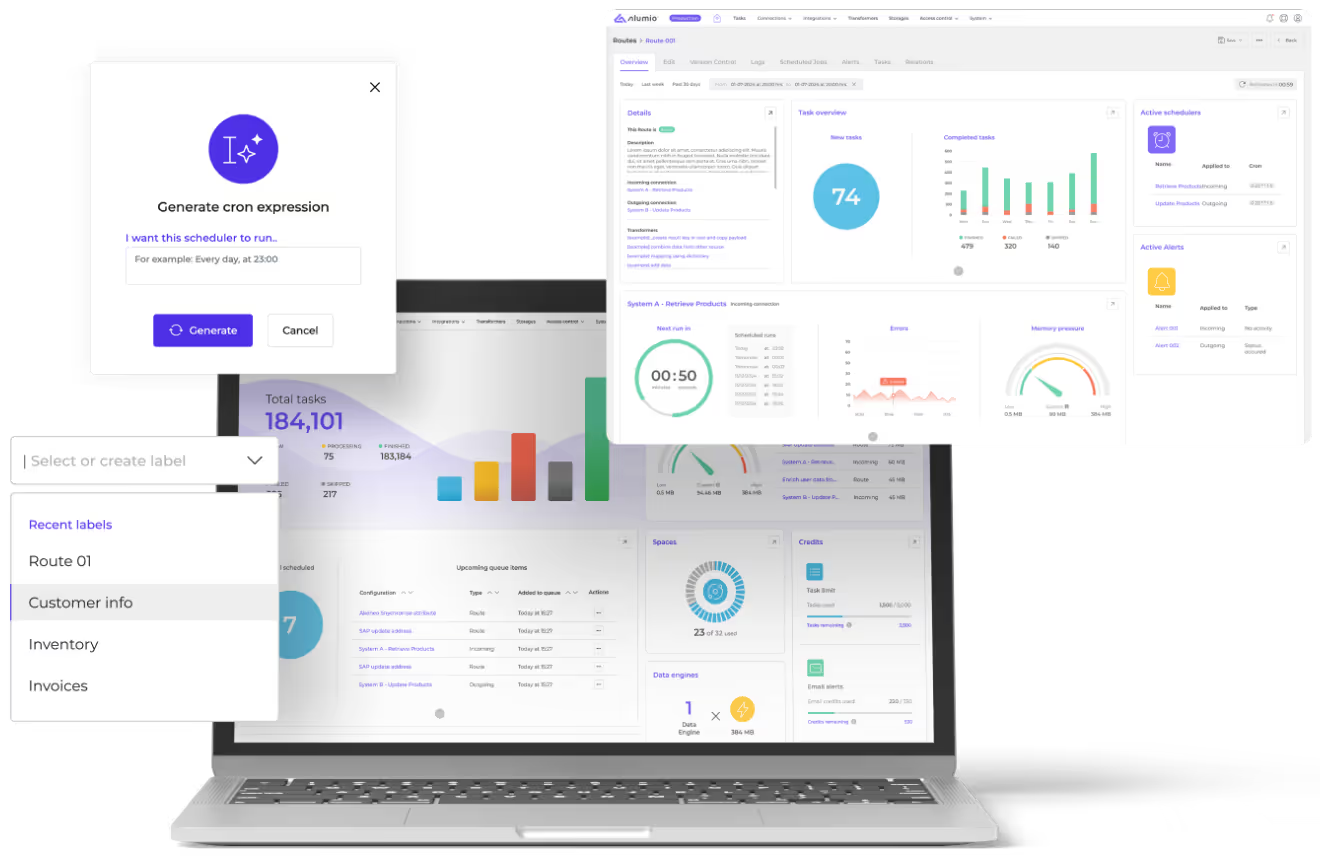
Laptop screen displaying the Alumio iPaaS dashboard, alongside pop-up windows for generating cron expressions, selecting labels and route overview.