


A Alumio vivid purple arrow pointing to the right, a visual representation of how to access more page material when clicking on it.
Go back

Make vs. Alumio: Best integration platforms, 2025

By
Saad Merchant
Published on
December 12, 2025
Updated on
December 24, 2025
IN CONVERSATION WITH
A 2D email icon in anthracite and vivid purple
A white cross 2D icon

Automation and AI have become the default way for businesses to build and connect workflows across CRMs, e-commerce, support tools, ERPs, and AI services—often before a formal integration architecture even exists. Many teams start with no-code platforms like Make, where the drag-and-drop canvas makes it easy to automate workflows across SaaS apps, APIs, and AI tools without heavy development. As usage grows and those workflows begin to handle orders, inventory, and finance-relevant data, the question shifts from “How fast can we automate this?” to “How do we turn this into sustainable integration infrastructure at scale?” While Make (formerly Integromat) is a renowned no-code automation platform, Alumio is a config-first, low-code iPaaS designed for scalable, reusable, and governed integrations across ERP, PIM, e-commerce, logistics, finance, and custom endpoints. This comparison explores Make vs. Alumio for scaling integrations, low-code vs. no-code integration tools, and how both approach pricing and use case specialization.

Alumio vs. Make: Comparison of best integration platforms 2025


When IT and digital teams compare low-code vs. no-code integration tools—or look for a Make alternative for e-commerce and ERP integration—Alumio stands as an ideal comparison. Make (formerly Integromat) is a no-code automation and AI workflow platform where users design scenarios on a drag-and-drop canvas, chaining together triggers, apps, and actions across SaaS and APIs. The Alumio iPaaS takes a config-first, low-code approach: integrations are defined through structured, reusable configurations that pick up data, transform it with mappings and rules, and automate data exchange in real-time or scheduled batches across IT ecosystems. Alongside this, Alumio provides built-in monitoring, logging, and storage to keep flows resilient. The question isn’t which tool is better, but which integration approach supports how your business operates and plans to scale.

TL;DR verdict: Alumio iPaaS vs. Make


Alumio
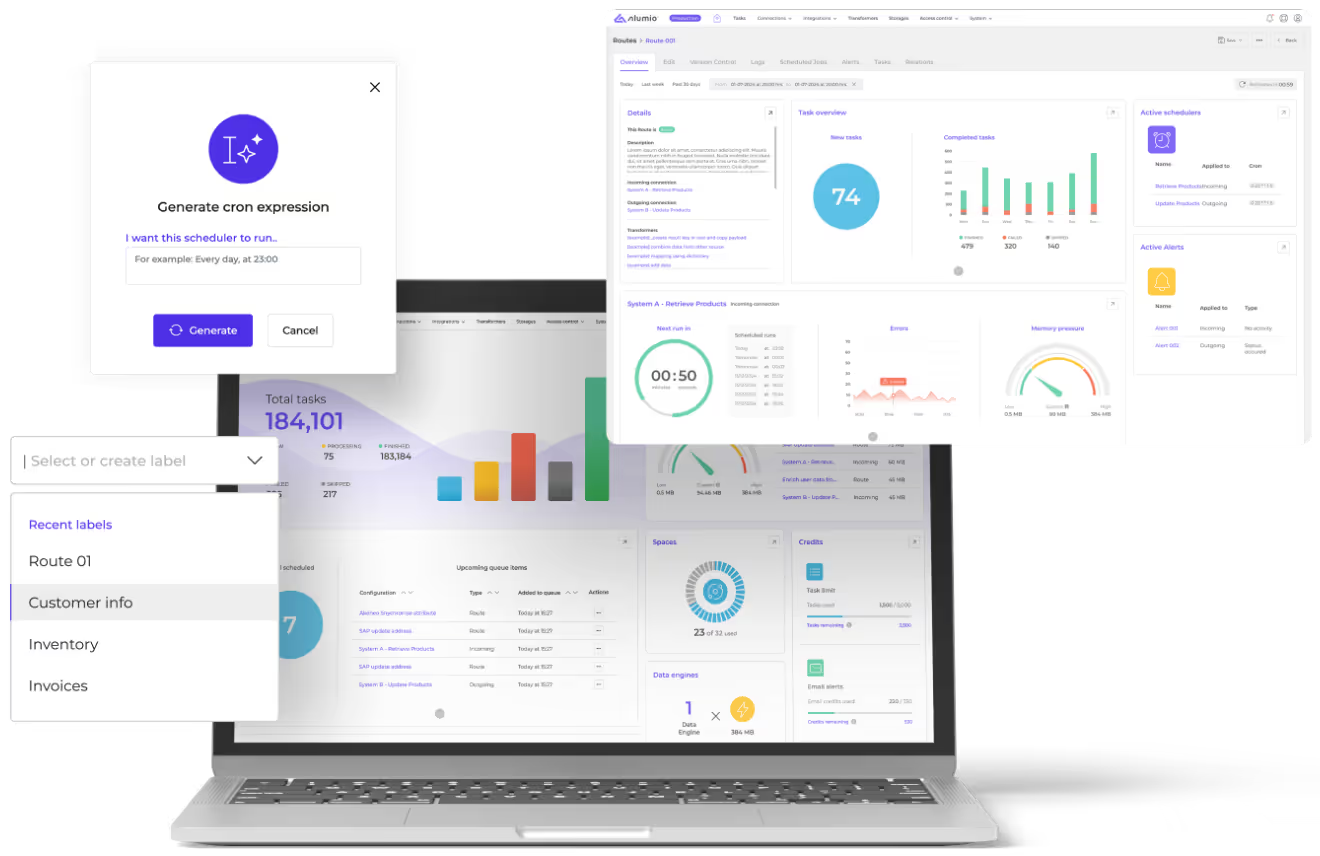
is a configuration-driven, API-centric integration platform-as-a-service (iPaaS) that’s designed to sit at the center of your landscape rather than at the edges. It gives IT and architecture teams a single place to define, reuse, and control integrations across ERP, PIM, e-commerce, CRM, logistics, finance, and custom services. Instead of scripting, integrations are assembled from configurable building blocks, with Transformers to reshape and enrich data and a Code Transformer (JavaScript) for exceptional cases. Storages add durability through buffering and replay, while monitoring, logging, and audit trails make every flow observable. Backed by ISO 27001 and GDPR alignment, Alumio turns integrations into governed, long-lived assets and creates the kind of consistent, contextual data foundation that AI and analytics actually depend on.

Choose Alumio if you need an integration backbone that can be standardized, audited, and scaled across core operational and e-commerce systems, not just a way to automate individual workflows.

Make is a no-code automation platform built to give teams a fast, visual way to connect tools and stitch together business workflows. Its scenario builder lets users combine triggers, branches, and actions across a wide catalog of SaaS apps, APIs, and AI services, making it easy for non-developers to experiment and roll out automations without waiting on central IT. This makes Make a strong fit for departmental use cases—marketing ops, RevOps, support, and internal tooling—where autonomy and speed matter more than deep integration governance. As processes become more intertwined with ERP, PIM, or warehouse systems, or when long-term auditability and standard deployment patterns are required, Make is better treated as a complementary automation layer rather than the sole integration backbone.

Choose Make if your priority is empowering teams with drag-and-drop automation across SaaS and AI workflows, and only a subset of your integrations needs the rigor of a dedicated iPaaS.

Comparing key integration platform facts: Alumio iPaaS vs. Make

Pricing model

Alumio: Task-tiered, quote-based pricing built around annual task volume. Editions such as Essential (1M tasks/year), Growth (2M), and Custom/Flex provide unlimited users, unlimited routes, all standard/generic connectors, and at least one production plus one sandbox environment. Costs scale with how much integration work you run, not how many systems or users you add.

Make: Credit-based pricing where each scenario step consumes “credits” per month. At low volumes (e.g., 10K credits/month), Pro and Teams sit in typical SaaS price ranges and are attractive for light automation. Slide the usage up to hundreds of thousands or millions of credits per month, and Pro/Teams move into high-hundreds or low-thousands per month—effectively enterprise spend. In other words, Make is inexpensive for small workloads, but sustained, high-volume automation sits in a similar budget conversation as an integration platform.


Best for

Alumio: Best suited for organizations that want a governed integration backbone spanning ERP, PIM, e-commerce, CRM, logistics, finance, and custom APIs. It fits IT and architecture teams that think in terms of “integration products” and long-lived Routes rather than one-off automations—especially where auditability, data quality, and predictable scaling matter.

Make: Best suited for teams that need fast, visual automation across SaaS and AI tools—marketing, RevOps, CX, internal operations, and SMBs building out no-code automation. It’s ideal when the goal is to give non-developers a powerful workflow builder, and only some data flows are truly “system-of-record” integrations.

Integration style

Alumio: Config-first, low-code iPaaS. Integrations are defined as Routes with clear Incoming/Outgoing configurations, Transformers for mapping/enrichment/filtering, optional Code Transformers for edge logic, and Storages for buffering and replay. This emphasizes standardization, reusability, and operational resilience across many systems.

Make: No-code visual workflow builder. Users design “scenarios” on a drag-and-drop canvas, chaining triggers, modules, routers, and filters across thousands of SaaS apps and APIs. It’s highly approachable and flexible for workflow design, but standardization and reuse depend largely on how well teams organize and govern their scenarios.

Industry focus

Alumio: Cross-industry, with strong patterns for e-commerce and ERP integration but not limited to them. Common use cases span retail, manufacturing, wholesale, logistics, finance, and B2B services—anywhere data must move reliably between operational systems, e-commerce, and analytics/AI platforms.

Make: Skews toward SaaS-heavy, digital-first environments: startups, SMBs, and internal digital teams in larger enterprises. Typical scenarios automate CRM, marketing, support, collaboration, and AI workflows rather than deep, multi-layer ERP/PIM/warehouse integration. It can connect to those systems, but they are not its primary design center.

Governance & compliance

Alumio: ISO 27001-certified and GDPR-aligned, with governance baked into the platform: role-based access, API-key-controlled endpoints, detailed monitoring, logging, and audit trails, plus replay via Storages. Combined with SLA-backed editions, this makes Alumio suitable where integrations must be explainable, reportable, and recoverable over the long term.

Make: Provides strong security for a SaaS automation platform (including enterprise features like SSO and audit logs on higher tiers) and is suitable for many departmental and SMB use cases. However, governance is oriented around scenarios and credit usage; long-term audit, standardized deployment patterns, and tight segregation between test and production typically require additional process or tooling if Make is used beyond team-level automation.


Turn AI ambition into action

Get a free demo of the Alumio platform

Strengths and limitations: Alumio vs. Patchworks

Alumio is built for organizations that need control, transparency, and flexibility across all their integrations—not just e-commerce. Its config-first, API-driven environment makes it easy to adapt integrations as systems evolve, while its Transformers allow limitless mapping, enrichment, and filtering without custom code. And it also provides a Code Transformer to help write JavaScript to solve edge cases. Storages add reliability through replay and recovery. Combined with enterprise-grade monitoring and logging, Alumio turns integrations into governed, auditable workflows that scale across industries.

Trade-off: Alumio’s depth can feel heavier for smaller retail teams that only need quick storefront-to-ERP automation. It’s optimized for multi-system orchestration rather than one-off commerce flows.

Patchworks excels at speed and simplicity. With a no/low-code visual builder and a strong catalog of e-commerce connectors, it enables retailers and D2C brands to launch storefront, marketplace, and ERP integrations quickly. It’s ideal for product, order, customer, and stock automation where time-to-value matters more than extensive configuration.

Trade-off: Patchworks is primarily retail-focused. As system landscapes expand—into finance, logistics, manufacturing, or AI-driven processes—their connector limits, transformation depth, and governance controls can be restrictive compared to a fully configurable iPaaS.


Best use cases: Alumio vs. Make

By this point, the split is fairly clear: Alumio is closer to an integration backbone, while Make sits in the no-code automation camp. The practical question is where each tool makes the most sense in real projects—especially when you’re weighing workflow automation vs. iPaaS.

Where Alumio fits best

  • ERP- and PIM-centric integration landscapes: When you need a scalable Make alternative for e-commerce and ERP integration—connecting SAP, Dynamics, NetSuite, or other ERPs to PIM, e-commerce, logistics, and finance with monitoring, replay, and audit.
  • E-commerce plus broader operational flows: When Alumio vs. Make for e-commerce isn’t just about the webshop but about keeping orders, prices, inventory, and product data consistent across ERPs, warehouses, marketplaces, and CRMs.
  • Data foundations for AI and analytics: When AI use cases or BI reporting rely on clean, contextual, and traceable data streams rather than ad hoc workflows scattered across tools.
  • Standardized integration programs: When IT, a central platform team, or an integration partner needs to define reusable patterns (Routes, mappings, storages) that can be rolled out and maintained across multiple brands, BUs, or customers.

Where Make fits best

  • Departmental workflow automation: When marketing, RevOps, CX, or operations teams want autonomy to automate SaaS tools and AI services on a drag-and-drop canvas without waiting on central IT.
  • SMB and scale-up automation: When you’re primarily connecting cloud apps—CRM, support, billing, collaboration, AI tools—and don’t yet have heavy ERP, PIM, or warehouse integration requirements.
  • Experimentation and rapid iteration: When teams need to quickly test and refine new workflows, AI-powered processes, or internal tools, and value speed of change over long-term standardization.
  • Edge workflows alongside an iPaaS: When an iPaaS like Alumio handles the core system integrations, and Make is used at the edges for local automations, alerts, and small bridging workflows owned directly by business teams.

Final thoughts: Alumio vs. Make integration platforms

Choosing between Alumio and Make is mostly about what kind of integration role you need to fill. Make can handle high volumes, but its strength is giving teams a visual, no-code way to build and adapt workflows across SaaS and AI tools without much development effort. Alumio is better suited when integrations are treated as shared infrastructure—where ERPs, PIMs, e-commerce platforms, logistics, finance, and analytics all rely on the same data moving consistently, with monitoring, logging, and audit in place. For some businesses, the right answer will be a single primary platform; for others, it may be a combination—using one for core integrations and the other for more flexible, team-owned automation.

Connect with popular apps!

No items found.

FAQ

Integration Platform-ipaas-slider-right
Is Make an iPaaS or just a workflow automation tool?

Make is primarily a no-code workflow automation platform. It connects SaaS apps and APIs using a visual scenario builder and can reach high volumes, but it isn’t positioned as a full iPaaS with config-first routing, storage, and long-term governance. Alumio fills that “integration backbone” role as an API-driven iPaaS.

Integration Platform-ipaas-slider-right
What is the best Make alternative for ERP integration?

For ERP-centric scenarios, a config-first iPaaS like Alumio is usually the stronger Make alternative for ERP integration. It’s designed to handle structured, bidirectional flows between ERPs, PIMs, e-commerce, logistics, and finance systems with monitoring, logging, and replay built in.

Integration Platform-ipaas-slider-right
How do Alumio vs. Make compare for e-commerce integration?

For e-commerce, Make is well-suited to automating workflows around your store—notifications, marketing, basic syncs between storefronts and SaaS tools. Alumio is a better fit when “Alumio vs Make for e-commerce” really means integrating storefronts with ERP, PIM, marketplaces, and warehouses as part of a broader e-commerce integration platform strategy.

Integration Platform-ipaas-slider-right
When do you need an iPaaS instead of only workflow automation?

You typically move from pure workflow automation to an iPaaS when integrations become shared infrastructure: multiple systems (ERP, PIM, e-commerce, logistics, finance) depend on the same data, you need audit trails and SLAs, and changes must be managed centrally. That’s the point where workflow automation vs. iPaaS is less about features and more about governance.

Integration Platform-ipaas-slider-right

Want to see Alumio in action?