




.svg)


Alumio vs. n8n: Quick comparison of best integration platforms 2025
The question isn't, is n8n better than Alumio for integrations or vice versa? Rather, it’s better to ask what kind of integrations you wish to build and how you want to manage them. This is because “integration” can mean different things depending on who’s using it and the business use case.
TL;DR Verdict: Alumio iPaaS vs. n8n integration platform
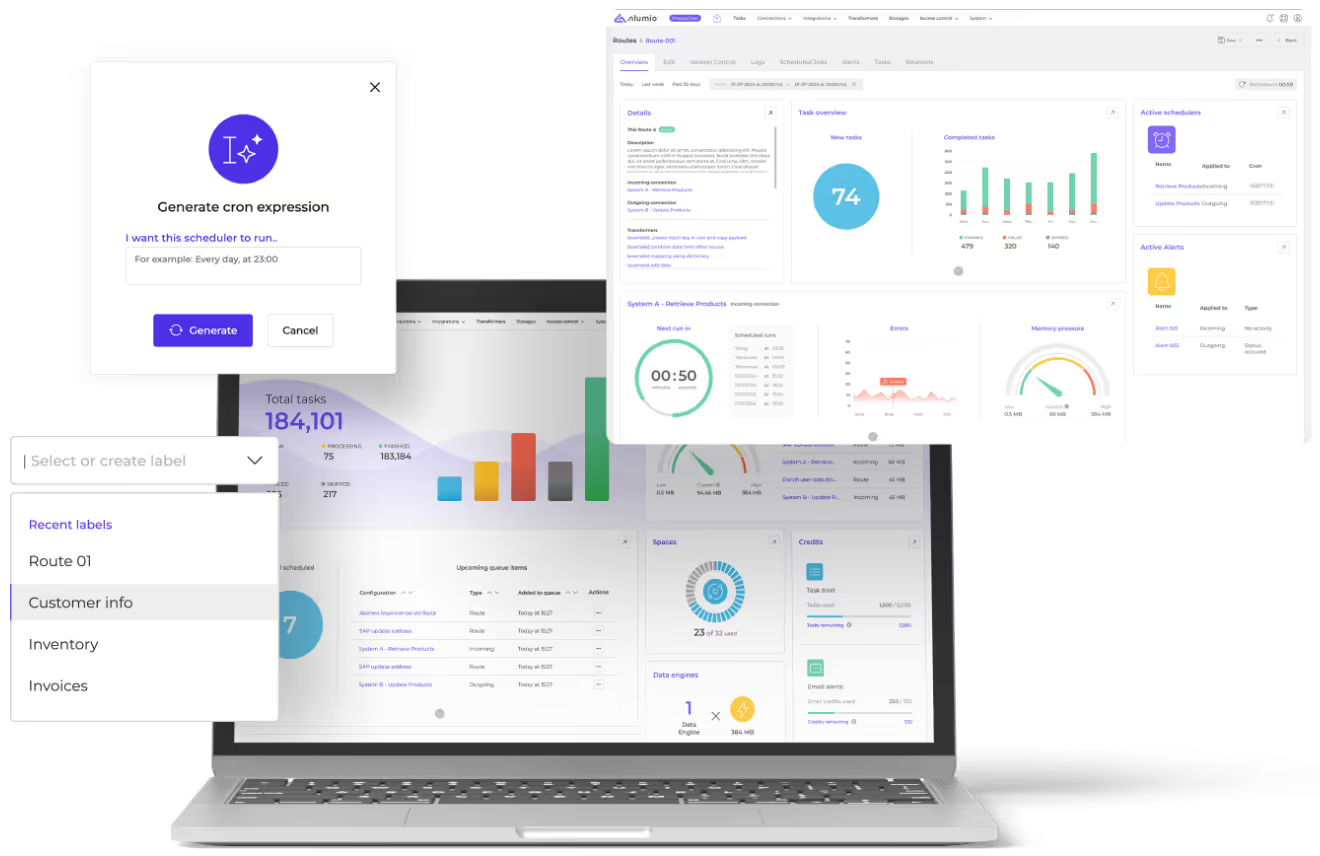
Alumio is an API-driven, config-first integration platform-as-a-service (iPaaS) designed to be the scalable backbone for future-proof digital ecosystems. It provides a governed cloud-native environment where enterprises can configure and monitor data flows at scale, with advanced Transformers (including a Code Transformer for JavaScript) to map, enrich, filter, and restructure data between systems. Alumio is the right choice if your priorities are governance, flexibility, and building scalable integrations that grow and adapt with your business.
n8n has carved out its space as a workflow automation engine with open DNA. Source-available and self-hostable, its strength lies in rapid experimentation: teams can stitch APIs together, prototype automations, and scale them on an execution-based model. If you want developer-driven flexibility, n8n is the right choice for product embedding and freedom from vendor lock-in.
Comparing key integration platform facts: Alumio iPaaS vs. n8n
Pricing model
- Alumio: Task-based subscription model starting at €999/month, with three tiers: (1M tasks/yr), Growth (2M), Custom (flexible)—each with its own SLA. Includes 1 prod + 1 sandbox on Essential, unlimited users & routes, and all standard/generic connectors.
- n8n: Transparent execution-based pricing. Cloud plans start at €24/month for 2,500 executions and scale with usage. The self-hosted Business plan is €800/month with 40K executions and enterprise features. Enterprise is custom, with unlimited scaling and SLA-backed support.
Best for
- Alumio: Mid-market and enterprise organizations that need governed, SLA-backed integrations with full observability and compliance across industries. Designed for IT leaders who want a scalable backbone for connecting their growing digital ecosystems and tech stack.
- n8n: Developers, startups, and product teams who require flexibility and speed. Ideal for embedding automation into products, building internal tools, or experimenting with new workflows at low entry cost, with capped execution limits.
Integration style
- Alumio: Built on a config-first approach, Alumio treats every connection as a configurable, reusable building block. Instead of writing custom code or relying on drag-and-drop, users set up integrations through clear, form-based steps, choosing how data should move, transform, and be monitored. Combining low-code flexibility and no-code simplicity, Alumio provides a rich library of Connectors and various Transformers to limitlessly customize, filter, and enrich data exchange. It also includes a Code Transformer that can be used to write JavaScript to solve edge cases.
- n8n: Designed as a workflow automation engine, n8n provides a visual builder where teams can stitch together 400+ pre-built nodes, add conditionals, and extend flows with JavaScript or Python. It's developer-friendly, open, and ideal for rapid prototyping, API stitching, and embedding automation directly into products.
Industry focus
- Alumio: Versatile across industries: retail, manufacturing, wholesale, logistics, transport, and finance. Specialized for complex multi-system and modular integrations (ERP, PIM, WMS, CRM, e-commerce) and custom endpoints.
- n8n: Industry-agnostic: appeals broadly to technical teams building API automations, internal tooling, or embedding workflows in SaaS products. Particularly strong for startups, dev-heavy orgs, and innovation teams.
Governance & Compliance
- Alumio: ISO-27001 certified and GDPR aligned. SLA-backed uptime, system monitoring, audit trails, and enterprise features like federated SSO, multi-factor authentication, and dedicated success management on higher tiers.
- n8n: SOC 2 compliant for Business/Enterprise. The Business tier adds SSO, LDAP, Git-based versioning, and environments. The Enterprise tier supports extended retention, log streaming, API key scoping, and SLA-backed support.
Strengths and limitations of Alumio vs. n8n
Let’s look beyond features and pricing to examine the real-world strengths and limitations of both Alumio and n8n:
Alumio strengths
- Config-first model keeps integrations resilient and easy to reconfigure as systems change.
- Task-based pricing means unlimited users and routes at no extra cost, starting with a 1M task allowance on the basic plan.
- Strong at orchestrating complex, multi-system landscapes (ERP, PIM, WMS, CRM, e-commerce).
Alumio limitations
- Might be oversized for small projects or light automations.
- While it’s config-first, advanced use cases (custom transformers, code snippets) still require developer input.
n8n strengths
- Source-available and self-hostable, giving teams full control over infrastructure.
- Rapid prototyping with 400+ nodes and scripting in JS/Python.
- Low entry cost with execution-based pricing that scales as usage grows.
n8n limitations
- Governance features (SSO, audit logs, SLA) mostly on higher tiers.
- Execution spikes can make high-volume use cases more expensive.




.svg)
.svg)
.svg)
.svg)
.svg)
.svg)
