

A Alumio vivid purple arrow pointing to the right, a visual representation of how to access more page material when clicking on it.
Go back

Know your customers – Grow your business

By
Carla Hetherington
Published on
April 3, 2023
Updated on
June 24, 2026
IN CONVERSATION WITH
Email icon
Email icon

Do you have a clear, unified picture of your customer's profile, even when data comes from multiple systems? Can you seamlessly retrieve information from your CRM, ERP, ticketing systems, and digital channels? If not, you're not alone. Many businesses struggle to map their customer's journey effectively, leading to inefficiencies and missed opportunities. Understanding your customers is the key to delivering personalized services, building stronger relationships, and ultimately driving more sales through positive word-of-mouth. But getting there can be challenging. It requires more than just intuition; it demands data-driven insights to understand what your customers truly need and expect. With the right approach, businesses can anticipate customer needs and deliver solutions that go above and beyond. Curious about how to achieve this? Read on!

Data-driven marketing: The key to understanding your customers

Data-driven marketing leverages both online and offline data to gain a deeper understanding of customer behavior, preferences, and needs. By analyzing this information, businesses can develop more effective marketing campaigns that resonate with their target audience.

How can data-driven marketing help your business?

  1. Behavioral insights: Use data analytics tools to track customer behavior—like what they click on, what they purchase, and how long they stay on your website. Analyzing these patterns reveals valuable insights into their preferences, helping you tailor your offerings.
  2. Personalized messaging: Data-driven marketing enables you to customize your messages based on customer behavior and preferences. This personalization makes your campaigns more engaging, driving higher conversion rates.
  3. Targeted campaigns: Segment your customer base based on demographics, interests, and behaviors. With clear customer segments, you can create targeted marketing campaigns that speak directly to each group’s needs.
  4. Real-time optimization: Analyze campaign performance in real-time to make data-driven adjustments. By refining your messaging, targeting, and offers, you can ensure that your marketing resonates with your audience.

Data-driven marketing provides true one-to-one personalization in a real-time context, unlocking new business opportunities and driving growth.

Understanding your customers from day one: How an iPaaS can help

Achieving a 360° view of your customers starts with integrating data across your business systems. This is where an iPaaS (Integration Platform as a Service) comes in. The Alumio iPaaS is the perfect solution to centralize customer data from various sources, providing a comprehensive view that can transform your business. Here’s how:

  1. Seamless data integration: Alumio offers pre-built connectors to integrate data from different systems, eliminating data silos and enabling a unified view of customer information. Connect your CRM, ERP, marketing platforms, and social media channels effortlessly.
  2. Data normalization: Bringing data from multiple sources can lead to inconsistencies. Alumio normalizes this data, ensuring accuracy and making it easy to compare and analyze.
  3. Data transformation: Alumio converts data into formats compatible with your existing systems, such as CRM, PIM, or data warehouses. This ensures smooth interoperability across your software ecosystem.
  4. Real-time data synchronization: With Alumio, data is always up to date. Real-time synchronization ensures that you have the latest information across all systems, enabling quick, informed decisions.

Learn more about how Alumio works →

The benefits of a 360° customer view

By centralizing and integrating your data, Alumio enables businesses to gain a holistic view of customer interactions across different channels and touchpoints. This leads to:

  • Personalized customer experiences: Understand customer preferences and deliver tailored solutions that meet their unique needs.
  • Increased customer satisfaction and loyalty: By anticipating needs and providing exceptional service, you build trust and loyalty.
  • Sustained business growth: A deeper understanding of your customers translates to improved engagement, higher conversion rates, and ultimately, increased revenue.

Unlock your business potential with the Alumio iPaaS

A comprehensive, data-driven approach to understanding your customers doesn’t just improve marketing efforts; it transforms your entire business. With Alumio’s powerful suite of integration tools, you can turn disparate data into actionable insights, create seamless customer experiences, and drive business growth. Ready to learn more? Get in touch with us to dive into the world of data-driven marketing and discover how Alumio can help you gain a 360° view of your customers.


Turn AI ambition into action

Portrait of Leonie Becher Merli, Business Development Manager at Alumio

Get a free assessment of your integration needs and next steps

Portrait of Leonie Becher Merli, Business Development Manager at Alumio

No items found.
Topics in this blog:
No items found.

FAQ

Integration Platform-ipaas-slider-right
Why do businesses struggle to get a unified view of their customers?

Businesses struggle to achieve a unified customer view because customer data is distributed across multiple disconnected systems: CRM holds relationship and contact data, e-commerce holds purchase and browse history, ERP holds account and financial data, customer service tools hold support ticket history, and marketing platforms hold engagement data. Without integration, each system has a partial picture of the customer that does not reflect what the other systems know. The gap between what a business should know about its customers and what any individual system actually makes available is an integration gap as much as a data gap.

Integration Platform-ipaas-slider-right
How does a unified customer profile improve business outcomes?

A unified customer profile improves outcomes across multiple functions: marketing can segment and target based on complete customer behavior rather than one channel's data, sales can engage with full context of the customer's commercial relationship before a conversation, customer service can resolve issues faster with complete order and interaction history, and product teams can prioritize improvements based on the behavior patterns of the highest-value customer segments. Each improvement requires the same foundation: data from all customer-facing systems flowing into a consistent, current, unified profile rather than remaining siloed by department.

Integration Platform-ipaas-slider-right
What is the customer journey mapping challenge when data comes from multiple systems?

Mapping the customer journey across multiple systems is challenging because each system captures different moments in the journey using different identifiers and data structures. A customer may exist in the CRM under their business email, in e-commerce under a personal email, and in the support system under a ticket number, and none of these records automatically recognize that they represent the same person. Identity resolution (linking these records into a single profile) is the core technical challenge of customer journey mapping, and it requires both data governance decisions (which system is the authoritative identity master) and integration flows that propagate that identity across all systems.

Integration Platform-ipaas-slider-right
How does Alumio help businesses build a unified customer data infrastructure?

Alumio builds unified customer data infrastructure by connecting all customer-data-generating systems (e-commerce, CRM, ERP, marketing automation, customer service tools) through a governed integration backbone. Customer data flows bidirectionally: e-commerce purchase behavior flows to CRM for sales context, CRM account status flows to e-commerce for customer-specific pricing and content, ERP payment history flows to customer service for service context. The result is not a single new database but a synchronized ecosystem where each system has access to the customer data it needs from all other systems, in real time.

Integration Platform-ipaas-slider-right
What role does a CDP play alongside an integration platform for customer data unification?

A CDP (Customer Data Platform) creates unified customer profiles by ingesting data from all touchpoints and resolving identities into a single record. An integration platform like Alumio manages the data flows that feed the CDP: order data from e-commerce, contact records from CRM, and engagement signals from marketing tools all flow through Alumio to the CDP as part of the same governed backbone that manages all other integration flows. The CDP focuses on profile unification and marketing activation; the integration platform focuses on the reliable, governed data delivery that makes the CDP's profiles accurate and current.

Integration Platform-ipaas-slider-right
What are the first customer data integrations a business should prioritize?

The highest-priority customer data integrations are: CRM to e-commerce (so sales has visibility into online purchase behavior, and e-commerce benefits from CRM account data for B2B pricing and segmentation), order status from ERP or WMS to CRM and customer service tools (so every customer-facing team can answer order queries without calling operations), and e-commerce to marketing automation (so campaigns reflect current purchase behavior and lifecycle stage rather than stale segments). These three integrations collectively eliminate the most visible symptoms of siloed customer data and deliver immediate value to sales, service, and marketing teams.

Get a free assessment of your integration needs

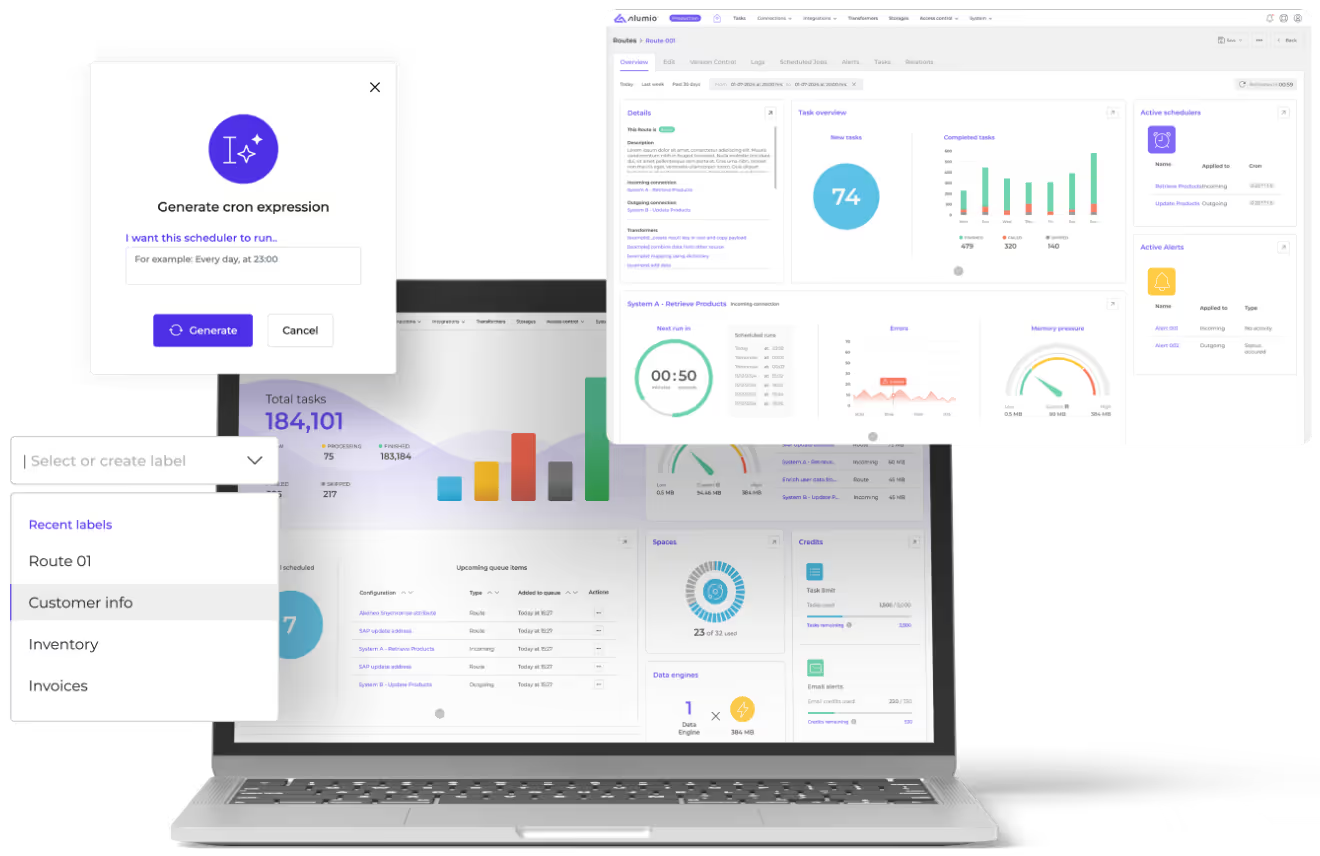
Laptop screen displaying the Alumio iPaaS dashboard, alongside pop-up windows for generating cron expressions, selecting labels and route overview.