

A Alumio vivid purple arrow pointing to the right, a visual representation of how to access more page material when clicking on it.
Go back

Grow your business on the cloud with Alumio

By
Carla Hetherington
Published on
March 24, 2023
Updated on
June 24, 2026
IN CONVERSATION WITH
Email icon
Email icon

Spring is not only a season of growth and renewal in nature; it can also be a time of growth and renewal for your business. As a business owner, you need to ensure that your software systems are connected and operating efficiently, since they are crucial parts of your business’s IT ecosystem, which grows in relation to the number of connections formed. An iPaaS (integration Platform as a Service) like Alumio is the backbone of said IT ecosystem, and is responsible for guaranteeing seamless connectivity. However, in order to ensure maximum growth, you must set your eyes on the cloud. Ever heard of the tale of Jack and the Beanstalk? A similar tale is unfolding in the digital landscape…

Once upon a time, on-premises software integrations were the norm. Recently, cloud migration has become the new standard, one that is only increasing as it positions itself as a stronghold for safety and innovation that can empower growth during uncertain times due to its agile and scalable nature. Businesses aware of this are moving to the cloud as part of IT modernization initiatives to reduce risks and minimize costs.

As an "integration Platform as a Service (iPaaS)", Alumio can help move your business to the cloud by providing a unified platform to connect different software, apps, and data sources with guaranteed seamless connectivity and data exchange in a secure cloud environment.

Here are the benefits of growing your business on the cloud with Alumio:

  • Flexibility: Alumio provides businesses with a flexible platform that can easily adapt to changes in needs. As businesses grow and expand, they can quickly add new applications and services to the platform without having to worry about managing hardware and infrastructure as Alumio enables the migration of legacy systems and old-school ERPs to modern, cloud-native, customer-facing applications without the risk of data loss or integrity.

Discover the future-proof flexibility of our integration platform ->

  • Scalability: Cloud-native systems can easily scale up or down to adapt to changes in business needs, channels, and customer demands without requiring additional hardware or infrastructure. Alumio enables businesses to adopt a Composable Commerce approach that fosters said adaptability, empowering the seamless integration of best-of-breed systems without the need to re-platform. This translates into being agile, and achieving a faster time-to-market.

Want to learn more about how Alumio empowers business scalability? Check out our blog!  

  • Automation: With Alumio, businesses can digitalize and automate business processes across Marketing, Sales, Customer Service, HR, and all other departments, allowing companies of all sizes to provide enhanced products and services to their customers.

Discover how Alumio empowers business process automation.

  • Cost-effectiveness: Alumio can reduce IT costs by eliminating the need for hardware, software licenses, and maintenance, allowing businesses to allocate their resources more effectively and focus on core business activities.

Learn more about the Cost Optimisation benefits of Alumio in our white paper.

  • Reliability: Alumio protects you from threats such as data loss, security breaches, and system crashes that get in the way of business continuity by buffering your data on a secure cloud space. By doing this, Alumio doesn’t just provide remote access to your data in case of any data loss from your on-premises systems due to fire, water, or accidental damage, but it also allows you to migrate your data securely, redeploy your systems remotely, and easily track your data security via automated logging.

Explore how Alumio ensures business continuity.

  • Security: Alumio guarantees the highest levels of data security, scalable infrastructure, and reliable cloud space, saving businesses from investing resources in constantly improving or expanding such features.

Learn more about how the Alumio integration platform ensures security and privacy compliance ->

In conclusion…

While each organization will have different business needs and varying approaches to fulfilling said needs, the backbone of any integration strategy is a cloud-native integration platform that can empower growth and profitability. The main motivations behind the implementation of cloud strategies are, for the most part, to decrease hardware costs, lessen management burdens, obtain desired deployment times, and promote scalability. With Alumio, businesses have access to all of this and more!

…And so the tale goes that businesses who joined Alumio in this venture achieved unprecedented digital growth and, naturally, reached the clouds just as Jack’s beanstalk did. Ready to live your own cloud-native fairytale? Request a demo and learn more about Alumio.


Turn AI ambition into action

Portrait of Leonie Becher Merli, Business Development Manager at Alumio

Get a free assessment of your integration needs and next steps

Portrait of Leonie Becher Merli, Business Development Manager at Alumio

No items found.
Topics in this blog:
No items found.

FAQ

Integration Platform-ipaas-slider-right
How does cloud adoption drive the need for better system integration?

As businesses adopt more cloud applications and SaaS solutions, the number of systems that need to exchange data grows proportionally. Each new cloud tool (an e-commerce platform, a CRM, a marketing automation tool, a cloud ERP) holds part of the business's operational data. Without integration, these systems create new data silos rather than amplifying the existing ecosystem. Cloud adoption and integration maturity must grow together: the more cloud applications a business runs, the more critical a governed integration backbone becomes to keep them working as a coordinated whole.

Integration Platform-ipaas-slider-right
How does Alumio help businesses grow on the cloud?

Alumio supports cloud-driven business growth by providing the integration backbone that connects cloud and SaaS applications to each other and to existing business systems. As a business adds new cloud applications (a new e-commerce channel, a new marketing tool, a new analytics platform), each connects to Alumio rather than requiring custom connections to every existing system. This makes the integration landscape grow linearly in complexity rather than exponentially, which is what allows cloud adoption to accelerate business capability rather than generating new integration debt with every addition.

Integration Platform-ipaas-slider-right
What is the relationship between IT ecosystem connectivity and business scalability?

IT ecosystem connectivity directly determines business scalability: organizations that can connect new systems and channels quickly can launch new capabilities faster, enter new markets with less IT friction, and respond to operational changes without long custom development cycles. Connectivity is the infrastructure that translates cloud investment into business capability. Businesses with governed integration backbones consistently demonstrate higher digital agility than those still managing each system connection as a bespoke project, because the backbone is what makes scalability structural rather than situational.

Integration Platform-ipaas-slider-right
What business growth opportunities does a well-integrated cloud ecosystem unlock?

A well-integrated cloud ecosystem unlocks: faster time-to-market for new channels (marketplace expansion, new storefronts, new regions), AI and analytics capabilities that depend on clean, synchronized data from all operational systems, personalization at scale using unified customer data from all touchpoints, and the ability to respond to operational disruptions (supply chain, demand shifts) with real-time data rather than day-old reports. Each of these growth opportunities is technically enabled by integration infrastructure and commercially realized through business execution.

Integration Platform-ipaas-slider-right
How does Alumio's cloud-native architecture benefit businesses compared to on-premise middleware?

Alumio's cloud-native architecture eliminates the infrastructure management overhead of on-premise middleware: no servers to provision, no hardware to maintain, automatic scaling with workload, and deployment updates managed by Alumio rather than the customer's IT team. This reduces both the cost and the technical barrier to operating a governed integration backbone, making enterprise-grade integration infrastructure accessible to mid-market businesses that could not justify the investment in on-premise ESB infrastructure. The subscription model also converts integration from a large capital expense into a predictable operational cost.

Integration Platform-ipaas-slider-right
What should businesses consider when planning their integration strategy for cloud growth?

Planning an integration strategy for cloud growth should address: which cloud applications will be central to the business's digital strategy in the next two to three years (and therefore most important to connect first), what the data ownership model should be across ERP, e-commerce, PIM, and CRM (which system is master for which data type), how integration reliability and monitoring will be governed as the application count grows, and whether the chosen integration approach will scale with the business or require a platform change once complexity exceeds its limits. Starting with a governed backbone architecture from the outset is always cheaper than retrofitting governance onto a sprawl of custom connections later.

Get a free assessment of your integration needs

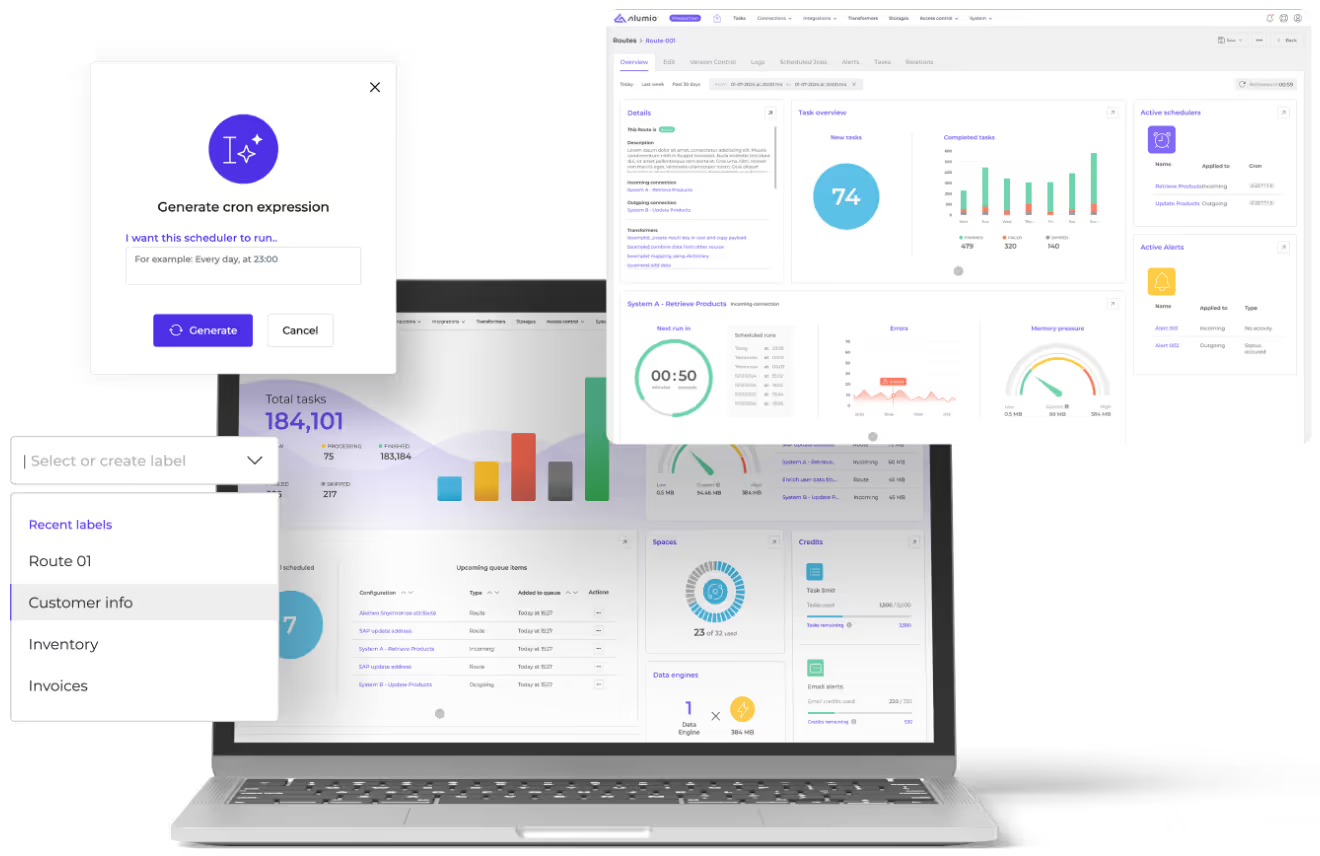
Laptop screen displaying the Alumio iPaaS dashboard, alongside pop-up windows for generating cron expressions, selecting labels and route overview.