




.svg)



Most modern businesses that integrate cloud apps, SaaS solutions, and data sources have already been implementing integration platforms to build and bolster their IT ecosystem. Those implementing such platforms are already ahead of the curve when it comes to integrating new technologies. They provide the flexibility to rapidly change and scale their customer experiences according to new technology and product features. Alumio is one such next-gen integration platform designed to integrate with any new kind of technology, especially “Composable Commerce”.
Three ways Alumio empowers business scalability:
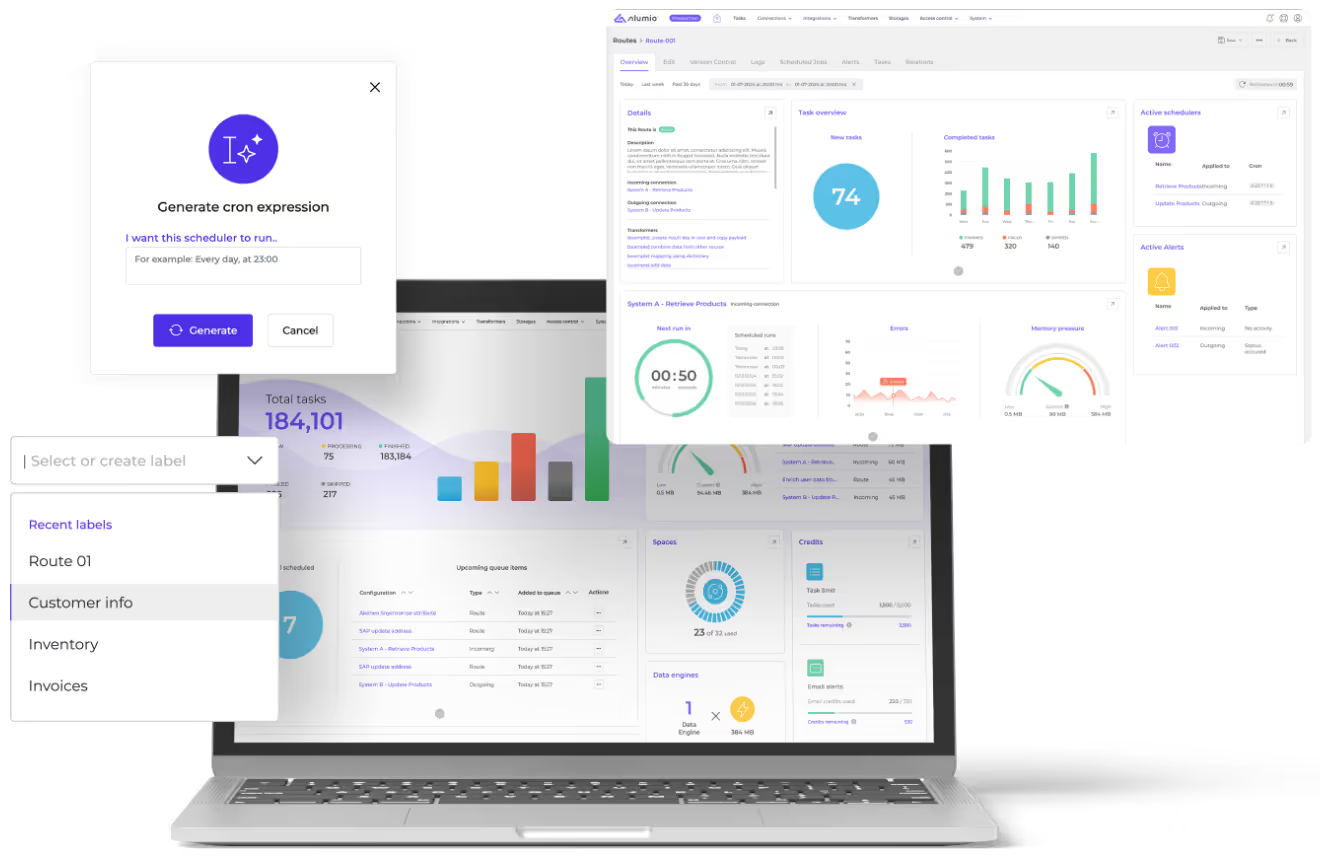
Alumio provides a cloud-native, low-code "integration Platform as a Service (iPaaS)" that works as a connectivity solution, enabling businesses to quickly and cost-effectively integrate two or multiple systems, software, apps, or data sources, across on-premise and cloud environments. As such, Alumio provides businesses with unparalleled flexibility to customize their IT stacks, accommodate change, and scale. With Alumio, you can:
1. Flexibly integrate software, cloud applications, and best-of-breed solutions.
As companies grow, more software integrations have to be added to automate business processes in order to keep up. If a business already has a composable business model, adding integrations to its tech stack is a piece of cake. If, however, a business is not yet composable, replacing outdated software can be a hassle that gets in the way of scalability. This can translate to businesses spending large sums of money on all-in-one software solutions filled with unnecessary features, re-platforming an entire IT ecosystem, and an overall inability to swiftly cater to emerging business needs.
✓ The Alumio integration platform equips businesses with the flexibility to seamlessly integrate multiple software, systems, or microservices. It also enables the migration of legacy systems and old-school ERPs to modern, cloud-based, customer-facing applications without the risk of data loss or integrity. At the same time, Alumio enables businesses to seamlessly integrate best-of-breed systems without the need to re-platform, fostering adaptability to new markets, channels, and customer demands.
2. Help manage big data exchanges in a secure cloud environment.
Having a popular and successful commerce site sounds like a dream, but without a scalable integration platform, it can quickly turn into a nightmare… Don’t believe it? Ask Amazon. According to CNBC, during their 2018 Prime Day, “Amazon wasn’t able to handle the traffic surge and failed to secure enough servers to meet the demand,” a breakdown that resulted in a roughly $1,000,000 per minute loss. The moral of the story: scalability saves the day.
✓ During periods of peak sales, Alumio prevents system crashes through a queuing mechanism, ensuring business continuity by buffering surges of data loads. Alumio can help gather and analyze customer data from all business touchpoints to improve customer experiences, enabling seamless data sharing and 360-degree data insights on a secure cloud environment without any limit on data routes, endpoints, or users.
“We started with big commercials on YouTube in 2021. This resulted in a growth of our business with 700% on peak moments. We were so happy with Alumio iPaaS in our IT landscape because it was able to buffer our orders, and saved our continuity in order process”
3. Save time and resources on digital growth.
The number of software integrations needed to operate a business inevitably increases when a business grows, and so does the complexity of managing these integrations. Data is stored in several places, and the first integration problems may arise, such as data silos, API conflicts, and integration errors, factors directly responsible for slowing down digital growth. Without a platform like Alumio, businesses need to rely on senior developers to solve these problems and integrate software by writing custom code or using plugins, resulting in expensive projects and third-party dependency that can stall growth.
✓ As a low-code integration platform, Alumio helps businesses create integrations via a user-friendly interface without requiring deep coding expertise or programming knowledge. In this way, non-developers, data experts, or even project managers can configure, monitor, and manage software integrations from one central dashboard, saving businesses the costs of needing to exponentially expand their IT team with growing software integrations.
In conclusion…
Alumio + Composable Commerce = Scalability
With scalability being more relevant now than ever, having a flexible platform that can scale with your business is paramount, and Alumio is exactly that. Alumio helps businesses to create flexible, composable, future-proof IT infrastructures that can easily accommodate rapid growth and change. Alumio was born ready for the new era of commerce. Will you join us?
Read more about it in our new white paper: Composable Commerce: A game changer for commerce systems.





.svg)
.svg)
.svg)
.svg)
.svg)
.svg)
