

A Alumio vivid purple arrow pointing to the right, a visual representation of how to access more page material when clicking on it.
Go back

Enhancing EDI & B2B data exchange with an iPaaS

By
Saad Merchant
Published on
July 3, 2023
Updated on
June 24, 2026
IN CONVERSATION WITH
Email icon
Email icon

With the rise of B2B (Business to Business) e-commerce and with the advent of D2C (Direct to Consumer) commerce, it is becoming imperative for traditional businesses to digitize data exchange with traders and suppliers. To achieve this, most businesses rely on Electronic Data Interchange (EDI), one of the oldest and most reliable methods for paperless data exchange. However, there’s also a demand for standardizing data exchange between business systems and applications. The Alumio “integration Platform as a Service (iPaaS)” helps businesses integrate EDI, legacy systems, and the latest cloud apps and SaaS solutions for digital growth, while helping standardize data exchange across formats such as JSON, CSV, XML, EDIFACT, and more.

Facilitating B2B data exchange with EDI

Introduced to supply chains in the 1960s, Electronic Data Interchange (EDI) is one of the oldest and most reliable standardized format for exchanging business documents electronically, such as invoices, shipping details, and purchase orders.

Revolutionizing paperless data exchange, EDI is one of the most essential components of supply chain management, streamlining trading processes, and enabling B2B businesses to stay connected with all their vendors and suppliers.

In 2019, EDI accounted for 78.4% - $7.00 trillion - of all B2B electronic sales, according to a 2020 B2B E-commerce Market Report.

The benefits of using EDI

Apart from helping businesses exchange data quickly and accurately, the reason the relevancy of EDI keeps increasing with time is because several key benefits that it provides, such as:

Enhanced business efficiency

EDI enables the automated exchange of data, removing the need for manual re-keying of messages such as orders, stock, invoices, credit notes, and ASNs.

Reduce operational costs

EDI eliminates the need for manual data entry otherwise required to move data back and forth between your EDI and back-office system. And it saves the accumulating costs of maintaining paper documents.

Improve data security

By enabling paperless exchange, EDI ensures improved accuracy of data sharing, eliminates data errors, and ensures your data can be remotely stored and accessed.

The need to integrate EDI with an integration platform


Today, EDI standards are often required by trading partners as a condition of doing business with them. In other words, a company may need to use EDI in order to maintain their relationships with these partners. Each EDI standard consists of different message types, and each region and sector uses its own EDI standard and format. Thus, businesses can greatly benefit from having a central integration platform to establish EDI connections with partners and customers.

What is the Alumio iPaaS and how does it facilitate EDI integrations?

The Alumio iPaaS is a cloud-based, low-code integration platform that enables organization to connect multiple systems, software, and data sources. It provides a user-friendly web interface to create, manage, and monitor all their integrations and data flows, across various data formats.

As a next-gen middleware, the platform acts as a bridge between different technologies and enables seamless real-time data exchange and synchronization. It provides powerful data transformation and mapping features. Centralizing all integrations and data on one dedicated cloud space, the Alumio iPaaS supports a wide range of integration patterns, including API integration, file-based integration, and comprehensive support for EDI.

Specializing in EDI integrations, the Alumio iPaaS helps seamlessly transform data between different EDI formats, such as EDIFACT, ANSI X12, and XML. The platform offers pre-built connectors and templates for popular EDI standards, reducing the time and effort required for implementation. It also supports message validation, ensuring that the exchanged data complies with the specified standards and rules.

“One global manufacturer routinely exchanges about 55 different EDI document types with nearly 2,000 partners" - IBM


Enabling standard format data exchange with Alumio

In addition to EDI, the Alumio iPaaS empowers businesses to exchange data in standard formats across various systems and applications. By adhering to commonly used formats, such as XML, JSON, CSV, and others, organizations can achieve interoperability and compatibility between different software solutions.

The Alumio integration platform provides extensive data transformation capabilities, which help map data from one format to another seamlessly. This involves enabling businesses to configure standard formats such as JSON, CSV, XML, IDOC, or even EDI, and then connect them to any API or trading partner. This enables organizations to seamlessly integrate multiple disparate systems and and data sources, and to automate data exchange across all these connections.

Boost your B2B success with EDI and the Alumio integration platform

By helping connect business data across EDI or any other messaging formats, the Alumio iPaaS help seamlessly exchange B2B data between customers and suppliers. It also helps B2B businesses to integrate their eProcurement and ERP platforms with e-commerce platforms and the latest cloud apps to improve digital growth. In this regard, the Alumio iPaaS empowers organizations to connect their systems, unlock the value of their data, and helps simplify digital transformation efforts.


Turn AI ambition into action

Portrait of Leonie Becher Merli, Business Development Manager at Alumio

Get a free assessment of your integration needs and next steps

Portrait of Leonie Becher Merli, Business Development Manager at Alumio

No items found.
Topics in this blog:
No items found.

FAQ

Integration Platform-ipaas-slider-right
What is EDI and why is it still essential for B2B commerce?

EDI (Electronic Data Interchange) is the automated exchange of standardized business documents (purchase orders, invoices, advance ship notices) between organizations in agreed electronic formats. It remains essential for B2B commerce because large retail chains, manufacturers, and logistics networks mandate EDI as a condition of doing business: compliance is not optional for suppliers who want access to these trading networks. EDI also handles the structured, high-volume document exchange at the scale and reliability that informal methods (email, spreadsheets) cannot match.

Integration Platform-ipaas-slider-right
How does an iPaaS enhance EDI and B2B data exchange?

An iPaaS enhances EDI by managing EDI flows alongside API-based integrations in the same governed platform, eliminating the need for separate EDI middleware. When EDI purchase orders arrive from a trading partner, Alumio routes them directly into the ERP for processing; when the ERP confirms fulfillment, Alumio generates the appropriate EDI advance ship notice and invoice back to the partner. This unified approach gives operations a single place to monitor all B2B data exchange (EDI and API alike) with consistent error handling and audit logging across both protocols.

Integration Platform-ipaas-slider-right
What challenges does traditional EDI integration create for businesses?

Traditional EDI middleware challenges include: per-partner mapping complexity (each trading partner uses slightly different interpretations of the same EDI standard), expensive specialist expertise for EDI configuration and troubleshooting, difficulty connecting EDI flows to modern cloud systems (ERP, e-commerce) without custom adapters, and the operational overhead of maintaining separate EDI middleware alongside the rest of the integration landscape. An iPaaS that handles EDI alongside API integration centralizes these challenges in one governed platform rather than managing them in separate tools.

Integration Platform-ipaas-slider-right
How does Alumio support EDI alongside modern API-based integrations?

Alumio supports EDI by enabling EDIFACT and ANSI X12 document processing within its Route architecture, so EDI transactions can be received, transformed, and routed to connected systems (ERP, WMS) as part of the same integration backbone that manages API-based flows. This means B2B businesses do not need separate EDI middleware and API integration tools: a single Alumio instance handles EDI trading partner exchanges alongside the e-commerce and ERP integrations that the same team manages for direct channel operations.

Integration Platform-ipaas-slider-right
What is the benefit of unifying EDI and API integrations in a single iPaaS?

Unifying EDI and API integrations in a single platform provides: centralized monitoring (all B2B data exchange, whether EDI or API: is visible in one dashboard), consistent error handling (failed EDI transactions are surfaced and replayable using the same mechanisms as failed API calls), reduced operational overhead (one team with one platform rather than specialist EDI operators managing separate middleware), and a unified audit log covering all trading partner exchanges for compliance and dispute resolution.

Integration Platform-ipaas-slider-right
As B2B businesses move toward D2C, how do their integration requirements change?

As B2B businesses move toward D2C, their integration requirements expand: they add e-commerce platform connections alongside existing EDI trading partner integrations, need to synchronize B2B pricing and B2C pricing from the same ERP to different storefronts, and must manage a combined B2B/B2C order flow through the same fulfillment infrastructure. An integration platform that handles both EDI (for B2B trading partner exchange) and API-based integration (for D2C e-commerce) from a single backbone is the practical infrastructure choice for businesses navigating this transition.

Get a free assessment of your integration needs

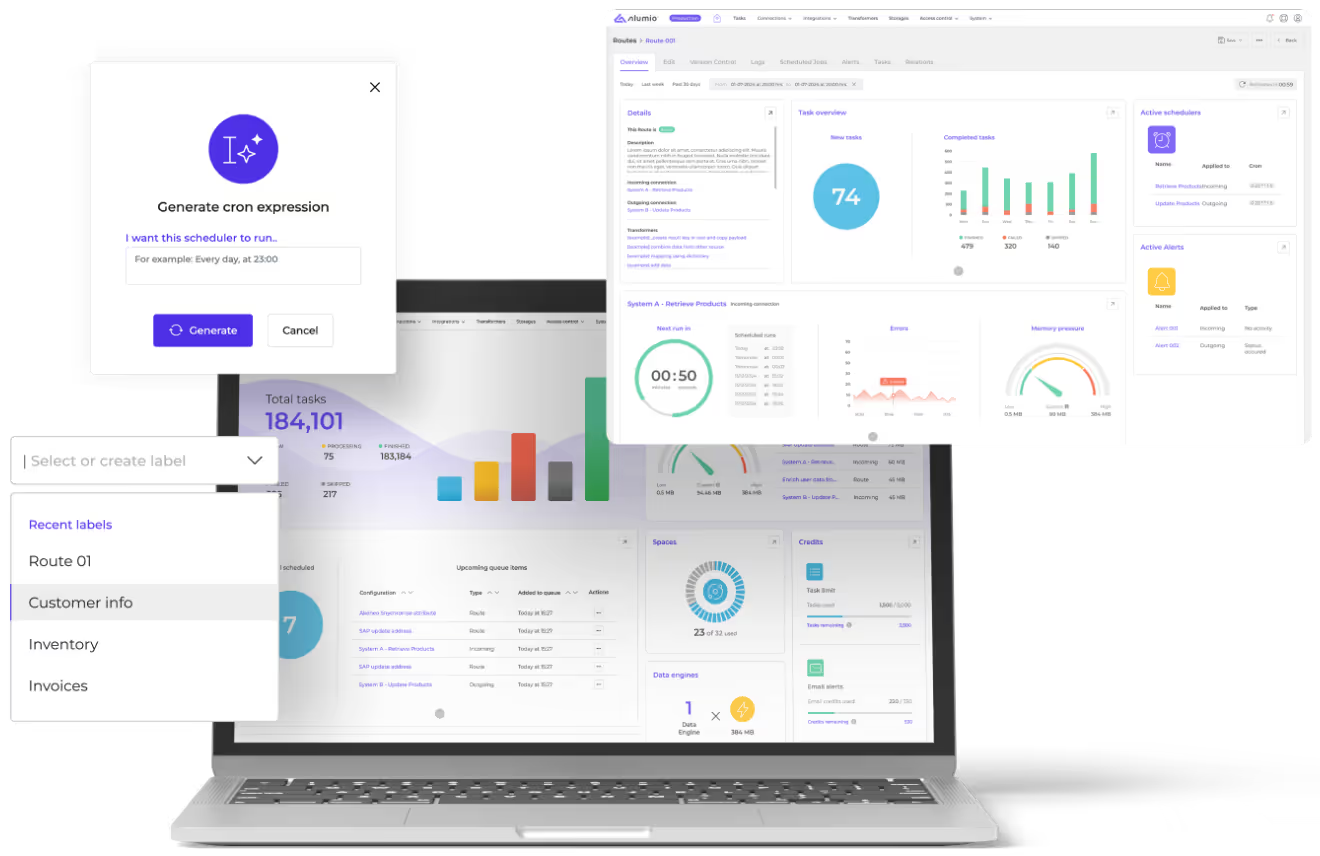
Laptop screen displaying the Alumio iPaaS dashboard, alongside pop-up windows for generating cron expressions, selecting labels and route overview.