Why integration outgrows a point-to-point connector
Both an iPaaS and a point-to-point connector move data between systems, so early on they can look interchangeable. The difference is what happens as the business adds more systems. A connector is built to link a specific pair and keep that link running. It does that one job well and does not reach beyond it.
That is fine until the business grows, which it usually does. A fourth system arrives, then a fifth, and each new connector only knows about its own two endpoints. None of them coordinate, so the business ends up managing a pile of separate links that cannot act together. The work of integration has grown, but the tools have not grown with it.
An iPaaS starts from the opposite assumption: that the number of systems will keep rising and the connections need to be managed as one. The sections below show where that assumption pays off, through the iPaaS capabilities a connector was not built to provide, and where a connector is still the better call.
Every added system multiplies the connections
Connecting systems one pair at a time works until the count climbs. Link an ERP to a CRM, then to a PIM, then to a warehouse system and a storefront, and the number of direct connections grows faster than the number of systems. Each one is built and maintained on its own.
An iPaaS breaks that pattern. Every system connects to one platform instead of to every other system, so adding the sixth or tenth system does not multiply the wiring. It also connects across categories and formats, including ERP, commerce, PIM, CRM, WMS, and finance, which is central to what an iPaaS is and to why it keeps working as the landscape expands.
Transforming and orchestrating data, not just moving it
This is where the gap widens. A point-to-point connector moves data as-is, matching a field in one system to a field in another, which is exactly what a straightforward sync needs. An iPaaS reshapes data in transit: it maps and converts formats, validates values, and enriches records, so each system receives exactly what it needs rather than a raw copy.
Orchestration is the larger difference. A connector fires one hop between two systems. An iPaaS runs multi-step flows, where a single event triggers a coordinated sequence across several systems at once. As integration grows, more of the value lives in those cross-system processes, which a set of separate connectors cannot run, because none of them sees beyond its own pair.
Seeing and governing every connection as they multiply
The more connections a business runs, the harder they are to watch. Separate connectors each log their own activity, if they log at all, so a problem often surfaces only when something visibly breaks, and tracing it means checking each tool in turn.
An iPaaS puts every flow through one platform, so each exchange is logged, monitored, and traceable in one place, with access controlled centrally. This is one of the iPaaS capabilities that grows more valuable as the landscape does. A handful of connectors can be watched by hand. Fifty cannot, and a collection of them cannot add that oversight after the fact.
When is a point-to-point connector the right tool?
When the need is narrow and likely to stay that way. For a business linking two systems and nothing more, a connector is faster to set up, cheaper to run, and perfectly adequate. The same holds for a one-time job, such as migrating data from an old CRM into a new one. In these cases a connector is not a compromise, it is the correct tool.
The test is whether the scope will hold. If the integration genuinely will not grow, a connector is the sound, economical choice. But that case is rarer than it looks, because integration tends to expand with the business. When more systems, partners, or channels are on the horizon, the low entry price of a connector is usually paid back later in the cost of point-to-point integrations, the manual upkeep and the breakage when one system changes.
The iPaaS capabilities that grow with the business
An iPaaS is built for the case where integration keeps expanding. The Alumio iPaaS is a cloud-native platform that connects ERP, commerce, PIM, CRM, WMS, and finance systems through one layer, and manages those connections together as their number grows.
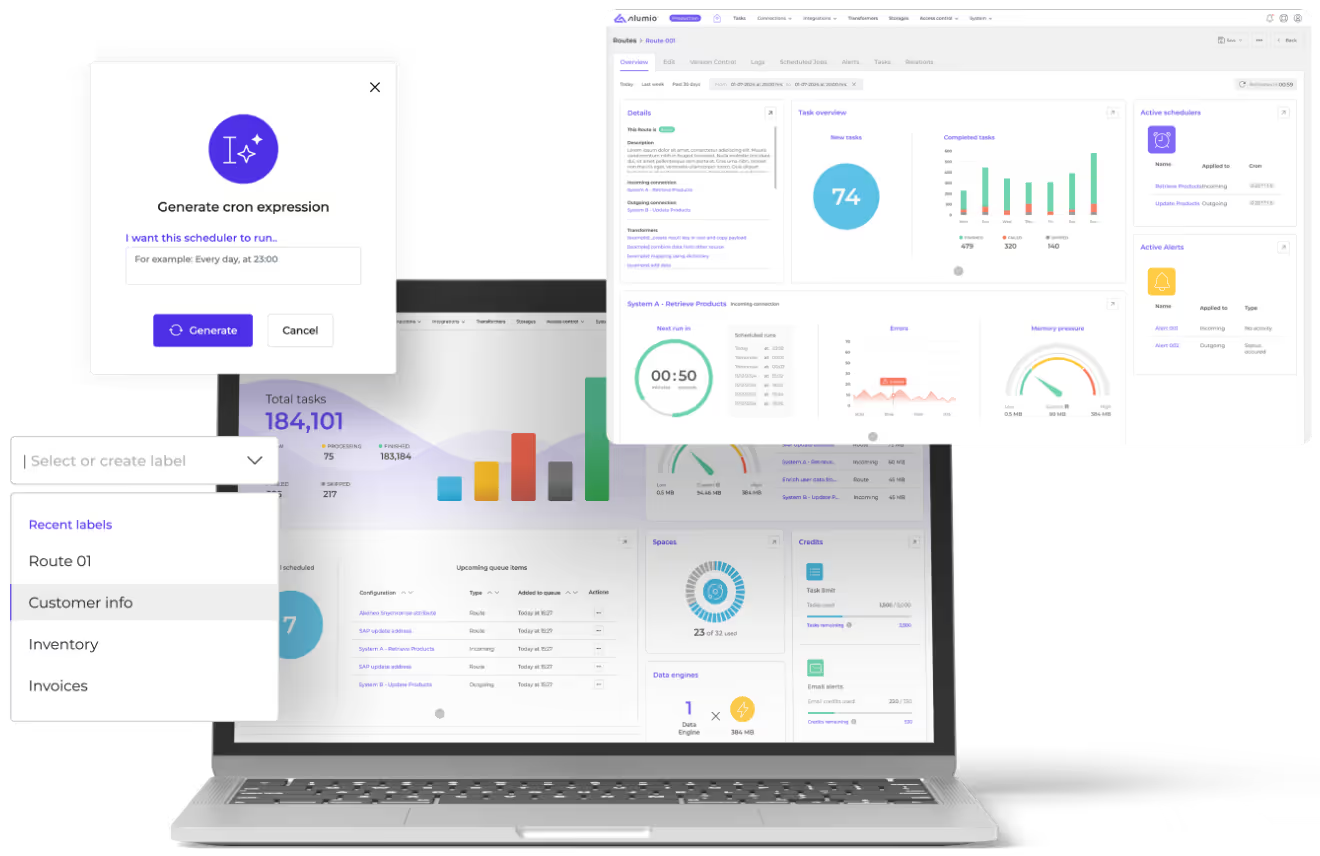
Each connection is configured once, data is mapped and transformed so each system receives what it expects, and multi-step flows are orchestrated as Routes rather than left to fire on their own. Every flow is logged and monitored, with alerts when something breaks. Because systems connect to the platform rather than to each other, a business can add or swap one without rewiring the rest, which is what lets the integration keep growing without becoming unmanageable.
There is an honest trade-off. For a business with two systems and a one-time sync, an iPaaS is more than the job needs, and it carries a subscription a single connector does not. Its value appears once integration starts to grow, which for most businesses is a matter of when, not if.
Choosing an iPaaS for integration that keeps growing
The choice is not about which tool is better in the abstract. It is about whether the integration will grow. A narrow, stable need is well served by a point-to-point connector. A landscape that will keep adding and coordinating systems calls for the iPaaS capabilities that only a platform provides.
The mistake to avoid is buying for today's scope alone. A tool that fits two systems now can become the thing a business has to rip out once it connects ten, and by then the migration is the price of the delay. Choosing for how integration is likely to grow, rather than how small it starts, is what keeps that decision from having to be made twice.





.svg)








.svg)
.svg)
.svg)
.svg)
.svg)
.svg)
