A Alumio vivid purple arrow pointing to the right, a visual representation of how to access more page material when clicking on it.
Go back

AI orchestration explained: The invisible engine behind smarter workflows

By
Carla Hetherington
Published on
November 4, 2025
Updated on
November 4, 2025
IN CONVERSATION WITH

Sander Bast

AI Specialist, Enrise

A 2D email icon in anthracite and vivid purple

Marten Schilstra

Tech Lead, Enrise

A 2D email icon in anthracite and vivid purple
A white cross 2D icon

AI may be grabbing headlines with flashy interfaces and viral copilots, but the true transformation is happening where no one’s looking: in the background. Deep inside workflows, under your CRM, between your ERP and support systems, and inside your business logic, AI is becoming the silent force behind smarter operations. At Enrise, a Dutch digital agency known for its technical depth and pragmatic innovation, this invisible layer of AI is already reshaping how businesses work. To understand how, we spoke with Sander Bast, AI Specialist, and Marten Schilstra, Tech Lead at Enrise. Their message? The most powerful AI doesn’t need to be seen to be felt.

Why invisible AI matters more than ever

While most headlines chase flashy copilots and viral prompts, a quieter revolution is underway. Sander Bast and Marten Schilstra are leading that shift. At Enrise, they both work alongside engineering teams to embed AI deep into operational workflows. While they also build and deliver conversational AI solutions, they emphasize that those only succeed when backed by strong backend orchestration and clean data infrastructure.

Too often, AI adoption is treated as a UI project. But Sander and Marten argue that’s missing the point. The real opportunity lies in applying AI on an infrastructural level to unleash orchestration; using AI not just to interpret or predict, but to act. As Sander Bast points out:

The real value of AI is not about adding a chatbot to your homepage; it’s about quietly transforming the flow of decisions and operations beneath the surface.”

Sander Bast

AI Specialist, Enrise

Invisible AI in action: Real-life examples of AI orchestration

Let’s break it down with a real-world use case:

Imagine a support ticket comes in through your website. Behind the scenes, AI kicks in immediately:

  • It’s automatically tagged for urgency and issue type.
  • The language and sentiment are analyzed using natural language processing (NLP) models.
  • The customer tier is identified from your CRM to determine priority.
  • Relevant past interactions, purchase history, and similar cases are pulled from your knowledge base.
  • Based on all this, the ticket is routed to the right support team or agent, and a draft response is prepared; before a human even sees it.

No manual triage. No context-switching. No redundant data entry. As Marten Schilstra puts it:

This is the power of invisible AI. It’s not just classification or output generation. It’s wiring intelligence into the flow so the system adapts and responds automatically.”

Marten Schilstra

Tech Lead, Enrise

This kind of automation is already being adopted by enterprise service teams. According to Salesforce’s State of Service report, 68% of service professionals say their organizations now use AI to automate customer support tasks, and that number is growing rapidly as backend orchestration tools mature.

The role of iPaaS in AI orchestration  

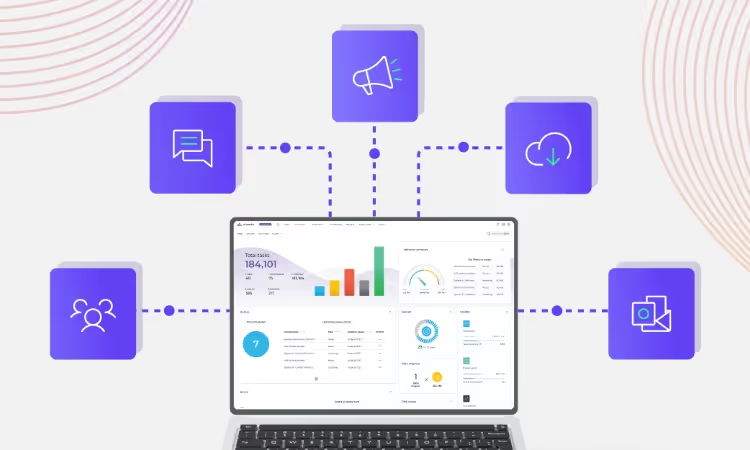
This kind of seamless efficiency doesn’t come from AI alone; it’s only possible when your systems are tightly integrated and your orchestration logic is built on a solid foundation. After all, AI can’t act intelligently if your CRM, ERP, helpdesk, PIM, and analytics platforms are siloed or out of sync. To make decisions, AI needs real-time access to clean, structured, and contextual data. That’s exactly why companies are increasingly turning to iPaaS (integration Platform as a Service) solutions to centralize data and build flow logic across tools.

iPaaS solutions like Alumio allow companies to:

  • Connect fragmented systems through standardized APIs and prebuilt connectors
  • Map and transform data between tools so that AI receives consistent inputs
  • Trigger workflows across platforms based on specific conditions or events
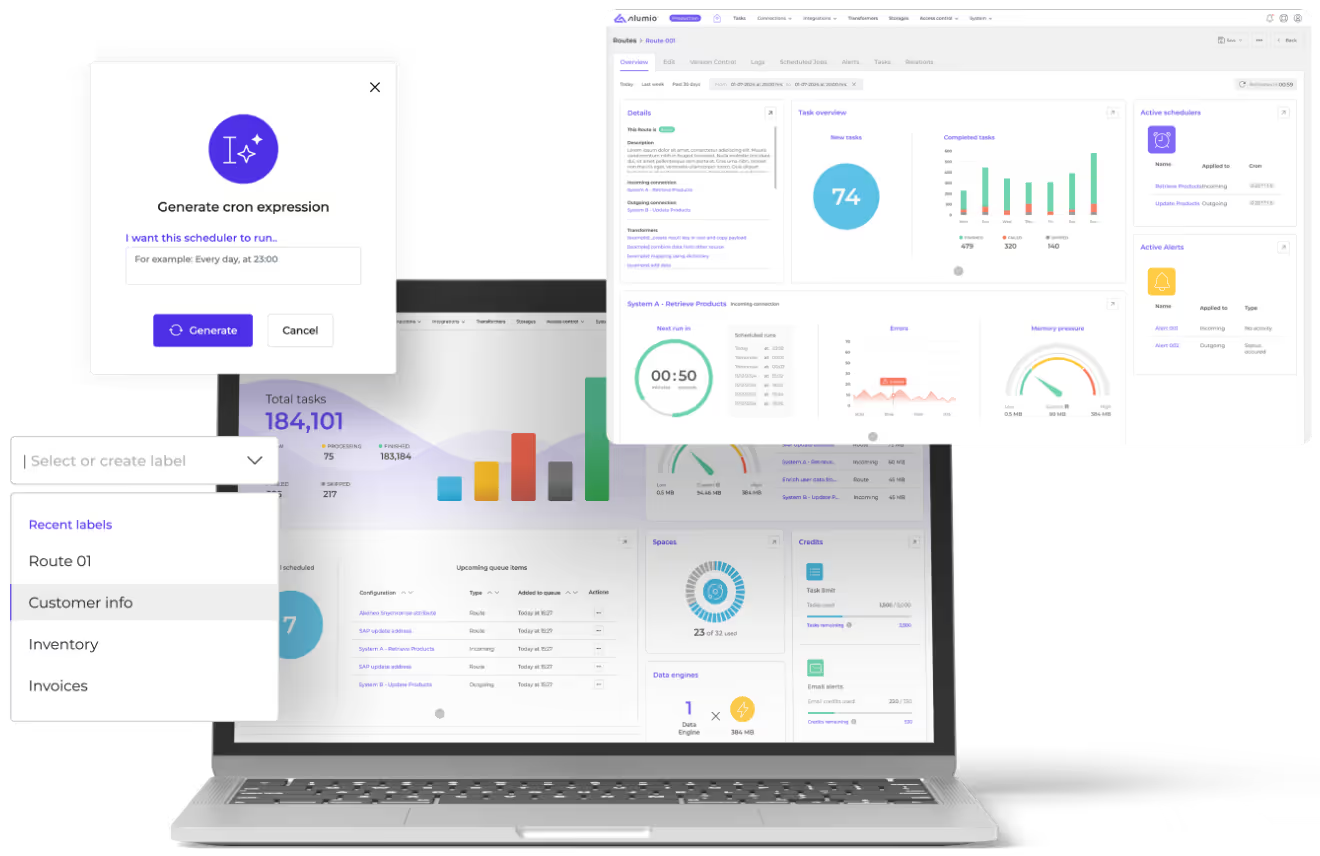
  • Log and monitor integrations for debugging and governance
  • Scale orchestration without custom code or fragile point-to-point connections

In essence, iPaaS acts as the nervous system for your AI: it tells your tools when to fire, where to send data, and how to work together in real time. Without iPaaS, businesses often fall into the trap of duct-taping systems together, creating brittle, unscalable architectures that can’t support intelligent automation.


Learn more about the role of iPaaS in AI here.

Turn AI ambition into action

Get a free demo of the Alumio platform

How to build your first AI-driven orchestration (without breaking things)

Curious where to start? Here's a proven, low-risk playbook used by modern IT teams:

  1. Find the friction
    Identify repetitive tasks, frequent handovers, and manual data entry, especially in high-volume areas like support, invoicing, or lead routing. These are ideal candidates for orchestration because they follow consistent logic and drain valuable time.
  2. Connect your systems
    Use an iPaaS like Alumio to unify your stack: CRM, ERP, helpdesk, marketing automation, and beyond. A strong integration layer ensures clean, real-time data flow, which is essential for context-aware AI. Without this, even the best models produce inconsistent or irrelevant outputs.
  3. Start small with logic
    Begin with deterministic, rule-based flows (“If X, then route to Y”) to stabilize your automation layer. Once your flows are reliable, layer in AI models, like NLP for sentiment detection or LLMs for data classification, triggered from within your iPaaS.
  4. Test in the background
    Run AI in shadow mode first: allow models to suggest outcomes while humans still act. Use your iPaaS logs to compare accuracy, speed, and consistency. This lets you fine-tune without risking customer experience or compliance.
  5. Scale smartly
    When AI reliably outperforms manual workflows, promote those decisions to full automation. Start with low-risk flows, such as internal tagging or lead scoring, then expand to high-impact use cases based on measurable success.

Strong systems first, smart AI second

Let’s be clear: not everything should be automated, and AI isn’t here to steal the spotlight. When done right, orchestration turns AI into a silent force, streamlining operations, accelerating decisions, and enhancing experiences without adding complexity. Your teams feel less friction. Your systems work in sync. And your customers get faster, more accurate outcomes, often without realizing AI was involved at all.

But that kind of impact doesn’t start with flashy interfaces or standalone tools. As Sander Bast and Marten Schilstra from Enrise have shown, the most powerful AI is invisible by design, embedded deep into workflows through strong integrations, clean data, and smart orchestration. That’s the foundation. Without it, even the most advanced models will fall short.

So before you build a chatbot, build the plumbing. Lay the groundwork that enables AI to adapt, act, and scale across your business in real time.

Ready to see what AI orchestration can do for your business? Book a demo or schedule a consultation with us.

Connect with popular apps!

No items found.
Topics in this blog:

FAQ

Integration Platform-ipaas-slider-right

Want to see Alumio in action?