


A Alumio vivid purple arrow pointing to the right, a visual representation of how to access more page material when clicking on it.
Go back

Benefits of replatforming for online businesses

By
Saad Merchant
Published on
February 7, 2025
Updated on
June 24, 2026
IN CONVERSATION WITH
Email icon
Email icon

Consider this: countless online retailers are clinging to outdated, monolithic platforms that simply can't keep pace with today’s consumer demands. When SAP announced its shift from its legacy SAP ECC system to SAP S/4 HANA, it sent a clear message — sticking with old systems can stifle growth and innovation. Relying on legacy infrastructure in today’s cloud-based, API-driven digital landscape hampers operational efficiency and leaves businesses vulnerable to market disruptions and security risks. Thus, replatforming emerges as a strategic imperative to help modern businesses modernize their business systems by opting for more user-friendly, secure, and leaner applications with more flexible architectures. This blog delves into the transformative benefits of replatforming that help your business remain agile in the face of change.

The benefits of replatforming for online businesses

Picture a Fortune 500 retailer still running its e-commerce site on a 15-year-old platform. Orders take seconds longer to process than competitors. Inventory syncs lag. Mobile users abandon carts at twice the industry rate. This isn’t a hypothetical — it’s the reality for businesses clinging to legacy systems while rivals leverage cloud-native agility. With rapidly evolving consumer expectations and emerging technologies, outdated platforms can quickly become a liability. This is why replatforming isn’t just an IT project — it’s a boardroom-level strategy to future-proof revenue streams and operational resilience.

What is replatforming, and why does it matter?

Replatforming is the strategic process of moving your existing digital system — be it a website, application, or overall infrastructure — from an outdated or legacy platform to a modern, agile one. Unlike routine updates or patches, replatforming involves a comprehensive overhaul of your tech stack to ensure seamless adoption of evolving market trends and consumer expectations. It can include integrating advanced applications, transitioning to cloud-native environments, advanced content management systems, or microservices-based frameworks.

This transformation via replatforming not only enhances performance and scalability but also improves user experiences and bolsters security, ensuring that businesses can adapt quickly to evolving market demands and technological advancements. As such, there are wide-ranging benefits of replatforming for online businesses that result in enhanced operational efficiency, user experiences, and future-proof success.

However, before we dive into the benefits of replatforming for online businesses, let’s first explore the challenges and causes for it.

Key challenges of legacy systems needing replatforming

  • Scalability issues: Traditional monolithic systems often struggle to support growth and increased transaction volumes.
  • Poor user experience: Outdated interfaces and slow response times can deter potential customers.
  • Operational inefficiencies: Manual workflows and legacy integrations hinder efficiency and innovation.
  • Security risks: Older platforms may not be equipped with the latest security features, leaving your business vulnerable.

By addressing these challenges head-on, replatforming offers a pathway to a more resilient, flexible, and secure digital ecosystem. Let’s explore its benefits and how it leads to much more measurable ROI along with modernization.

What are the core benefits of replatforming?

The benefits of replatforming for online businesses entail a myriad of advantages that can significantly enhance an online business’s performance:

1. Enhanced scalability

Modern platforms are built with scalability in mind. By moving away from rigid, monolithic systems, online businesses can easily integrate new tools and features as they grow. This modular approach allows for connecting best-of-breed applications with ease, and it also comes with the flexibility to adapt to market changes without a full system overhaul.

2. Improved user experience

User experience is at the heart of digital success. A replatformed system with modern infrastructure can deliver better load times, ensuring faster website and app performance. Newer platforms present with intuitive designs, which present streamlined navigation and user-friendly interfaces that lead to higher engagement and conversion rates. This also includes responsive designs that are optimized to cater to the growing mobile audience. Enhanced features such as personalized recommendations, better search capabilities, and easier checkout processes lead to higher customer satisfaction and loyalty.


Turn AI ambition into action

Portrait of Leonie Becher Merli, Business Development Manager at Alumio

Get a free assessment of your integration needs and next steps

Portrait of Leonie Becher Merli, Business Development Manager at Alumio

3. Better integration and flexibility

Replatforming with modern cloud-native, API-first platforms allows businesses to integrate their websites seamlessly with modern third-party tools and services. This can involve integrating with customer relationship management (CRM), product information management (PIM), marketing automation, analytics, and inventory applications. Quickly adapt to new market trends such as AI, machine learning, and microservices architectures. Furthermore, the flexibility and customization offered by new platforms allow you to tailor the online store to your specific business needs, keeping you agile in a competitive market.

4. Cost efficiency and operational savings

While replatforming requires an initial investment, it often leads to long-term savings by reducing the maintenance and operational costs associated with outdated systems. By optimizing resource usage, many modern platforms operate on a pay-as-you-go model, meaning you only pay for what you use. Most new platforms automate routine business processes, helping significantly cut down on labor and error fixing.

5. Enhanced data security and compliance

Security is a critical concern for any online business. Upgrading to a contemporary platform means you can take advantage of advanced, built-in security measures. Modern solutions typically include robust encryption, regular security updates, and compliance with industry standards (such as PCI or GDPR), which protect both your business and your customers’ sensitive data. This reduces the risk of data breaches and builds customer trust. Newer platforms and applications enhance protection against cyber threats, deliver constant improvements to guard against vulnerabilities, and some even provide tools to ensure data privacy and regulatory compliance.

Strategic approach to replatforming

Transitioning to a new platform might sound daunting, but a strategic, phased approach can mitigate risks and ensure a smooth transition. Consider these best practices:

  • Conduct a comprehensive audit: Evaluate your current systems and identify pain points.
  • Plan incremental migration: Avoid disruption by transitioning in stages.
  • Leverage modern integration tools: Use API-driven platforms or iPaaS solutions to bridge new and legacy systems.
  • Test rigorously: Ensure each phase of the migration meets performance and security benchmarks before full-scale rollout.

Future-proof your business with replatforming

Replatforming is not a one-time event — it’s an ongoing commitment to innovation and growth. By embracing a modern, flexible architecture, online businesses can continually evolve to meet emerging challenges and seize new opportunities.

In conclusion, replatforming is far more than a routine IT upgrade — it’s a strategic transformation that empowers online businesses to thrive in a rapidly evolving digital landscape. By replacing outdated, monolithic systems with agile, cloud-native platforms, companies not only boost performance and scalability but also deliver superior customer experiences and fortify their security posture. This shift enables businesses to integrate cutting-edge tools and services seamlessly, reduce long-term operational expenses, and position themselves to respond nimbly to emerging market trends. Ultimately, replatforming is a proactive investment in future-proofing your business, ensuring that you remain competitive and resilient against disruptions.

No items found.
Topics in this blog:

FAQ

Integration Platform-ipaas-slider-right
What is e-commerce replatforming and what triggers the decision?

E-commerce replatforming is the process of migrating an online store from one platform to another. The decision is typically triggered by: the current platform's inability to support new business requirements (international expansion, B2B functionality, headless delivery), poor performance and scalability limitations, excessive customization complexity that has accumulated over years, end-of-life announcements from the platform vendor (as with SAP ECC's 2027 sunset), or a strategic shift toward composable commerce that requires a more API-friendly platform architecture.

Integration Platform-ipaas-slider-right
What are the main benefits of replatforming for online businesses?

The main benefits are: improved performance and customer experience (faster load times, better mobile UX, modern checkout flows), greater flexibility to add new channels, markets, and capabilities without the constraints of the legacy platform, reduced maintenance overhead (modern platforms require less custom development to maintain), better integration with the modern SaaS ecosystem (APIs rather than plugins), and the ability to pursue composable commerce or headless architecture strategies that monolithic platforms cannot support.

Integration Platform-ipaas-slider-right
What are the biggest risks of e-commerce replatforming projects?

The biggest risks are: SEO impact (URL structure changes causing ranking losses if redirects are not correctly implemented), data migration errors (customer records, order history, product data not transferring accurately), integration regression (existing integrations with ERP, PIM, WMS needing to be rebuilt for the new platform), timeline and budget overruns (replatforming projects consistently underestimate integration complexity), and business continuity risk during cutover (running both platforms simultaneously until the new one is fully stable). Managing these risks requires careful planning, particularly for integration migration.

Integration Platform-ipaas-slider-right
How does an integration platform like Alumio support e-commerce replatforming?

Alumio supports replatforming by providing connector templates for both the old and new platforms, allowing the integration team to build new Routes for the new platform while the old platform remains live. The integration logic (data transformation, business rules, error handling) stays in Alumio rather than being rebuilt in each platform's native integration framework. When the cutover happens, the Alumio Routes are switched to the new platform's connector rather than requiring a complete integration rebuild, significantly reducing the integration risk and timeline of the replatforming project.

Integration Platform-ipaas-slider-right
How do businesses avoid SEO loss during a replatforming project?

Avoiding SEO loss during replatforming requires: auditing all existing URLs and implementing 301 redirects from old URLs to their equivalents on the new platform, preserving meta titles, descriptions, and structured data from the existing site, submitting the new sitemap to Google Search Console immediately after launch, monitoring crawl errors and redirect chains in the weeks following launch, and avoiding URL structure changes wherever possible (keeping existing URLs on the new platform is always lower risk than implementing redirects). The post-launch monitoring period is as important as the pre-launch preparation for protecting organic rankings.

Integration Platform-ipaas-slider-right
When is replatforming to a composable or headless architecture the right choice?

Replatforming to composable or headless architecture is the right choice when the current platform's front-end constraints are directly limiting new customer experience initiatives, when the business needs to deliver consistent experiences across multiple touchpoints a traditional theme cannot support, or when the platform's release cycle and customization complexity are creating a development bottleneck. It requires significantly more integration investment than a like-for-like platform migration, so the decision should be driven by concrete business constraints rather than architectural preference alone.

Get a free assessment of your integration needs

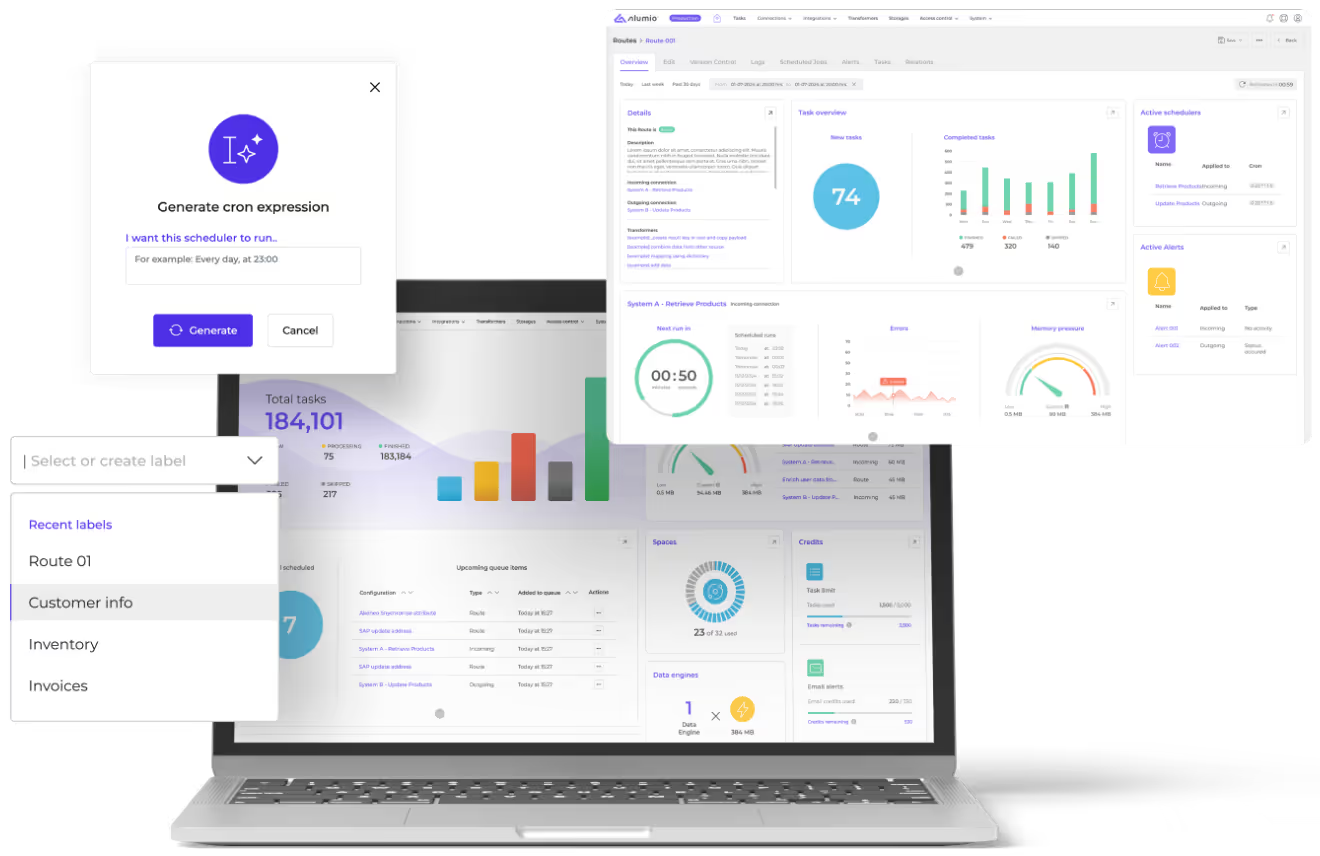
Laptop screen displaying the Alumio iPaaS dashboard, alongside pop-up windows for generating cron expressions, selecting labels and route overview.