

A Alumio vivid purple arrow pointing to the right, a visual representation of how to access more page material when clicking on it.
Go back

iPaaS vs CSB: Discover the differences

By
Carla Hetherington
Published on
April 23, 2023
Updated on
June 24, 2026
IN CONVERSATION WITH
Email icon
Email icon

The last decade has seen a steady rise in cloud adoption, and it will not slow down any time soon. In fact, the cloud has remained the reigning buzzword in the digital landscape and has played a crucial role in enterprises' digital optimization and transformation worldwide. Today, a sizable portion of responsibilities related to data infrastructure, hosting, security tasks, and others have been replaced by cloud services. However, the rapid evolution of cloud computing has brought with it an increasingly complex integration of cloud services, often too intricate for end users to manage independently. As a result, new concepts like iPaaS (integration Platform as a Service) and CSB (Cloud Services Brokerage) have gained relevance as they aim to simplify cloud computing for modern businesses. Although these concepts both involve the integration of different cloud services and applications, they suit different purposes. Keep on reading to find out more!

What is CSB?

Cloud Services Brokerage (CSB) is a business model in which a company or other entity acts as a third-party intermediary to negotiate relationships between cloud providers and consumers, thus helping organizations manage and optimize their cloud services from multiple providers. A cloud broker is, in this way, a middleman between cloud solution vendors and consumers. While end-users can directly approach the cloud solution providers, they may want experienced and professional guidance to ensure the optimal functioning of cloud services.

What are the benefits of using CSB?

  • Enhanced cloud service management

By offering a central location for all inquiries, issues, and requests related to the cloud, CSB aids organizations in effectively managing their cloud services. As such, cloud brokers are frequently employed to evaluate services from various providers, and they provide invaluable insights on better leveraging cloud services to drive an organization’s digital innovation.

  • Cost optimization

Organizations can improve their cloud cost efficiency with the assistance of CSB, which offers an analysis of cloud usage and performance, pinpoints cost-saving opportunities, and negotiates improved pricing with cloud service providers. In this way, CSB ensures the production of a unified cloud strategy that aligns various facets of a business with IT capabilities.

  • Integration

CSB can assist organizations in seamlessly integrating their cloud services with other IT systems and applications, facilitating intercommunication and data exchange between various systems and cloud services.

  • Flexibility and scalability

With the capability to add or remove cloud services as required, scale cloud resources up or down, and support new business ventures with cloud-based solutions, CSB offers organizations the adaptability and scalability necessary to respond to evolving business needs and IT requirements.

  • Security and compliance

By monitoring cloud usage for security threats, managing access controls, and ensuring adherence to data protection and privacy regulations, CSB can assist organizations in guaranteeing the security and compliance of their cloud services.

What is an iPaaS?

The iPaaS (integration Platform as a Service) is a cloud-based integration platform that enables companies to connect any two or more systems, SaaS solutions, cloud applications, or data sources from one central hub. As such, it provides a range of tools and services for connecting, mapping, and transforming data between various applications and systems.

What is the Alumio iPaaS?

Designed to supersede the problems of complex integrations, the Alumio iPaaS emerged as a leading solution to help significantly lower the technical threshold for creating integrations. As a low-code integration platform, it enables businesses to integrate two or multiple software solutions from one user-friendly interface, without any custom coding, and across on-premise or cloud environments.

Get a comprehensive overview of how the Alumio iPaaS works.

What are the differences between an iPaaS and CSB?

CSB (Cloud Services Brokerage) and iPaaS (Integration Platforms as a Service) serve distinct yet complementary roles in the realm of cloud computing:

CSB primarily focuses on providing a centralized intermediary layer between cloud service providers and end-users, offering services like procurement, aggregation, integration, and management of diverse cloud services. In contrast, an iPaaS specializes in facilitating the integration of various applications and systems within an organization’s IT infrastructure, enabling seamless data exchange and workflow automation.

As such, while CSB emphasizes service aggregation and management across multiple cloud providers, an iPaaS is more concerned with streamlining internal processes through efficient application integration. Thus, CSB caters to a broader spectrum of cloud service needs, whereas iPaaS targets specific integration challenges within an organization, meaning an iPaaS could well be part of CSB service provision, as it is the tool needed to connect various cloud apps seamlessly.

Conclusion

In a nutshell, Cloud Service Brokerage (CSB) acts as an intermediary between cloud service providers and their end-users, assisting businesses (the end-users) in selecting tailored offerings and services to fit their requirements. CSB also helps integrate and deploy applications in a multi-cloud environment and can include an iPaaS like Alumio as a component of its service provision, together with other cloud management and optimization services.

While each organization will have different business needs, the backbone of an efficient cloud integration strategy is an integration platform that can empower growth and profitability. The main motivations behind implementing cloud strategies are, for the most part, decreasing hardware costs, lessening management burdens, obtaining desired deployment times, and promoting scalability. With Alumio, businesses have access to all of this and more.

Interested in reaping the benefits of the cloud with our flexible platform? Request a free demo and empower your digital growth with Alumio!


Turn AI ambition into action

Portrait of Leonie Becher Merli, Business Development Manager at Alumio

Get a free assessment of your integration needs and next steps

Portrait of Leonie Becher Merli, Business Development Manager at Alumio

No items found.
Topics in this blog:
No items found.

FAQ

Integration Platform-ipaas-slider-right
What is Cloud Service Bus (CSB) and how does it differ from iPaaS?

Cloud Service Bus (CSB) is a cloud-hosted version of the traditional Enterprise Service Bus (ESB) pattern: providing message routing, transformation, and protocol mediation as a cloud service rather than on-premise middleware. An iPaaS (Integration Platform as a Service) is more complete: it combines service bus messaging capabilities with API management, event-driven integration, prebuilt application connectors, and config-first development environments. The key difference is scope and accessibility: CSB is primarily an infrastructure-level messaging service requiring integration development expertise to use effectively; iPaaS provides a full integration platform with application connectors and config-first tooling that reduces the specialist expertise required for business-level integration development.

Integration Platform-ipaas-slider-right
What are the advantages of iPaaS over CSB for modern digital commerce integration?

iPaaS advantages over CSB for digital commerce include: prebuilt application connectors that connect to specific SaaS and enterprise systems without requiring custom development, config-first Transformer components for data mapping that reduces the coding expertise required compared to CSB message transformation, a growing connector library that extends coverage as new systems are added to the landscape, monitoring and audit logging designed for business operations teams (not just IT infrastructure teams), and pricing models suited to mid-market organizations rather than large enterprise infrastructure budgets. For connecting Shopify to SAP or Akeneo to Adobe Commerce, iPaaS delivers faster time-to-integration with lower specialist expertise requirements than CSB.

Integration Platform-ipaas-slider-right
When would a business choose CSB over iPaaS?

A business might choose CSB when: the integration requirement is primarily high-throughput message queuing and routing at the infrastructure level (event streaming, IoT message processing) rather than business application integration, the organization has existing investment in CSB infrastructure it wants to extend to the cloud, the integration patterns required are more aligned with messaging infrastructure (pub-sub, message durability, dead letter queuing) than with application-level data exchange, or the existing team has deep CSB expertise and the transition to iPaaS tooling represents more retraining cost than value. For most business-application integration use cases in digital commerce, iPaaS is the more appropriate and accessible choice.

Integration Platform-ipaas-slider-right
How does cloud adoption drive the shift from ESB to iPaaS?

Cloud adoption drives the ESB-to-iPaaS shift because: on-premise ESB infrastructure becomes architecturally misaligned when connected systems migrate to cloud (ESB routing traffic between cloud systems through on-premise infrastructure is inefficient), cloud-native SaaS applications have REST APIs that iPaaS connectors handle natively but ESB adapters require custom development for, the cloud subscription model aligns better with the operational expense model that cloud-first organizations prefer over ESB's large upfront licensing costs, and the cloud-native scalability of iPaaS handles variable workloads automatically without the capacity planning that on-premise ESB requires. Organizations completing cloud migrations simultaneously see the opportunity to replace aging ESB with cloud-native iPaaS.

Integration Platform-ipaas-slider-right
What is the migration path from CSB or ESB to an iPaaS like Alumio?

Migration from CSB or ESB to Alumio follows a documented-first approach: map all existing integration flows managed by the bus (what connects to what, what transformations apply, what routing rules exist), prioritize which to migrate based on business criticality and technical fragility, build the equivalent Alumio Routes using prebuilt connector templates where available, run both the bus and Alumio Routes in parallel during validation to confirm equivalent behavior, and progressively decommission bus routes as Alumio Routes are confirmed stable. The migration is often pursued alongside a broader cloud migration program, combining system and integration modernization for efficiency.

Integration Platform-ipaas-slider-right
How does Alumio handle the messaging and routing capabilities traditionally provided by CSB?

Alumio handles messaging and routing through its Route architecture: event-driven Routes with webhook triggers replace pub-sub messaging patterns for real-time integration, scheduled Routes replace periodic batch message processing, retry and dead-letter queue functionality handles message delivery failures, and conditional routing logic in Routes replaces content-based message routing rules. For very high-throughput event streaming scenarios (IoT, high-frequency financial transactions), dedicated event streaming platforms (Kafka, Azure Event Hub) may supplement Alumio as the application integration layer above the streaming bus. For the typical business application integration patterns of digital commerce organizations, Alumio's Route architecture covers the CSB messaging patterns without requiring a separate message bus.

Get a free assessment of your integration needs

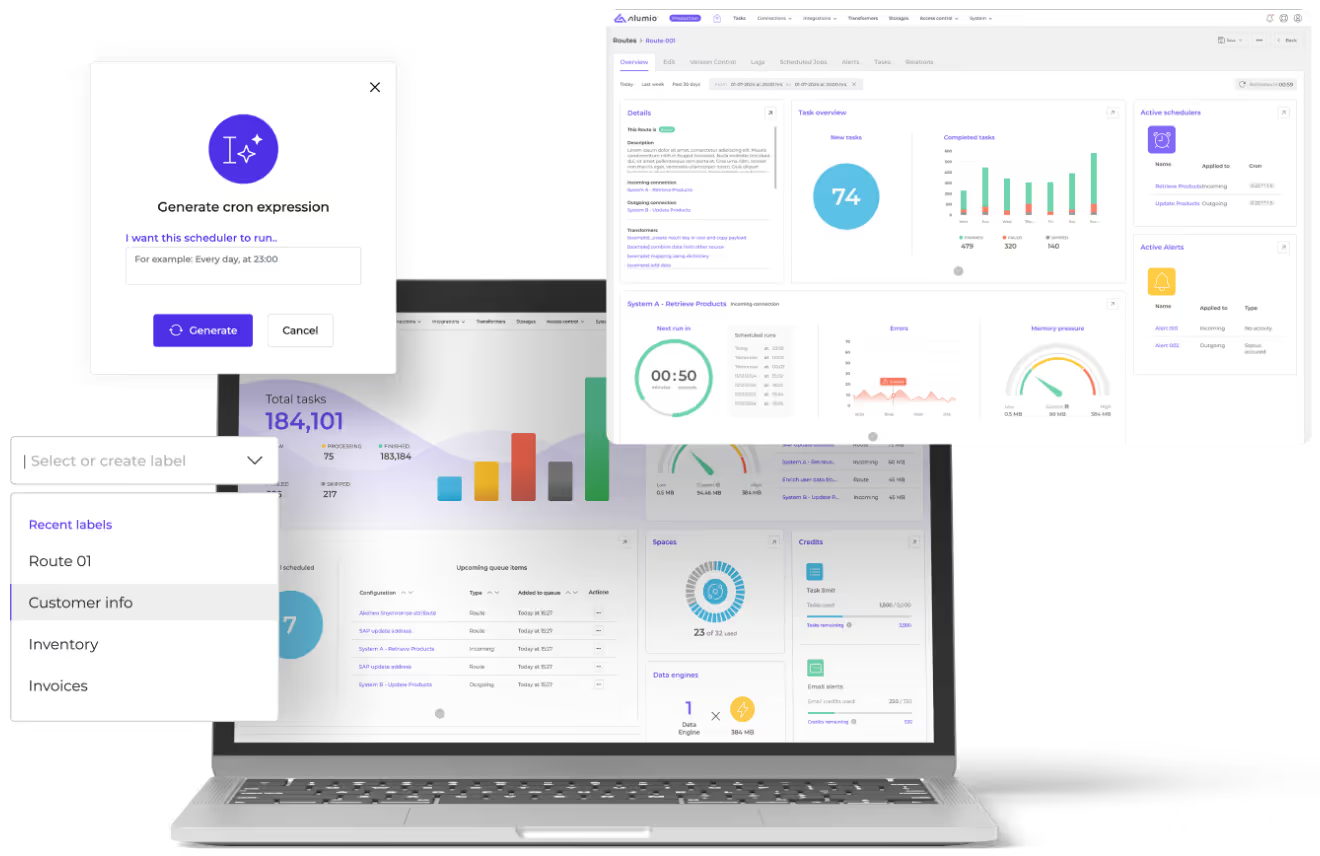
Laptop screen displaying the Alumio iPaaS dashboard, alongside pop-up windows for generating cron expressions, selecting labels and route overview.