

A Alumio vivid purple arrow pointing to the right, a visual representation of how to access more page material when clicking on it.
Go back

What are the benefits of moving to the cloud?

By
Carla Hetherington
Published on
April 23, 2023
Updated on
June 24, 2026
IN CONVERSATION WITH
Email icon
Email icon

In recent years, cloud computing has revolutionized the way in which businesses operate. The reason behind this revolution is that the cloud offers many benefits, including scalability, cost-effectiveness, and flexibility. However, migrating to the cloud can be a daunting task for many, especially for businesses with complex IT environments. Fortunately, Alumio presents the perfect solution to this problem: a cloud-native integration platform that can empower business growth through cloud migration. Keep on reading to learn more!

What are the main benefits of migrating to the cloud?

Moving to the cloud has many benefits. Here are the most valued by businesses:

  • Scalability: Cloud computing allows businesses to scale up or down quickly and easily, supporting larger workloads and users than on-premises software while fostering adaptation to changes in demand or growth without having to invest in expensive physical servers, software licenses, storage and network equipment.
  • Cost-effectiveness: Companies that migrate to the cloud spend significantly less money on IT operations. By eliminating the need for on-premises servers, businesses can save on hardware, maintenance, and energy costs. Additionally, cloud computing allows businesses to pay only for the resources they need, which can be significant cost savings compared to traditional on-premises solutions. Instead, companies can devote more resources to developing new products or enhancing existing ones.
  • Flexibility: Cloud computing provides businesses with the flexibility to access their data and applications from anywhere with an internet connection, improving performance and end-user experience.
  • Security: Cloud providers invest heavily in security measures to protect their customers' data. This means that businesses can benefit from enterprise-level security features without having to invest in their own security infrastructure. Additionally, in the event of a natural disaster or cyberattack, businesses can quickly recover their data and applications from the cloud, where they are securely stored.
  • Enhanced performance: By migrating to the cloud, businesses can leverage the latest technologies and innovations to remain competitive and relevant in their industry. Being on the cloud allows businesses to quickly adopt new technologies and services, providing them with a competitive edge over their competitors to outpace them easily.

How can Alumio empower business growth through cloud migration?

While each business will have different priorities and varying approaches to fulfilling said priorities, the backbone of any successful cloud migration for modern businesses is a cloud-based integration platform or the iPaaS (integration Platform as a Service) that can ensure seamless connectivity, empower growth, and foster profitability.

Alumio helps businesses rapidly migrate and unify all their systems, applications, and data in one secure cloud environment. It enables businesses to seamlessly develop, govern, and orchestrate system integrations with multiple cloud apps and SaaS solutions via one user-friendly interface.

Learn more about the benefits of growing your business on the cloud with Alumio iPaaS ->

Conclusion

In a nutshell, the benefits of migrating to the cloud are to host applications and data in the most effective, secure, and flexible IT environment possible, based on factors such as cost-effectiveness, increased performance, and guaranteed security, among others. If you are interested in migrating your business to the cloud but are afraid this transition may be too sudden, expensive, or complex, get in touch with us and we will put your mind at ease! Cloud migration is simple with Alumio.


Turn AI ambition into action

Portrait of Leonie Becher Merli, Business Development Manager at Alumio

Get a free assessment of your integration needs and next steps

Portrait of Leonie Becher Merli, Business Development Manager at Alumio

No items found.
Topics in this blog:
No items found.

FAQ

Integration Platform-ipaas-slider-right
What are the main benefits of moving business operations to the cloud?

The main benefits of cloud migration are: scalability without infrastructure investment (cloud resources scale with business demand rather than requiring hardware procurement), cost efficiency (operational expense model replaces large capital expenditure, and idle resources are not paid for), geographic accessibility (teams and systems anywhere can access cloud-hosted applications), automatic software updates and security patching (reducing the operational overhead of on-premise maintenance), disaster recovery (cloud redundancy provides resilience that on-premise hardware often lacks), and the integration advantage that cloud-native applications offer: standard REST APIs that integration platforms like Alumio connect to more easily than legacy on-premise protocols.

Integration Platform-ipaas-slider-right
What are the challenges of cloud migration that businesses must plan for?

Cloud migration challenges include: data security and compliance (ensuring cloud-hosted data meets GDPR, industry regulations, and organizational security standards), integration reconfiguration (existing integrations built for on-premise systems often need updating for cloud versions), cost management (cloud costs can exceed projections when consumption patterns are poorly understood), performance for latency-sensitive workloads (some applications perform better when data is local rather than in the cloud), organizational change management (teams must adapt to new operational models), and the risk of vendor lock-in when relying heavily on a single cloud provider's proprietary services.

Integration Platform-ipaas-slider-right
How does an integration platform support cloud migration?

An integration platform supports cloud migration by providing connectors for both on-premise and cloud versions of business systems, enabling parallel operation during migration. When migrating from SAP ECC (on-premise) to S/4HANA Cloud, Alumio's connectors for both versions allow the organization to route data through both systems simultaneously during the transition period, validating that the cloud system produces equivalent results before decommissioning the on-premise instance. Cloud-native iPaaS architecture also means the integration platform itself does not require migration: it already runs in the cloud and connects to on-premise systems via API or file-based protocols where APIs are unavailable.

Integration Platform-ipaas-slider-right
What cloud migration approach is recommended for businesses with complex integration landscapes?

For businesses with complex integration landscapes, the recommended approach is: audit all existing integrations before migration begins (documenting which connect to which systems and what protocols they use), identify which integrations will be affected by each planned system migration, build and test cloud-version connections in parallel with on-premise connections before cutover, migrate systems in priority order (non-critical first, business-critical last with the longest parallel-run periods), and treat the integration platform as the migration governance layer that provides visibility into data equivalence between old and new systems during each transition phase.

Integration Platform-ipaas-slider-right
How does Alumio specifically help businesses with the cloud migration integration challenge?

Alumio helps with cloud migration integration by providing: connectors for both on-premise legacy systems (SAP ECC via BAPIs and IDocs) and their cloud replacements (S/4HANA via REST APIs), support for both cloud-to-cloud and hybrid (cloud-to-on-premise) integration patterns, the ability to run old and new system connections in parallel during migration validation, and a cloud-native platform that does not itself require migration when the organization moves to cloud. The config-first architecture means adapting integration logic when systems change (different API versions, different data models in the cloud version) is a configuration update rather than a code rewrite.

Integration Platform-ipaas-slider-right
What integration-specific best practices apply to cloud migration projects?

Integration-specific best practices for cloud migration are: document all on-premise integration protocols before migration (SFTP feeds, file-based interfaces, database-level connections that will not work in cloud) so cloud-compatible alternatives are designed in advance, test cloud system API rate limits early (cloud APIs often have different rate limits than on-premise APIs and integration flows may need rate management configuration), validate that data that was previously local is now handled with appropriate encryption and access controls in the cloud integration layer, and plan for the changed latency profile of cloud APIs (on-premise API calls may return in milliseconds; cloud calls may add network latency that requires integration timeout configuration updates).

Get a free assessment of your integration needs

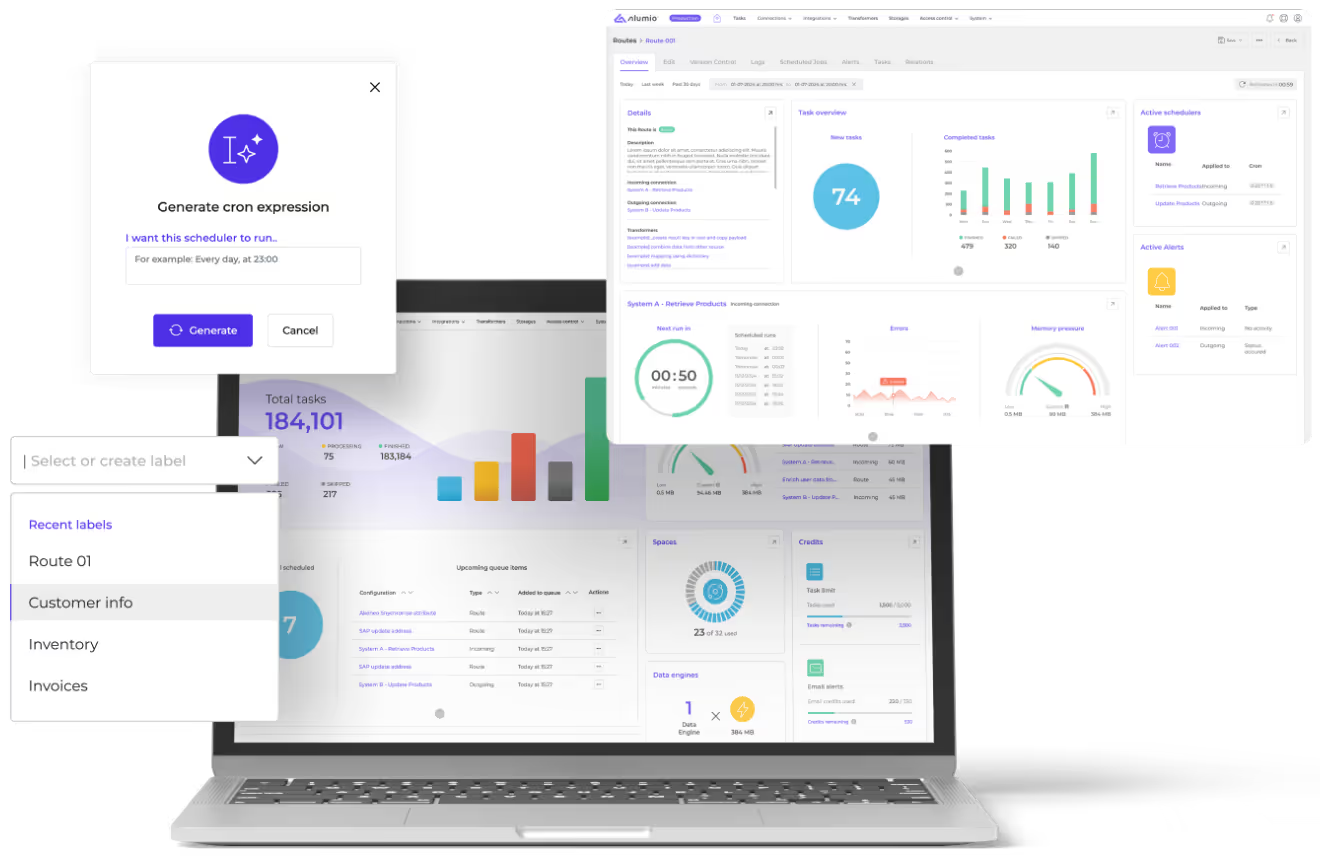
Laptop screen displaying the Alumio iPaaS dashboard, alongside pop-up windows for generating cron expressions, selecting labels and route overview.