

A Alumio vivid purple arrow pointing to the right, a visual representation of how to access more page material when clicking on it.
Go back

Ensure business continuity & prevent system crashes

By
Carla Hetherington
Published on
July 6, 2023
Updated on
June 24, 2026
IN CONVERSATION WITH
Email icon
Email icon

Downtime caused by system crashes can severely harm businesses, causing significant financial losses that may be irreversible. So, how can businesses avoid this? The answer is quite simple: with a reliable platform that ensures business continuity and avoids system crashes. Want to know the full story? Keep on reading!

What are the effects of system crashes?

According to Gartner, a business can lose around $5,600 per minute due to system crashes, which extrapolates to well over $300K p/hour.

Do these numbers scare you? If not, they should, and there are many more where that came from:

In March 2015, Apple suffered a 12-hour outage that cost the company $25 million.

In August 2016, Delta Airlines underwent a five-hour power outage in an operation center, causing 2,000 cancelled flights and an estimated loss of $150 million.

In March 2019, Facebook experienced a 14-hour outage that cost the company an estimated $90 million.

Although these numbers are nothing short of shocking, they belong to huge enterprises with vast financial resources and big operating margins. As such, these companies can handle short-term financial challenges and quickly make up for the losses in ways smaller companies simply cannot.

However, to smaller companies, especially startups, any downtime can be detrimental and even fatal. Thus, the lesson is straightforward: downtime, at any rate, can have an irreversible impact on businesses and must, therefore, be avoided at any cost.

How can you avoid system crashes and downtime?

The way to avoid this is simple: having a reliable platform that ensures business continuity and uptime.

Alumio is a low-code integration platform as-a-service (iPaaS) that connects multiple software, cloud apps, and data sources, guaranteeing seamless workflow automation and uninterrupted data synchronization.

How does Alumio prevent system crashes and ensure business continuity?

  • Real-Time Synchronization: Alumio can synchronize data in real-time, ensuring that changes made in one system are immediately reflected in another system. This is especially useful for applications that require real-time updates, such as e-commerce sites.
  • Process huge data loads: Alumio can handle large volumes of data through batch processing, optimizing performance and reducing the load on systems, thus avoiding system crashes. To add to this, Alumio’s queueing mechanism prevents your IT systems from overloading with data peaks by breaking data down into many queues and sub-queues that can be processed chronologically, as required by an endpoint. Additionally, Alumio helps normalize huge data loads across integrations using data entities like JSON, CSV, and XML in all kinds of data structures.
  • Data visibility: Alumio centralizes data and integrations on a single interface, providing 360-degree insights at all times that improve detection capabilities in the event of an error, prevent data silos, and facilitate the secure expansion of your IT landscape.
  • Secure environment for your data: Alumio safeguards your data to protect it from system crashes that can disrupt business operations. It offers a configurable option to centralize and store your data on dedicated cloud space, providing remote access and protection against on-premises data loss caused by accidents, fire, or water damage. Additionally, it enables secure data migration, remote system redeployment, and simplified monitoring of data security through automated logging.
  • Reactivation procedures: Alumio has reactivation procedures in case of system crashes and buffers and caches data to ensure business continuity

Among others, these are the key benefits that Alumio provides that ensure IT infrastructural insurance, especially when it comes to system crashes, massive orders during peak seasons, or other unexpected back-office failures.

In conclusion...

System crashes can have severe consequences for businesses, and thus must be avoided at all costs. The most cost-effective and future-proof way to avoid them? A reliable platform like Alumio.

Alumio offers real-time synchronization, the ability to handle large data loads, centralized data visibility, a secure environment for data, and reactivation procedures in case of system crashes. These features provide optimal IT infrastructural insurance, protecting businesses from the impacts of system crashes and unexpected failures. By implementing a robust platform like Alumio, businesses can minimize downtime, prevent financial losses, and maintain uninterrupted operations.

Looking to discover how Alumio ensures business continuity? Get a personalized demo of our integration platform -> 

Turn AI ambition into action

Portrait of Leonie Becher Merli, Business Development Manager at Alumio

Get a free assessment of your integration needs and next steps

Portrait of Leonie Becher Merli, Business Development Manager at Alumio

No items found.
Topics in this blog:
No items found.

FAQ

Integration Platform-ipaas-slider-right
What are the business consequences of system crashes and integration downtime?

System crashes and integration downtime cause measurable financial harm: according to Gartner, IT downtime costs organizations an average of $5, 600 per minute. For e-commerce operations, downtime means lost orders, unfulfilled customer expectations, and customer service overload from status inquiries. Integration downtime specifically (when data stops flowing between connected systems) can cause inventory discrepancies, missed order processing windows, and financial reconciliation failures that persist long after the underlying system recovers.

Integration Platform-ipaas-slider-right
How does Alumio help ensure business continuity for integration-dependent operations?

Alumio ensures business continuity through several platform features: automatic retry logic for failed data exchanges (records are retried rather than dropped when a connected system is temporarily unavailable), maintenance window scheduling (Routes pause gracefully during planned downtime rather than generating error floods), a replay queue for failed records (any record that did not process correctly can be replayed once the system is restored), and real-time monitoring with alerting (failures are surfaced immediately rather than discovered through customer complaints).

Integration Platform-ipaas-slider-right
How does Alumio handle temporary system unavailability without losing data?

When a connected system is temporarily unavailable, Alumio does not drop the data being sent to it. Instead, the platform buffers records in a queue and retries delivery according to a configurable retry schedule. Once the system comes back online, queued records are processed in order, and the full audit log shows what happened to each record during the unavailability window. This means a 30-minute ERP maintenance window does not result in 30 minutes of lost orders: it results in a brief delay and then full recovery.

Integration Platform-ipaas-slider-right
What is a maintenance window in the context of integration platforms?

A maintenance window in an integration platform is a scheduled period during which a specific Route or system connection is paused to accommodate planned downtime on the connected system. Rather than allowing integration flows to generate error alerts during known maintenance, the platform pauses gracefully and resumes automatically when the maintenance window ends. Alumio's maintenance window feature allows these pauses to be pre-scheduled, eliminating the operational overhead of manually disabling and re-enabling integrations around every system maintenance event.

Integration Platform-ipaas-slider-right
What monitoring capabilities does Alumio provide to prevent system crashes from causing integration failures?

Alumio's monitoring provides: real-time dashboards showing the status of every active Route, alerting when a Route fails or falls below an expected performance threshold, detailed error logs for every failed record (including the full data payload and the error message), integration health history for SLA reporting, and a failed-records queue that makes it easy to identify patterns in failures (such as a specific data format causing repeated rejections from a destination system). This visibility allows the integration team to detect and resolve issues before they become operational problems.

Integration Platform-ipaas-slider-right
How does investing in integration reliability reduce overall business risk?

Integration reliability reduces business risk by eliminating the hidden risk of silent data failures that accumulate between systems. In an unmonitored integration landscape, a broken sync between e-commerce and ERP might go undetected for hours or days, during which overselling accumulates, financial records diverge, and customer service queries build. A governed integration backbone with proactive monitoring surfaces these failures within minutes, limits their blast radius, and provides the audit trail needed to understand what happened and fix it accurately rather than guessing about what data may have been lost.

Get a free assessment of your integration needs

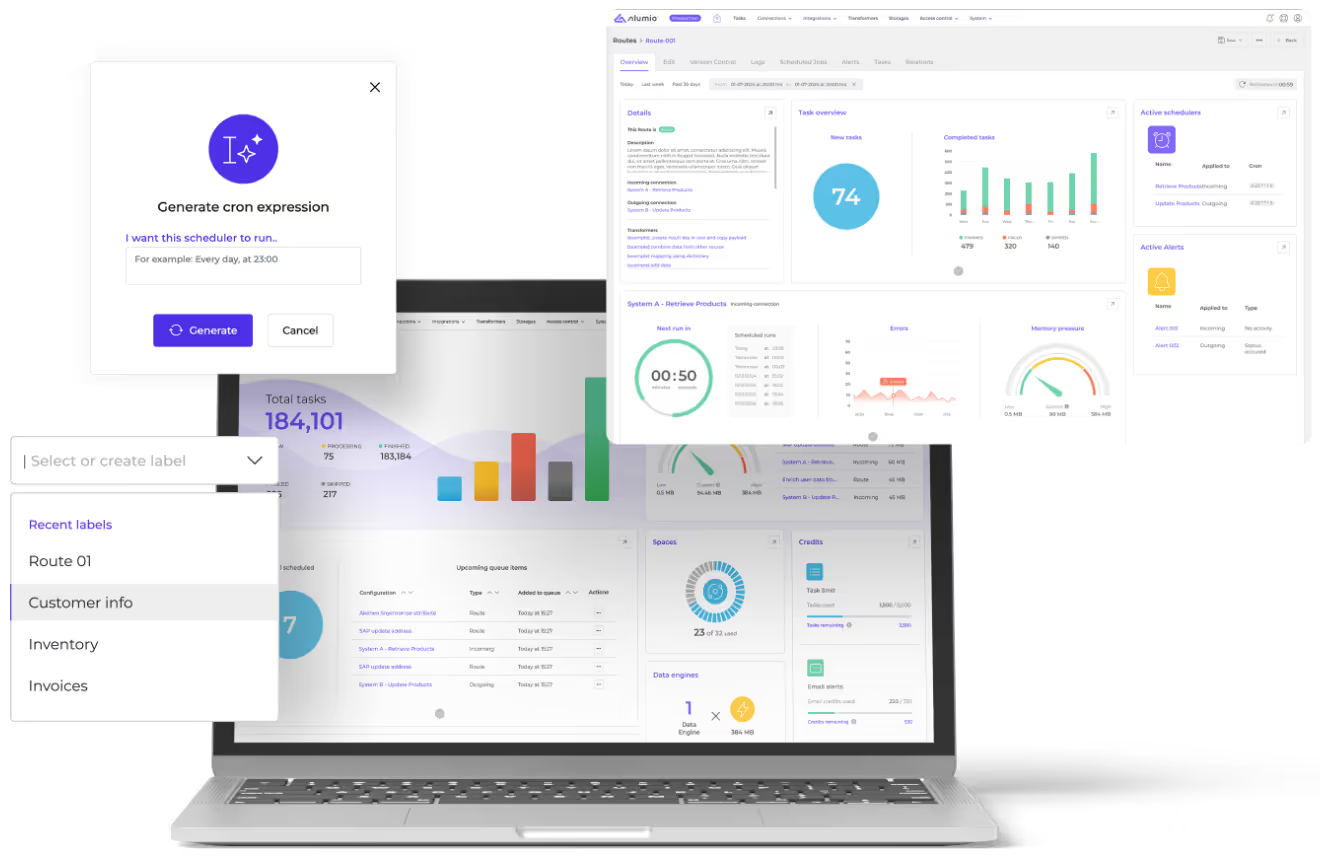
Laptop screen displaying the Alumio iPaaS dashboard, alongside pop-up windows for generating cron expressions, selecting labels and route overview.