
A Alumio vivid purple arrow pointing to the right, a visual representation of how to access more page material when clicking on it.
Go back

Build strategic alignment between business and IT teams

By
Carla Hetherington
Published on
September 24, 2024
Updated on
June 24, 2026
IN CONVERSATION WITH
Email icon
Email icon

In today's competitive landscape, businesses must navigate constant changes in market dynamics, customer expectations, and emerging technologies. To thrive, their business strategy must align seamlessly with their IT strategy. This alignment isn’t just a technical challenge; it’s a strategic imperative, as the proper alignment enables companies to unlock new opportunities for growth and innovation, creating a clear roadmap for success. Enter the Alumio iPaaS (Integration Platform as a Service), a powerful tool that helps businesses achieve this alignment by connecting disparate systems, automating processes, and ensuring data synchronization. But how can companies effectively build a strategic alignment model using the Alumio iPaaS? Let’s break it down.

Why strategic alignment is the foundation for growth

Strategic alignment involves ensuring that every component of the business—people, processes, and technology—supports the overall business objectives. The goal is to ensure that IT investments are not just about solving isolated technical challenges but are directly tied to business outcomes like increasing revenue, enhancing customer experience, or driving operational efficiency.

However, many organizations struggle with silos where business and IT strategies are developed independently, leading to disconnected systems and wasted resources. The Alumio iPaaS is designed to bridge these gaps by enabling seamless integration between business applications and IT infrastructure, creating a unified digital ecosystem that supports both business and IT goals.

Aligning business strategy and IT with the Alumio iPaaS

At the core of strategic alignment is the need for IT to move from a support function to a driver of business value. Using the Alumio iPaaS, organizations can:

  • Centralize integration management: Alumio’s iPaaS provides a centralized platform where businesses can manage all their integrations. This centralization ensures that business processes are streamlined and all systems communicate effectively, eliminating black-box issues and mitigating the risk of fragmented systems that can hinder business strategy execution.
  • Enable data-driven decision-making: Clean, high-quality, and synchronized data is the foundation of any effective business strategy. With Alumio’s integration capabilities, data from multiple sources can be automatically synced, ensuring that business leaders have access to accurate real-time information that allows for better decision-making.
  • Improve agility and speed: One of the main benefits of the Alumio iPaaS is the ability to scale and adapt quickly. In today’s fast-paced business environment, companies must pivot rapidly in response to market shifts or customer demands. Alumio enables businesses to quickly integrate new applications or services with a wide range of connectors, enabling faster time-to-market for new products or innovations.
  • Orchestrate workflows efficiently: Strategic alignment requires efficient workflows; there is simply no way around it. Alumio allows businesses to automate complex processes across departments, ensuring that everyone in the organization is working toward the same objectives without manual intervention. This frees up IT and business teams to focus on higher-value tasks and drives both operational efficiency and innovation.

Practical steps to build strategic alignment using the Alumio iPaaS

a. Identify key business objectives

Begin by identifying the core business objectives you want to achieve. Is it to improve customer engagement? Reduce operational costs? Enter new markets? Once your business goals are clear, you can define the IT initiatives required to support them. The Alumio iPaaS allows you to tailor integrations and processes to meet these specific objectives, ensuring IT solutions are always aligned with business strategy.

b. Map out the IT requirements

Next, map out the necessary IT systems and capabilities to support these goals. For instance, if your objective is to enhance customer engagement, you might need to integrate CRM systems, marketing automation tools, and customer support platforms. Alumio’s flexible platform allows for easy integration of diverse systems, ensuring that your IT infrastructure supports your overall business strategy.

c. Leverage data for continuous improvement

Business and IT alignment isn’t a one-time event; it’s an ongoing process. The Alumio iPaaS provides businesses with the ability to continuously monitor and manage data across systems, offering insights into both operational performance and customer behavior. Users can then leverage this data to make informed decisions, refine their strategy, and ensure that business and IT continuously evolve.

d. Foster collaboration between IT and business teams

True alignment requires collaboration across departments. With Alumio’s low-code and user-friendly platform, technical and non-technical teams can collaborate within a shared environment and have control over their integrations. By giving both teams access to the same data and systems, you eliminate silos and ensure that everyone has the same information and is working toward the same common goals.

Real-life examples of strategic alignment with Alumio

Businesses across industries are using tools like the Alumio iPaaS to align their strategies and achieve impressive results. For example, e-commerce businesses have used Alumio to integrate their front-end and back-end systems, enabling them to deliver personalized customer experiences, reduce cart abandonment rates, and scale their operations globally. Manufacturing companies have streamlined their supply chain by integrating ERP systems with logistics, procurement, and production systems, leading to increased operational efficiency and faster go-to-market times.

In each case, the Alumio iPaaS served as the bridge between business objectives and IT execution, resulting in more agile and resilient operations.

Check out our case studies to learn more about Alumio’s real-life impact →

Building a future-proof business

Strategic alignment is more than just connecting IT and business; it’s about building a sustainable foundation for growth and innovation. The Alumio iPaaS empowers businesses to seamlessly integrate their IT systems with their strategic goals, ensuring they are well-equipped to navigate today’s complex digital landscape. Whether your goal is to improve customer experiences, drive operational efficiency, or scale your business globally, the Alumio iPaaS can help you achieve the strategic alignment you need.


Turn AI ambition into action

Portrait of Leonie Becher Merli, Business Development Manager at Alumio

Get a free assessment of your integration needs and next steps

Portrait of Leonie Becher Merli, Business Development Manager at Alumio

No items found.
Topics in this blog:

FAQ

Integration Platform-ipaas-slider-right
Why is alignment between business and IT strategy important?

Misalignment between business and IT strategy creates one of the most common forms of organizational waste: IT invests in infrastructure that business teams cannot use effectively, while business teams request capabilities that IT cannot deliver within the time and cost constraints of the existing system landscape. When business and IT are aligned, technology investments are evaluated against business outcomes rather than technical preference, and the systems and integrations built by IT directly enable the revenue, efficiency, and customer experience goals the business is pursuing.

Integration Platform-ipaas-slider-right
How does integration infrastructure contribute to business-IT alignment?

Integration infrastructure is the layer where business strategy meets IT execution: it determines how quickly new digital capabilities can be connected to existing systems, how reliably operational data flows between business-critical systems, and how visible those data flows are to both IT and business stakeholders. When integration is governed through a platform like Alumio with visible Routes and centralized monitoring, business teams can understand what data flows support their processes and IT teams can demonstrate the operational impact of the integration work they deliver.

Integration Platform-ipaas-slider-right
What causes misalignment between business and IT teams?

Common causes of misalignment include: IT roadmaps driven by technical debt reduction rather than business capability delivery, business teams making system purchasing decisions without IT involvement (creating shadow IT), a lack of shared language between business outcomes and technical requirements, and long delivery cycles that make IT changes feel disconnected from the business problems they are supposed to solve. Integration is often a symptom of this misalignment: when business teams request a new system connection and IT quotes months of custom development, the gap between expectation and reality reflects a deeper organizational disconnect.

Integration Platform-ipaas-slider-right
How does a config-first iPaaS reduce the gap between business and IT in integration projects?

A config-first iPaaS reduces the gap by making integration logic visible and accessible to both business and IT stakeholders. Business teams can participate in defining data mapping and flow logic through the platform's visual interface rather than having to translate requirements into technical specifications for a developer. IT retains governance and handles technically complex scenarios. The result is shorter feedback cycles, fewer misunderstandings about what was built, and a shared ownership model where both teams are invested in the integration's success.

Integration Platform-ipaas-slider-right
What does strategic alignment look like in practice for a digital commerce business?

In practice, strategic alignment means: new digital commerce initiatives (a new marketplace channel, a new ERP, a composable commerce migration) are evaluated with both business and IT input before commitment, integration requirements are scoped alongside functional requirements rather than as an afterthought, the integration platform is treated as shared infrastructure that both teams govern together, and IT delivery metrics (integration uptime, time to connect new systems) are tied to business outcomes (order accuracy, time to market, channel expansion speed). Alumio's platform visibility supports this shared governance by making integration health a shared concern rather than an IT-only metric.

Integration Platform-ipaas-slider-right
How does Alumio help businesses build a more agile IT ecosystem?

Alumio builds agility into the integration layer by making it fast to connect new systems (prebuilt connectors), easy to change existing flows (config rather than code), and reliable to operate (centralized monitoring and error handling). When integration is agile, the full IT ecosystem becomes more agile: adding a new digital channel, replacing a component in a composable stack, or responding to a business requirement no longer requires months of custom development. The integration backbone becomes the infrastructure that enables the business's digital strategy to execute at the speed the market demands.

Get a free assessment of your integration needs

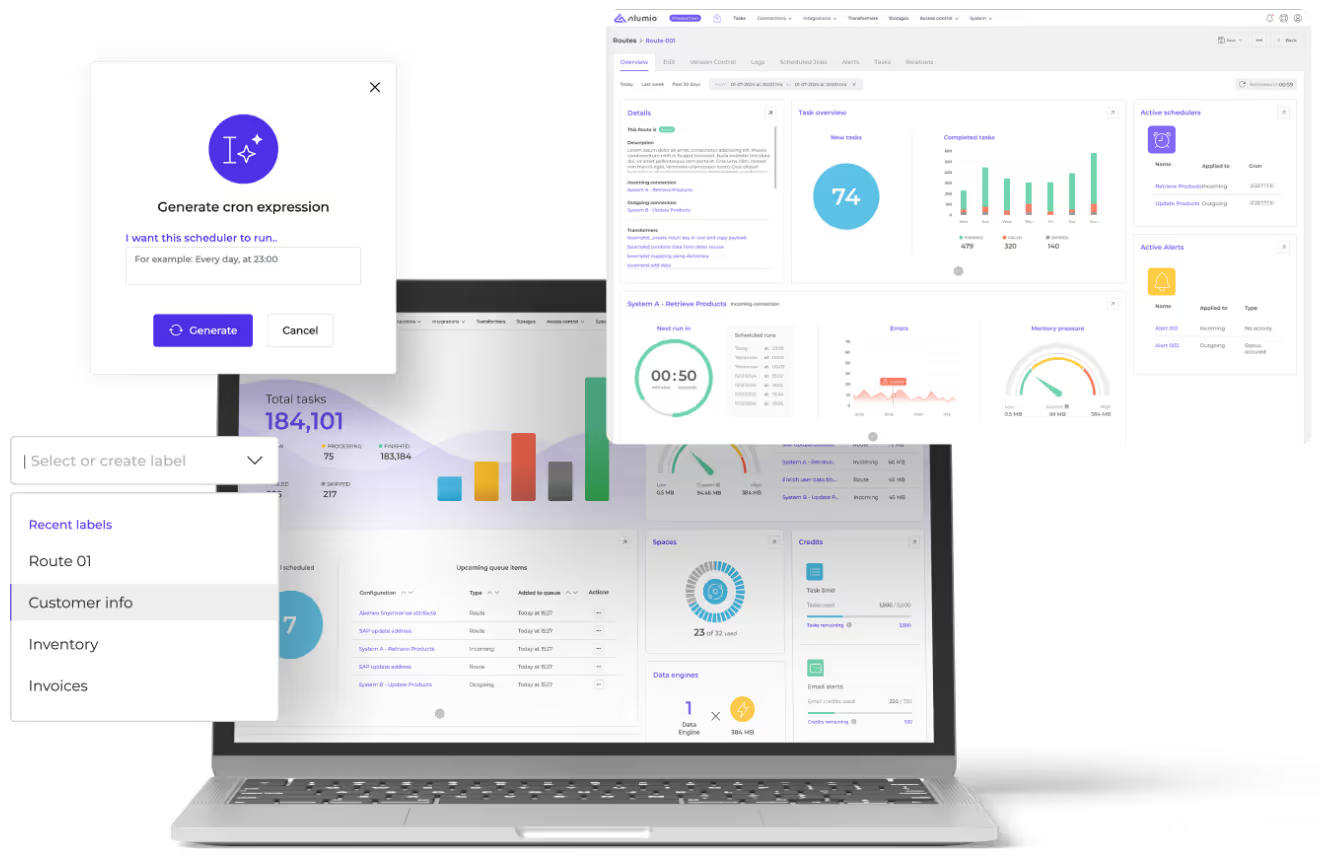
Laptop screen displaying the Alumio iPaaS dashboard, alongside pop-up windows for generating cron expressions, selecting labels and route overview.