




.svg)


The integration challenges professional services face
In early growth, most teams can survive on a collection of specialized cloud applications. A CRM like HubSpot or Salesforce manages the pipeline. A project management tool like Jira or Asana tracks delivery. A finance system like QuickBooks or NetSuite supports invoicing and revenue processes. At this stage, manual updates and a handful of one-off integrations are often enough to keep things moving.
As volume increases, the cracks appear. Projects multiply, client environments become more diverse, and the volume of customer and delivery data grows quickly. What used to be manageable admin becomes a bottleneck. More importantly, decision-making suffers because data becomes fragmented, inconsistent, and hard to trust.
This is where agencies and system integrators feel the pain most sharply. They are not just integrating their own tools. They are building and managing integrations for customers, and every customer brings unique constraints: different ERPs, different naming conventions, different data quality, different security requirements, and different business rules.
For ISVs, the pattern is similar. You can build a great product, but if customers cannot connect it to CRM, ERP, e-commerce, and support systems, adoption slows, value realization is delayed, and your software becomes “another silo.” Integration becomes a product expectation, not a nice-to-have.
Assessing integration maturity across delivery and customer work
Recognizing the problem is step one. Most professional services teams and product organizations sit in one of three integration maturity levels. Knowing where you are helps you choose the right next step, especially when you are delivering integrations repeatedly across customers.
Level 1: The manual stage
At this stage, there are no formal integrations. People move data between systems. A project manager creates a new project after a deal is marked closed-won in the CRM. A finance team copies time entries into another system to generate invoices. Agencies may also be doing this across customer environments by relying on repetitive implementation checklists and manual exports.
This stage is defined by high overhead, frequent errors, and a lack of real-time visibility.
Level 2: The point-to-point stage
Teams try to reduce manual work with native connectors and scripts. A CRM is linked to email marketing. A custom integration syncs customer data into billing. A webhook pushes leads from one tool to another. It works until it doesn’t.
Point-to-point connections also becomes a delivery trap for agencies and system integrators. Each customer integration becomes its own mini-codebase with its own exceptions. Over time, you end up with a brittle web of one-to-one connections, where every change request creates risk and every incident takes too long to diagnose.
This stage is usually defined by:
- brittle integrations that break when systems change
- limited monitoring and error handling
- slow onboarding because integration logic is scattered
- escalating maintenance costs that are hard to price into projects
Level 3: The integration layer stage
Mature organizations treat integration as a repeatable capability. They implement an integration platform as a service (iPaaS) like Alumio, to standardize how data flows are built, monitored, governed, and scaled.
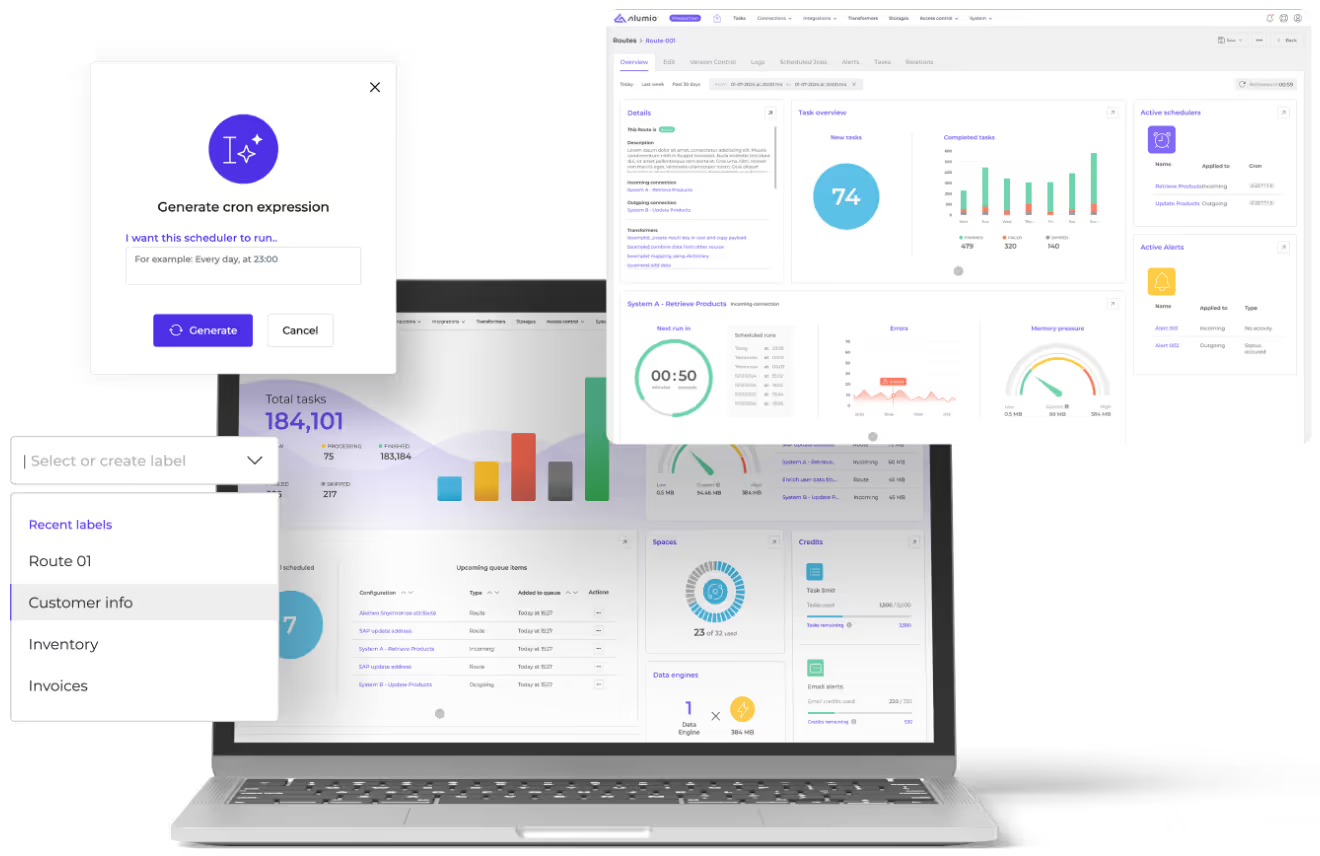
Instead of connecting applications to each other, systems connect to the integration layer. This decoupled architecture makes it easier to add or replace applications without destabilizing the ecosystem. It also provides centralized monitoring, error handling, and governance, which turns integration into an operational asset.
For agencies and system integrators, this is the point where integrations stop being a fragile “project output” and start becoming a scalable managed service. For ISVs, it is how integration becomes consistent and supportable across many customer environments.
How an integration layer solves growth-related chaos
An integration platform like Alumio changes the model from “many fragile links” to “one governed connection per system.” Instead of building separate integrations for every pair of applications, you standardize how data moves, how it is transformed, and how failures are handled.
Key benefits include:
- Standardized data flows across systems: You reduce mismatches and duplicate records by automating synchronization between CRM, ERP, and delivery tools. When client details change in one system, updates propagate consistently.
- Automation across teams and customers: You can build workflows that span systems. Marking a deal closed-won can trigger client creation in the ERP, project creation in the delivery tool, and internal handoff notifications. This becomes even more valuable when agencies replicate the same patterns across customers instead of rebuilding logic each time.
- Visibility and operational control: Centralized monitoring and logging make it easier to diagnose issues quickly. That matters for internal operations, but it is essential when you are responsible for customer integrations and SLAs.
- Faster change management: Because integrations are decoupled, changing one endpoint does not force you to rewrite everything around it. That improves delivery predictability and reduces long-term maintenance overhead.
The practical outcome is less time spent reconciling systems and more time spent delivering outcomes with predictable margins.




.svg)
.svg)
.svg)
.svg)
.svg)
.svg)
