How growth increases integration complexity for professional services
Each new client brings a different system landscape. One environment runs Salesforce and NetSuite. Another runs HubSpot and SAP. A third combines Shopify, Jira, and a regional ERP.
In the early stages, custom integrations seem manageable. Over time, patterns repeat:
- Similar integrations are rebuilt for different clients
- Mapping logic is duplicated across projects
- API changes require reactive fixes
- Monitoring is handled separately per implementation
Instead of building reusable integration assets, agencies accumulate fragmented implementations. Delivery slows. Support workload increases. Margins tighten as more time is spent maintaining integrations rather than delivering new projects.
Professional services integration challenges are therefore tied directly to scalability, profitability, and delivery consistency.
Why point-to-point integration models limit scalability
Point-to-point integrations appear flexible. They allow full control and client-specific customization. However, as project volume increases, this model becomes difficult to sustain.
Each new client environment introduces:
- New endpoint configurations
- Custom mapping logic
- Unique transformation rules
- Separate error handling processes
Without a centralized orchestration layer, agencies must maintain integration logic across multiple disconnected systems. When APIs evolve or clients change systems, teams revisit brittle implementations. This creates operational drag.
Delivery teams spend increasing time debugging integrations. Support teams respond to recurring synchronization issues. Innovation slows because capacity is allocated to maintenance.
For agencies positioning themselves as strategic technology partners, this model does not scale.
How an integration platform standardizes delivery
An integration platform such as Alumio introduces a centralized orchestration layer that agencies can standardize across client environments.
Instead of building direct integrations between systems, agencies connect applications through a governed integration backbone. This centralization produces measurable advantages for professional services:
- Integration logic becomes reusable: Data mapping, transformation rules, and workflow automation are centralized rather than embedded in client-specific scripts.
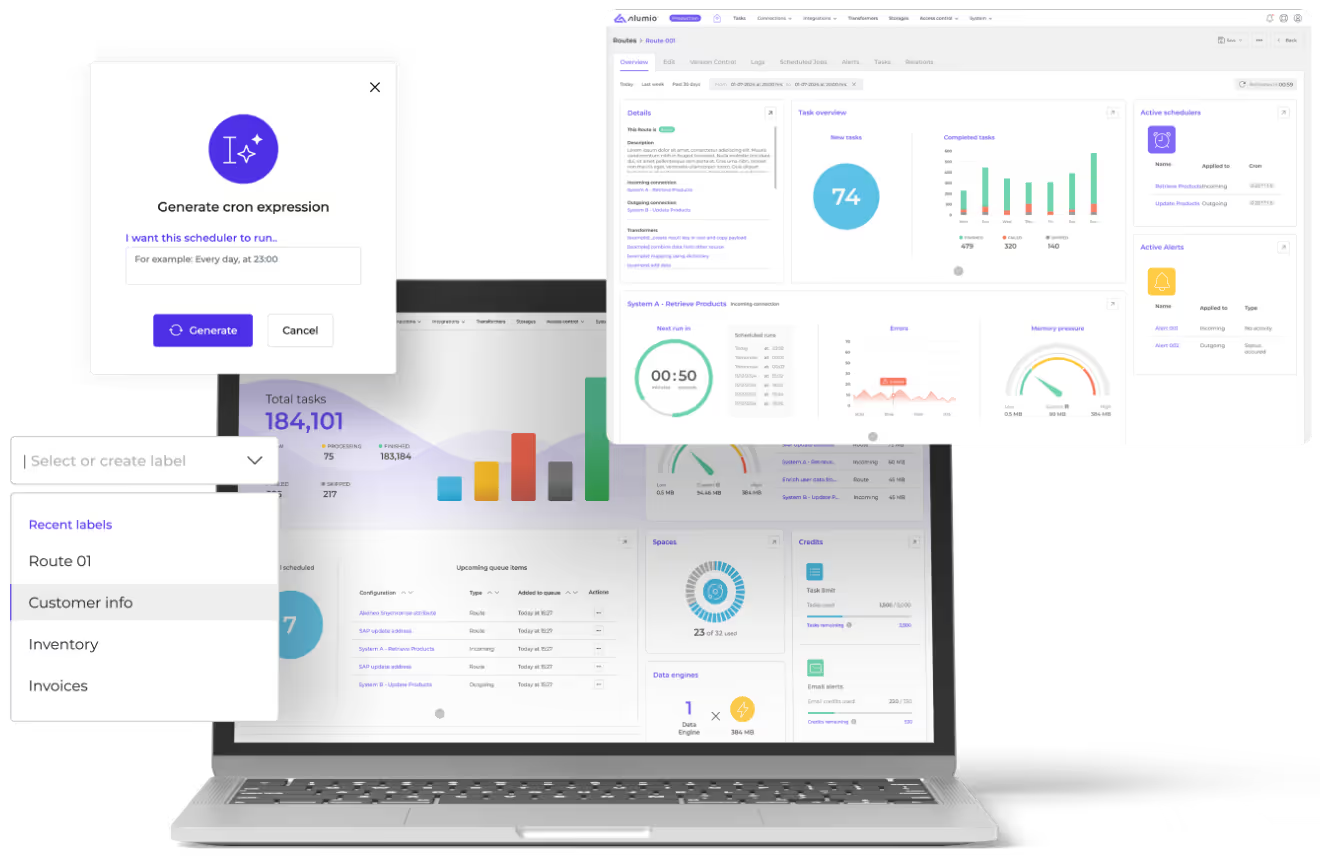
- Monitoring, logging, and alerting are unified: Instead of troubleshooting across isolated connectors, teams gain visibility across all data flows from a single control layer. This shortens incident resolution time and improves operational transparency for both agencies and clients.
- API changes are managed within the integration platform: When endpoints evolve, updates can be handled centrally rather than requiring widespread rework.
This reduces technical debt and increases implementation consistency, Most importantly, the integration platform becomes part of the agency’s delivery methodology rather than a project-specific tool.
How Alumio connects applications across the entire tech stack
Alumio provides a centralized integration platform that connects CRM, ERP, PIM, WMS, e-commerce platforms, marketplaces, finance systems, latest AI tools, and other applications within a structured orchestration layer. It provides a rich library of connectors that accelerates integrations with SaaS platforms as well as legacy systems that are typically more complex to integrate.
Instead of building direct system-to-system connections, each application connects to Alumio. This creates a governed environment where:
- Data mapping and transformation logic are centralized
- Workflow automation is configurable without modifying core systems
- Integrations are monitored from a unified interface
- API changes are absorbed within a controlled layer
In other words, the Alumio integration platform enables agencies and System Integrators to connect applications across the entire customer tech stack without embedding logic inside individual systems. As a result, integrations become standardized assets rather than isolated projects.
Simplifying multi-client integration environments
Alumio is designed to support agencies and system integrators managing multiple clients. Each customer environment can be configured separately and securely, ensuring that integrations remain isolated and compliant.
At the same time, professional service partners can manage all customer environments from a single platform. This approach provides:
- Logical separation between client integrations
- Secure, isolated environments per customer
- Centralized visibility across all managed integrations
- Operational efficiency without mixing client data
Agencies gain centralized oversight while maintaining strict separation between environments. This is particularly valuable when supporting regulated industries or clients operating under different compliance requirements.
Ensuring security and compliance across client environments
As agencies scale and manage multiple customer environments, security and compliance become critical operational requirements.
Alumio is GDPR compliant and ISO 27001-certified, providing a secure foundation for processing sensitive customer, financial, and operational data. This is particularly important for partners supporting clients in regulated industries or operating across multiple jurisdictions.
Each customer environment can be configured separately and securely, ensuring strict logical separation between integrations. At the same time, agencies retain centralized oversight across all managed environments without mixing client data.
This combination of secure isolation and centralized control enables partners to scale confidently while meeting enterprise-level governance and compliance standards.
Turning professional services integration into a scalable delivery model
Professional services integration challenges intensify as agencies and system integrators expand their client portfolios. Each new implementation introduces additional endpoints, workflows, and compliance requirements. Without a structured integration architecture, complexity accumulates, operational overhead increases, and margins erode as teams spend more time maintaining integrations than delivering new value.
Scaling integration services requires more than technical expertise. It requires a repeatable framework for connecting CRM, ERP, marketplaces, billing systems, and other applications across multiple client environments. By centralizing orchestration with the Alumio integration platform, agencies can define reusable mapping logic, standardized automation patterns, and unified monitoring standards that apply consistently across projects. Recurring use cases such as CRM-to-ERP synchronization or marketplace order flows become structured implementations rather than bespoke builds. Secure environment isolation ensures each client remains logically separated, while centralized oversight enables governance, visibility, and faster incident resolution across all managed integrations.
As client ecosystems grow more complex, integration must evolve from project-based custom code into managed infrastructure. Agencies that standardize delivery, automate workflows, and manage multiple environments from a single integration backbone scale more predictably, protect margins, and maintain control as their portfolios expand.





.svg)








.svg)
.svg)
.svg)
.svg)
.svg)
.svg)
