The operational trap of bespoke client delivery
Professional services firms typically build their early reputation on extreme flexibility. When taking on initial clients, agencies and system integrators willingly write custom code to connect disparate systems and build highly specific workflows tailored to a single client request. While this approach secures early revenue, it creates a fundamentally unscalable business model.
As the agency acquires more clients, the volume of custom code multiplies rapidly. Each bespoke integration requires dedicated hosting, unique security protocols, and constant monitoring. Because every client environment is architected differently, there is no standardization across the firm's delivery portfolio.
This lack of standardization directly impacts resource allocation. Highly skilled developers spend the majority of their billable hours maintaining, debugging, and patching legacy code for existing clients instead of building innovative solutions for new accounts. The business becomes entirely dependent on the specific knowledge of individual developers, creating severe operational risks if key personnel leave the company.
Identifying integration as your primary growth blocker
Growth in a traditional professional services model is strictly linear. To take on more client projects, the firm must hire more developers. This linear relationship prevents agencies from achieving exponential revenue growth and severely limits overall profitability.
Integration is consistently the primary chasm between linear and exponential growth. When integrations are hardcoded, rolling out an update or fixing a broken API connection requires manual intervention on a per-client basis. If a major software vendor updates its API structure, your team must rewrite the custom scripts for every single client utilizing that specific software.
This maintenance burden destroys project profitability. Fixed-price contracts become financial liabilities when post-launch support and troubleshooting consume hundreds of unbillable hours. Scaling professional services technology requires severing the tie between client volume and development headcount. You must implement a strategy where adding a new client requires minimal additional technical overhead.
The strategic shift: build once, reuse everywhere
Transitioning from a project-based mindset to a platform-based mindset is critical for long-term viability. The core philosophy of this transition is simple: build once, reuse everywhere. Instead of treating each client integration as a blank canvas, operations leads must view integrations as productized assets.
When a development team builds a connection between a popular CRM and a standard ERP system, that connection should be packaged as a reusable template. The next time a client requires that exact workflow, the delivery team deploys the pre-built template and configures the specific data mapping parameters.
This approach shifts the firm away from selling raw development hours. Instead, the firm sells access to robust, pre-tested integration solutions. This productization of services accelerates project timelines, reduces the risk of technical failure, and allows the firm to deliver high-quality results at a significantly lower internal cost.
Standardizing the delivery layer with an iPaaS
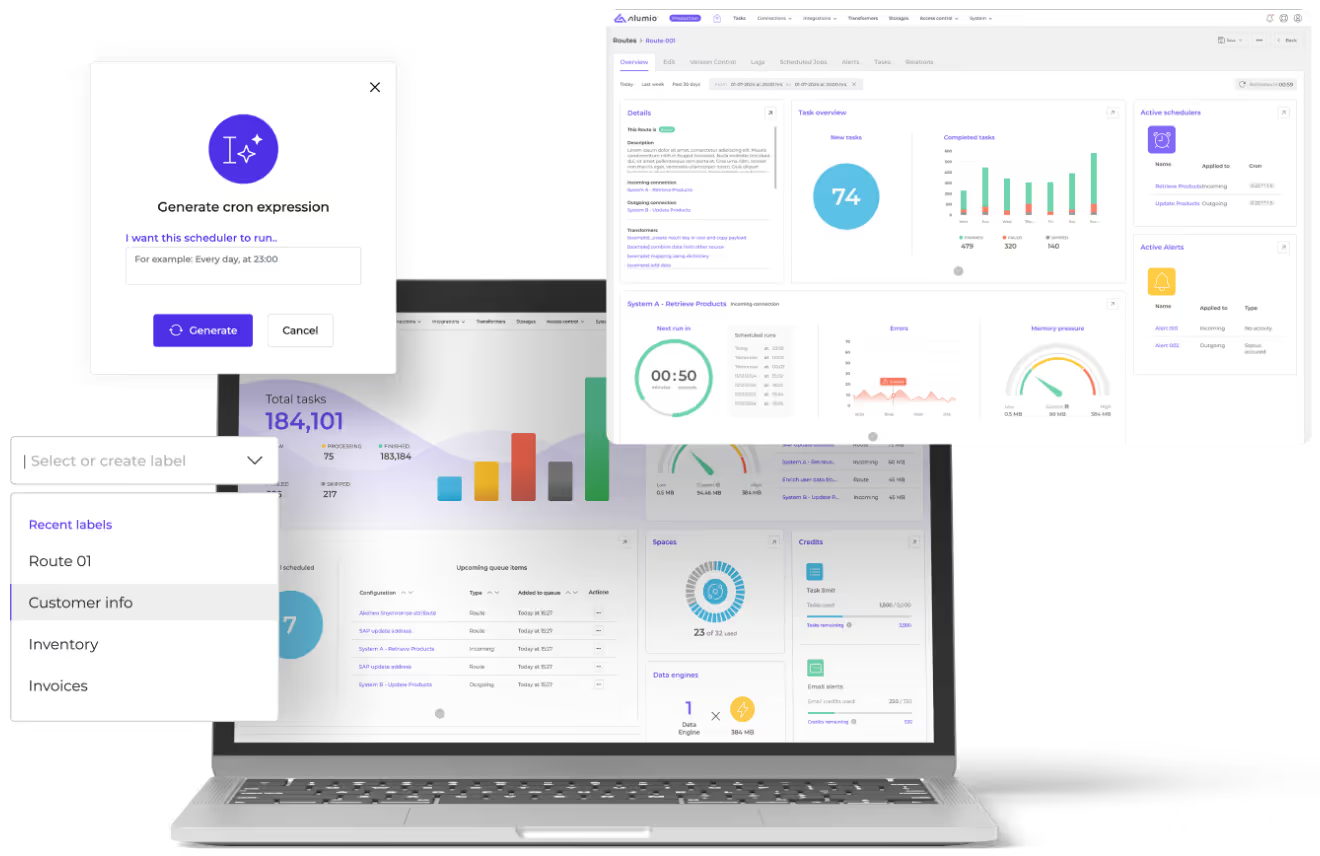
Executing a repeatable integration strategy requires the right architectural foundation. An integration platform-as-a-service (iPaaS) serves as the necessary central hub for standardizing client deployments. It provides a governed environment where system integrators can build, manage, and monitor all client connections from a single interface.
An iPaaS eliminates the need for custom, point-to-point scripts. It utilizes standardized connectors and visual mapping tools to orchestrate data flows between applications. For a professional services firm, this means your delivery team works within a single, unified framework regardless of the specific software the client utilizes.
Furthermore, an iPaaS provides built-in tools for automated error handling, comprehensive audit logging, and strict security compliance. When an integration fails, the platform automatically flags the error and provides detailed diagnostic data. This centralization ensures that your delivery leads maintain total visibility over the health of your entire client portfolio, ensuring strict adherence to Service Level Agreements without requiring constant manual system checks.
High-impact repeatable workflows for system integrators
To successfully productize your delivery, you must identify the most common operational challenges your clients face. Standardizing these core business processes allows your agency to deploy reliable solutions rapidly. Below are crucial workflows that professional services firms should build as reusable templates.
Lead-to-project synchronization
Sales and delivery teams often operate in completely isolated systems. You can build a standardized workflow that connects a client's CRM directly to their project management software. When a sales representative marks a deal as closed, the integration automatically generates a new project board, populates the project details, and assigns the correct delivery personnel. This eliminates manual data entry and ensures immediate project kickoff.
Quote-to-cash automation
Financial discrepancies frequently occur when sales quotes fail to align with final invoices. A standardized quote-to-cash integration connects the client's configuration and quoting software directly to their accounting or ERP system. Upon contract approval, the workflow automatically generates the precise billing schedule, updates the general ledger, and triggers the initial invoice generation.
Ticket-to-resolution tracking
Customer support teams require immediate access to product development data to resolve client issues effectively. You can template an integration that connects a standard helpdesk platform with technical issue-tracking software. When a support agent escalates a complex ticket, the platform automatically creates a corresponding development task, syncing comments and status updates between the two systems in real time.
Employee and client onboarding automation
Onboarding new personnel or new clients involves repetitive administrative tasks across multiple software platforms. A reusable onboarding workflow connects human resources or contract management tools to the organization's identity and access management systems. Upon contract signing, the integration automatically provisions software licenses, generates secure login credentials, and sends automated welcome communications.
Overcoming integration bottlenecks to secure scalable growth
The future of professional services belongs to firms that prioritize operational efficiency over custom development. Continuing to rely on bespoke integrations and one-off fixes guarantees that your business will eventually hit a hard growth ceiling. Technical debt will consume your margins, and maintenance tasks will drain your top technical talent.
By embracing an integration platform and committing to standardizing your delivery patterns, you establish a resilient operational foundation. Transitioning to a repeatable delivery model allows your firm to scale rapidly, secure predictable profit margins, and deliver unparalleled consistency to every client. Evaluate your current integration practices, identify areas of redundant development, and deploy a centralized architecture to transform your technical delivery into a strategic business asset.





.svg)







.svg)
.svg)
.svg)
.svg)
.svg)
.svg)
