


A Alumio vivid purple arrow pointing to the right, a visual representation of how to access more page material when clicking on it.
Go back

What are the benefits of MACH architecture?

By
Carla Hetherington
Published on
November 1, 2023
Updated on
June 24, 2026
IN CONVERSATION WITH
Email icon
Email icon

Want to know the secret to outpacing the competition in today’s competitive e-commerce landscape? Traditional architectures are becoming outdated, and modern businesses are now turning to MACH for a competitive edge. As such, any e-commerce business wanting to stay ahead of the competition must adopt this flexible approach. Keep on reading to discover all the benefits of MACH architecture and how it can transform your e-commerce operations.

What is MACH architecture?

Before diving into the benefits, let's understand what MACH architecture is. MACH stands for Microservices, API-first, Cloud-native, and Headless. This approach to architecture empowers e-commerce businesses to be more agile, scalable, and efficient.

Microservices: unleashing scalability

With MACH, e-commerce platforms are built using microservices. These are small, independent, and highly specialized components that can be modified and scaled individually. This modularity makes your system adaptable to changing business needs, ensuring that your e-commerce platform can grow seamlessly as your business does.

API-first: connectivity at its best

MACH architecture's API-first approach means that every part of your e-commerce platform is accessible via APIs. This creates a network of interconnected services, making it easier to integrate third-party tools, like payment gateways, analytics, or customer relationship management systems. The result? A seamless experience for your customers and enhanced operational efficiency.

Cloud-native: future-proof your business

The cloud-native aspect of MACH architecture provides the flexibility to adapt to your changing business requirements. You can scale your infrastructure up or down, and with cloud-based hosting, you have the peace of mind that your e-commerce platform can withstand traffic spikes and continue to perform optimally.

Headless: ultimate content flexibility

With a headless architecture, the Content Management System (CMS) is decoupled from the front-end presentation layer. This separation allows you to create and manage content independently from the e-commerce functionality. This flexibility means you can quickly adapt to changing trends and provide a personalized shopping experience.

Learn about the differences between Headless CMS vs traditional CMS ->

The benefits of MACH for e-commerce businesses

Now that we've covered the basics of MACH architecture, let's delve into the benefits that make it a game-changer for modern e-commerce businesses.

1. Speed and performance

MACH architecture significantly boosts the speed and performance of your e-commerce platform. The use of microservices and cloud-native hosting ensures that your website can handle high traffic loads without compromising on user experience. Faster loading times lead to higher conversion rates and happier customers.

2. Scalability

In the e-commerce world, scalability is key. With MACH architecture, you can effortlessly scale your platform to accommodate more products, users, and transactions. As your business grows, you won't need to undergo major overhauls or face performance bottlenecks.

3. Enhanced security

MACH architecture enhances security by isolating microservices. This means that even if one component is compromised, the rest of your system remains intact. It's a robust defense against potential threats, providing peace of mind for both you and your customers.

4. Improved user experience

The headless nature of MACH architecture enables e-commerce businesses to deliver a highly customizable and dynamic user experience. You can tailor the front-end to your brand's specific needs and react quickly to changing consumer preferences, ensuring a memorable shopping experience.

5. Cost efficiency

MACH architecture allows you to allocate resources more efficiently. You can use cloud-based infrastructure, which not only reduces upfront costs but also ensures you only pay for what you use. This cost efficiency frees up your budget for other essential aspects of your business.

6. Faster-time-to-market

With MACH, you can launch new features and updates faster than ever before. The modular microservices approach makes it easier to test and deploy changes, giving your business a competitive edge in a fast-paced e-commerce integration environment.

7. Integration freedom

MACH architecture is designed with connectivity in mind. The API-first approach makes it simple to integrate various tools and services, allowing you to choose the best solutions for your specific needs. This flexibility opens the door to a vast ecosystem of services and tools, ensuring you stay ahead of the curve.

Conclusion

In a world where e-commerce success depends on speed, adaptability, and reliability, MACH architecture has emerged as a game-changer. By adopting MACH architecture, e-commerce businesses can unlock a plethora of benefits, including enhanced performance, scalability, seamless integration, optimized customer experiences, cost efficiency, and robust security. Additionally, a MACH architecture can accomodate Composable Commerce, a game-changer for commerce systems. In summary, MACH redefines the e-commerce landscape, offering the agility and innovation required to thrive in the digital age.


Turn AI ambition into action

Portrait of Leonie Becher Merli, Business Development Manager at Alumio

Get a free assessment of your integration needs and next steps

Portrait of Leonie Becher Merli, Business Development Manager at Alumio

No items found.
Topics in this blog:

FAQ

Integration Platform-ipaas-slider-right
What are the main benefits of MACH architecture for e-commerce?

The main MACH (Microservices, API-first, Cloud-native, Headless) architecture benefits are: best-of-breed component selection (choose the best tool for each function rather than accepting a monolith's compromise features), independent component release cycles (update the front end without touching the commerce engine; upgrade the PIM without affecting the CMS), genuine multichannel delivery from a single back end (web, mobile, in-store, and voice channels all served from the same API-first commerce backend), better performance (purpose-built front ends consistently outperform platform templates on Core Web Vitals metrics), and long-term flexibility (replace any component without rebuilding the others).

Integration Platform-ipaas-slider-right
How does MACH architecture improve development velocity?

MACH improves development velocity by removing the coupling constraints of monolithic platforms: front-end teams deploy UI improvements without requiring back-end releases, back-end teams evolve commerce logic without breaking the front end, and different components are developed and tested independently on their own cadences. In a monolithic platform, a front-end change can require back-end deployment and regression testing across the entire system; in a MACH architecture, the change is deployed as a front-end update that does not touch the commerce engine or any other component. This independence is what allows digital teams to move at market speed rather than at platform release pace.

Integration Platform-ipaas-slider-right
What is the role of the integration layer in MACH architecture?

The integration layer is the infrastructure that makes MACH components function as a coherent system rather than isolated services. Each component in a MACH stack (commerce engine, CMS, PIM, search, loyalty) communicates with others through APIs, and the integration platform governs these connections centrally: product data from PIM flows to the commerce engine, inventory from ERP flows to the commerce engine, orders from the commerce engine flow to ERP and WMS. Without a governed integration backbone, each component requires custom connections to all others: recreating the very complexity that MACH architecture was supposed to eliminate. The integration platform is the governance layer that makes MACH operationally maintainable.

Integration Platform-ipaas-slider-right
How does MACH architecture enable e-commerce businesses to stay competitive?

MACH enables competitive advantage through speed and specialization: best-of-breed components are each optimized for their function by vendors whose entire focus is that specific capability, meaning the commerce engine, CMS, search, and personalization components are all better than the equivalent modules in a monolithic platform. And because each component evolves on its own release cycle, improvements happen continuously rather than waiting for the monolithic platform's annual major release. The combination of superior individual components and faster release cadence allows MACH-architected businesses to deliver better experiences and adopt new capabilities faster than competitors constrained by monolithic platforms.

Integration Platform-ipaas-slider-right
What does a typical MACH commerce stack look like and how does Alumio connect it?

A typical MACH commerce stack includes: a headless commerce engine (Commercetools, SCAYLE, Shopify Headless) for product catalog, pricing, cart, and checkout; a CMS (Contentful, Storyblok) for editorial and marketing content; a PIM (Akeneo, Pimcore) for product data enrichment; a search platform (Algolia, Constructor.io) for catalog search; a CDN and front-end framework for storefront delivery; and an ERP for financial and operational back-office management. Alumio connects the back-end components to each other and to the ERP through governed Routes: PIM data flows to the commerce engine, ERP pricing and inventory flows to the commerce engine, orders flow from the commerce engine to ERP and WMS.

Integration Platform-ipaas-slider-right
What should businesses realistically expect when adopting MACH architecture?

Realistic expectations for MACH adoption include: higher upfront implementation cost than like-for-like replatforming (the integration infrastructure investment is real and significant), a longer time-to-first-launch than a monolithic platform migration (composing multiple components takes longer than configuring one), a genuine requirement for strong technical governance capability (the organization must be able to manage a multi-vendor, multi-component architecture), and a payback period of 18 to 36 months before the flexibility and component quality advantages outweigh the higher setup cost. MACH is not for every organization or every stage of digital maturity, but for businesses where current platform constraints are genuinely limiting commercial performance, the long-term competitive advantage of MACH architecture justifies the investment.

Get a free assessment of your integration needs

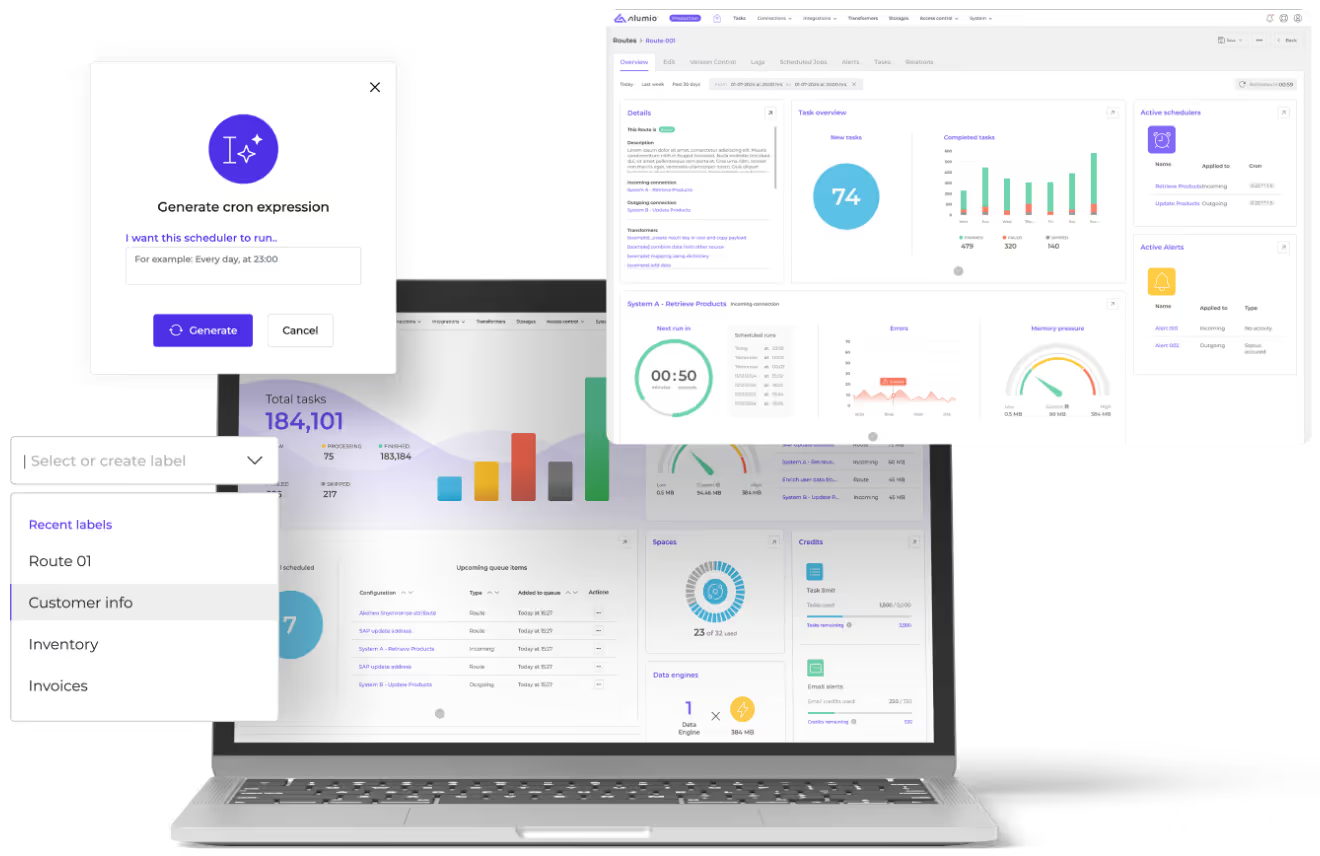
Laptop screen displaying the Alumio iPaaS dashboard, alongside pop-up windows for generating cron expressions, selecting labels and route overview.