A Alumio vivid purple arrow pointing to the right, a visual representation of how to access more page material when clicking on it.
Go back

The key to wholesale automation

By
Carla Hetherington
Published on
October 20, 2025
Updated on
June 24, 2026
IN CONVERSATION WITH
Email icon
Email icon

For decades, wholesale success depended on relationships, reliability, and razor-thin margins. But today, even the strongest partnerships can falter if your operations can’t keep up with digital demand. Spreadsheets, emails, and manual order entries might have worked before, but in a fast-moving B2B world, they’ve become roadblocks to growth. Let’s explore how wholesalers can leverage integrations to automate manual orders and scale intelligently.

What is wholesale automation?

To scale efficiently, distributors must automate the processes that slow them down most. That’s where integration platforms for wholesalers, powered by iPaaS (Integration Platform as a Service), come in. Automation isn’t just about working faster. It’s about building smarter, more connected systems that allow your business to grow without adding complexity or headcount.

The high cost of manual order processing

Manual order management is still surprisingly common in wholesale distribution. Sales reps receive orders via email, customer portals, or even phone calls, and then re-enter them into an ERP or CRM. Each touchpoint creates room for human error, wrong SKUs, missed quantities, incorrect pricing.

Beyond mistakes, manual processes eat into profitability. They slow fulfillment, limit scalability, and burden IT and customer service teams with repetitive tasks. In an industry built on precision and trust, a single data entry error can mean a lost customer. The truth is simple: if you’re still processing orders manually, you’re holding back your potential for wholesale digital transformation.

Why automation is now essential for wholesale growth

Automation allows distributors to eliminate time-consuming tasks while improving accuracy and customer satisfaction. By connecting systems like ERP, CRM, WMS, and e-commerce through a wholesale integration platform, you can turn every manual workflow into a seamless digital process.

When data flows automatically between systems, orders, invoices, inventory updates, and shipping information, teams can focus on strategic work instead of repetitive data entry. Automation also enables real-time visibility, giving customers the instant updates they’ve come to expect from modern B2B portals.

Simply put, automation transforms your distribution network into a connected, data-driven ecosystem that scales without chaos.

Turn AI ambition into action

Portrait of Leonie Becher Merli, Business Development Manager at Alumio

Get a free assessment of your integration needs and next steps

Portrait of Leonie Becher Merli, Business Development Manager at Alumio

How iPaaS powers smart automation

An iPaaS for wholesalers brings all your business systems under one roof. It connects ERP, WMS, CRM, PIM, and e-commerce platforms so they share accurate, synchronized data at all times.

Every time a customer places an order online, the iPaaS automatically validates the data, updates stock levels, sends the order to fulfillment, and triggers the invoice. No manual work, no risk of error, just clean, consistent automation that works around the clock.

More importantly, automation through iPaaS is flexible. As your business grows, you can easily connect new suppliers, marketplaces, or applications without overloading IT. This scalability is what sets integration for distributors apart from one-off scripts or custom connectors, it’s future-proof by design.

The real impact of automating wholesale workflows

When wholesalers move from manual orders to automation, the impact is immediate. Processing times shrink from hours to minutes. Errors drop dramatically. Customer response times improve, and IT teams gain breathing room to focus on innovation instead of firefighting.

Automation also gives decision-makers access to clean, real-time data. That visibility helps optimize inventory levels, forecast demand, and identify new sales opportunities faster.

And because iPaaS supports both B2B data automation and API connectivity, you can scale into new markets, integrate with partners, or launch e-commerce channels faster than ever, without breaking existing processes.

From reactive to proactive wholesale: Scaling smart with automation

Scaling smart means moving from a reactive mindset (“fixing data issues as they happen”) to a proactive one (“preventing them altogether”). With automated data flows, you’re not just streamlining operations, you’re building a foundation for resilience, agility, and innovation.

As buyer expectations evolve and competition grows, automation will no longer be optional,it will be the difference between standing still and scaling sustainably.

By embracing an integration-first approach, wholesalers can future-proof their business, eliminate manual bottlenecks, and turn every order, customer, and product into part of one intelligent, connected system.

The smarter way to scale your wholesale business

Manual order entry belongs to the past. The future of wholesale is automated, connected, and powered by iPaaS. By turning fragmented workflows into synchronized, data-driven operations, wholesalers can scale smarter, serve faster, and stay ahead of every market shift. Automation isn’t just an upgrade, it’s your competitive advantage.

No items found.

FAQ

Integration Platform-ipaas-slider-right
What is wholesale automation and why is it critical for modern distributors?

Wholesale automation is the use of digital technology to execute wholesale business processes automatically without manual intervention: order intake flowing from customer portals or EDI into ERP without manual entry, inventory levels updating across all customer touchpoints in real time, pricing synchronization from ERP to all ordering channels without manual export, and fulfillment status returning to customers automatically from WMS. It is critical because manual processes that were manageable at lower order volumes and slower customer expectations have become operational bottlenecks as B2B buyers increasingly expect the speed and self-service of B2C digital commerce.

Integration Platform-ipaas-slider-right
What manual wholesale processes create the biggest operational bottlenecks?

The biggest bottlenecks are: manual order entry from customer emails, fax, or phone into ERP (time-consuming, error-prone, and unscalable at high volume), inventory level updates that require manual export from ERP and import to customer portals or e-commerce channels (creating stock inaccuracy windows that cause overselling or customer disappointment), pricing updates that require manual distribution to all customer-facing systems (slow to propagate and prone to inconsistency), and fulfillment status communication that requires manual status lookups and customer emails (creating service overhead that scales with order volume).

Integration Platform-ipaas-slider-right
How does an integration platform enable wholesale automation?

An integration platform enables wholesale automation by connecting the systems involved in each wholesale process and automating the data flows between them: EDI purchase orders flow automatically into ERP for processing, inventory from ERP flows to B2B portals in near real time, pricing from ERP propagates to all customer ordering channels automatically, and fulfillment confirmations from WMS flow back to customer portals and notifications automatically. Each automated flow eliminates a manual step, and the iPaaS backbone governs all of them centrally with monitoring and error recovery rather than managing each as a separate script.

Integration Platform-ipaas-slider-right
How does Alumio specifically support wholesale automation requirements?

Alumio supports wholesale automation through: EDI support for B2B trading partner document exchange (the most common ordering channel for wholesale), prebuilt connectors for wholesale ERP systems (SAP, Dynamics 365, Business Central), B2B e-commerce and portal connectors for self-service ordering channels, WMS connectors for fulfillment automation, and the config-first Route architecture that allows wholesale operations teams to manage integration logic for their specific customer pricing, product, and fulfillment requirements. Central monitoring ensures that high-volume, operationally critical wholesale data flows are governed and reliable.

Integration Platform-ipaas-slider-right
What customer experience improvements do wholesale buyers gain from better automation?

Wholesale buyers gain: real-time inventory availability on self-service portals (enabling confident ordering without phone confirmation), automatic order confirmations with accurate pricing (reducing disputes and follow-up calls), proactive shipment notifications and tracking information (reducing inbound service calls for status updates), self-service account information access (invoice history, credit status, order history without calling the account manager), and faster processing of EDI orders (confirmation within minutes rather than hours or next-day). Each improvement reduces the friction of doing business and strengthens the distributor relationship by matching the service quality B2B buyers now expect based on B2C experiences.

Integration Platform-ipaas-slider-right
What ROI should wholesale businesses expect from automation investment?

Wholesale automation ROI comes from: reduced order entry labor cost (each automated order is one fewer manual entry at operations staff rates), fewer order errors and associated rework costs, inventory accuracy improvements that reduce lost sales from overselling and emergency re-orders from stock-outs, customer service call volume reduction from automated status communications, and the ability to scale order volume without proportional headcount increases. For wholesale businesses processing hundreds or thousands of orders per week, the labor savings alone typically justify the integration investment within the first year, with ongoing ROI compounding as order volumes grow.

Get a free assessment of your integration needs

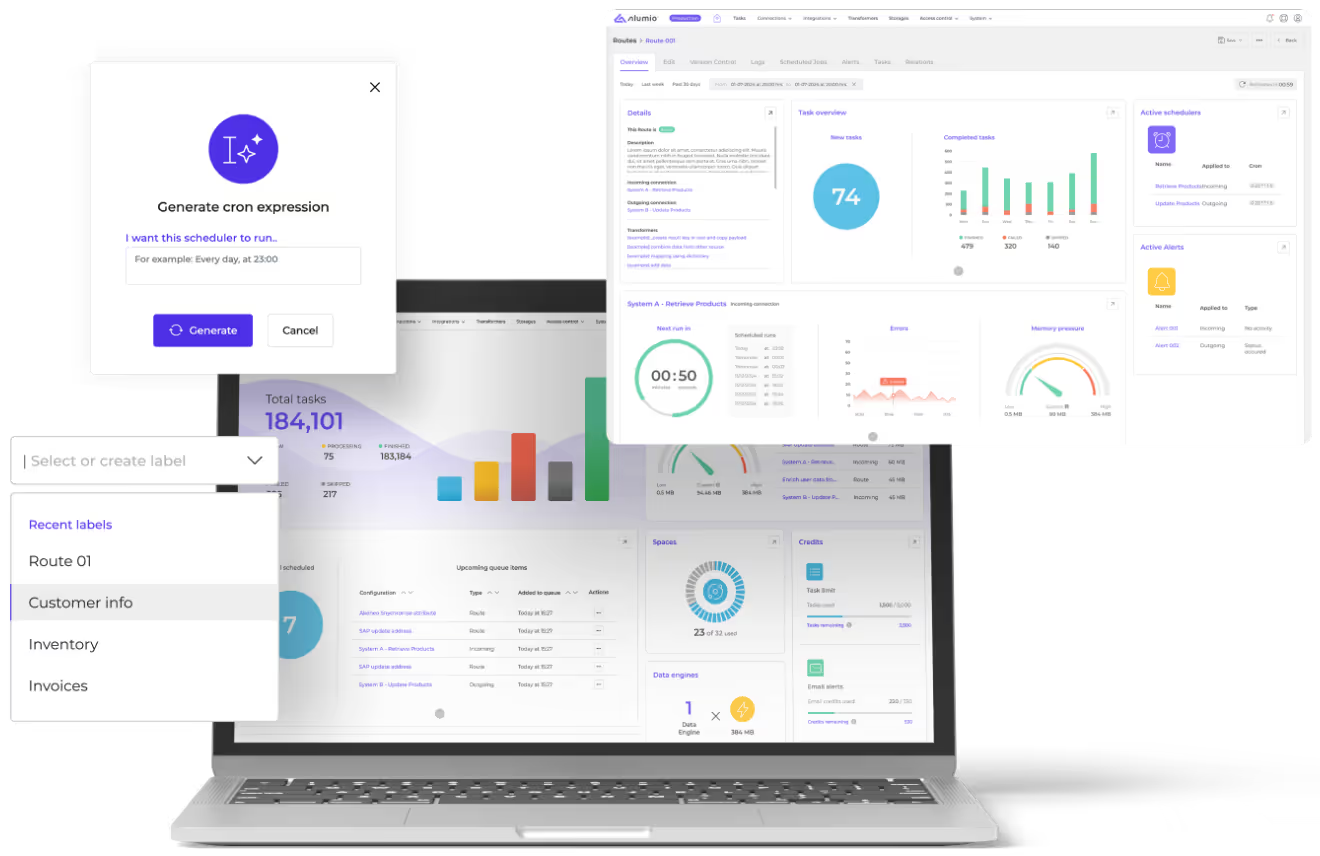
Laptop screen displaying the Alumio iPaaS dashboard, alongside pop-up windows for generating cron expressions, selecting labels and route overview.