

A Alumio vivid purple arrow pointing to the right, a visual representation of how to access more page material when clicking on it.
Go back

Patchworks vs. Alumio: Best integration platforms 2025

By
Saad Merchant
Published on
December 12, 2025
Updated on
December 24, 2025
IN CONVERSATION WITH
A 2D email icon in anthracite and vivid purple
A white cross 2D icon

E-commerce integration in 2025 is no longer just about syncing storefronts—it’s about building intelligence into every connection. As AI reshapes how retailers forecast demand, personalize experiences, and manage supply chains, integration platforms are under new pressure to deliver cleaner, more contextual, and real-time data across ERPs, PIMs, CRMs, and marketplaces. This has raised the bar for what “connected commerce” really means. Among the leading iPaaS solutions, Patchworks has become the go-to for fast, no/low-code e-commerce automation, while Alumio—originally specializing in e-commerce integration itself—has evolved into a configurable, API-driven integration platform-as-a-service (iPaaS) that’s designed to orchestrate governed data flows for businesses across industries. This Alumio vs. Patchworks comparison explores pricing, governance, and use cases to help you choose the right approach to future-proof your digital commerce strategy.

Alumio vs. Patchworks: Comparison of best integration platforms 2025

While both Alumio and Patchworks are leading e-commerce integration platforms compared, it is important to understand how both solutions approach integrations differently. Patchworks is purpose-built for retail automation—simplifying e-commerce integrations with PIM, ERP, and marketplaces through prebuilt connectors and a no/low-code interface. By contrast, businesses looking for a Patchworks alternative for ERP integration may stumble on Alumio, since it enables businesses to extend and go beyond e-commerce connectivity by simplifying integrations focused on finance, logistics, manufacturing, and more.

As more non-retail companies now sell or service customers online, the line between e-commerce and enterprise integration has blurred. The real question is whether you need a retail-focused platform for quick wins or a configurable, API-driven environment that scales across industries and supports governed, real-time retail data flows.

TL;DR verdict: Alumio iPaaS vs. Patchworks

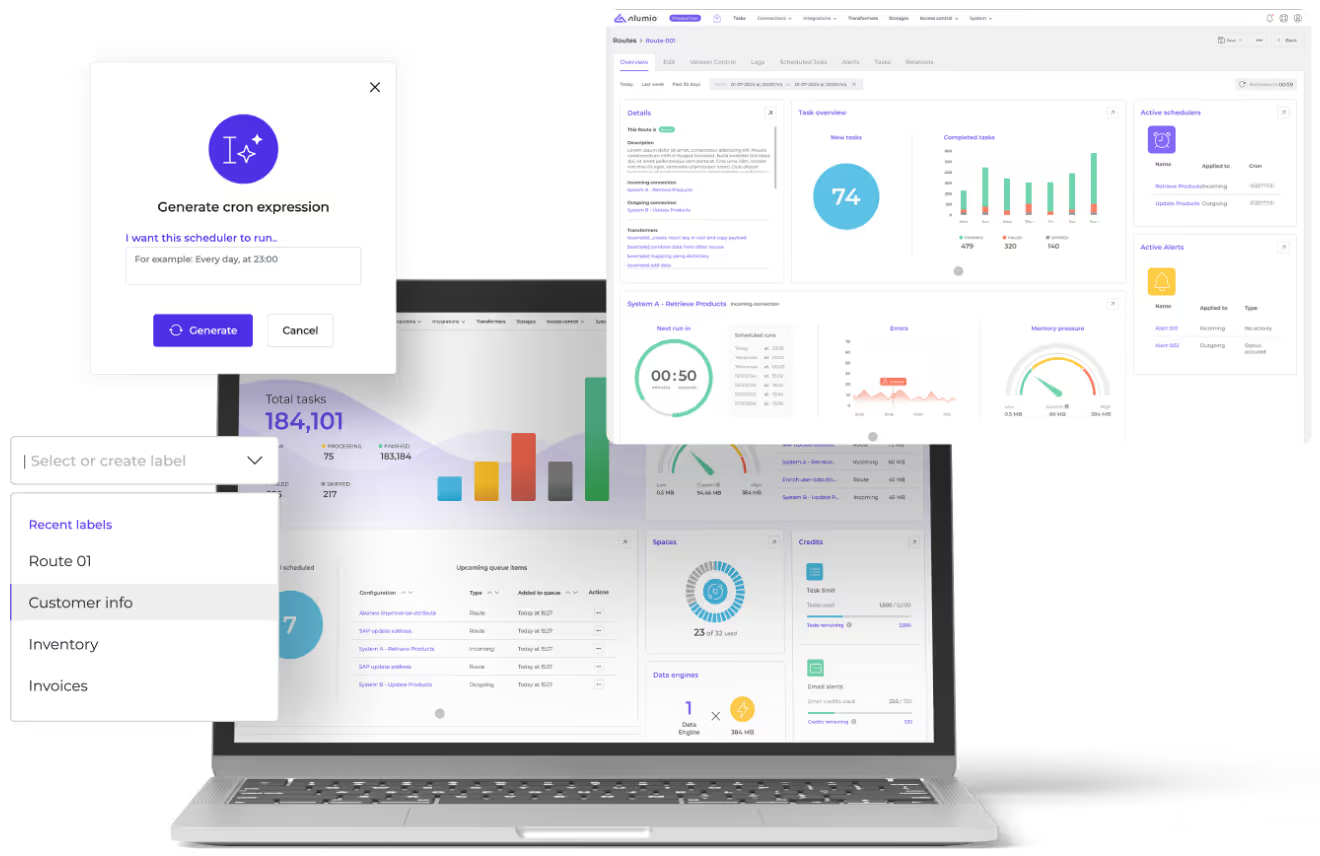
Alumio is a config-first, API-driven integration platform that lets teams configure integrations swiftly, modify data exchanges limitlessly, and monitor every process with precision. Beyond its e-commerce integrations, it provides a rich library of connectors to swiftly integrate ERPs, CRMs, finance systems, logistics platforms, and custom endpoints across industries. Its built-in transformers handle mapping, enrichment, and filtering, while Storages ensure reliability through replay and recovery. Combined with enterprise-grade monitoring and logging, Alumio gives businesses complete visibility and governance over how data moves through their landscape. Emphasizing data security and compliance, the Alumio integration platform is ISO 27001-certified and GDPR-aligned, it turns integration management into a controlled, scalable, and transparent practice.

Choose Alumio if your priority is implementing a governed, scalable integration platform that connects ERP, PIM, CRM, and e-commerce systems under one configurable, API-driven environment—ready for future AI use cases.

Patchworks is a no/low-code, cloud-based integration platform purpose-built for e-commerce. It enables retailers and D2C brands to connect storefronts, marketplaces, ERPs, and PIMs through prebuilt connectors and visual workflows, helping teams launch integrations quickly without custom code. Patchworks focuses on retail speed—automating orders, inventory, and product data across sales channels—making it ideal for companies scaling online sales or expanding into new marketplaces. While governance and cross-industry extensibility are lighter, its simplicity gives businesses immediate time-to-value in digital commerce.

Choose Patchworks if your priority is rapid e-commerce automation—deploying integrations fast with prebuilt retail connectors and minimal technical overhead.

Comparing key integration platform facts: Alumio vs. Patchworks

Pricing model

  • Alumio: Task-tiered, quote-based pricing built for predictable scaling. Plans include Essential (1M tasks/year), Growth (2M), and Custom/Flex tiers, each SLA-backed and inclusive of unlimited users, unlimited routes, and all standard/generic connectors, plus one production and one sandbox environment. Pricing is designed around usage—not connector limits—making it easier to scale integrations without cost surprises.
  • Patchworks: Tiered subscription model (Standard, Professional, Enterprise) based on connector count, active process flows, and monthly operations. The Standard tier includes 2 deployed connectors, 10 flows, and 250,000 operations/month; Professional increases this to 4 connectors, 20 flows, and 500,000 operations; Enterprise offers custom limits. Advanced features, event connectors, and webhook capacity are available only in higher tiers. Pricing is fully quote-based and optimized for e-commerce use cases.

Best for

  • Alumio: Enterprises and mid-market organizations that need governed, reusable integrations across ERP, CRM, PIM, commerce, finance, logistics, and analytics systems—especially where auditability, data transformation, and multi-system scalability matter.
  • Patchworks: Retailers, D2C brands, and e-commerce agencies that need to deploy storefront, marketplace, and ERP integrations quickly using prebuilt retail connectors and no/low-code workflows.

Integration style

  • Alumio: Config-first, API-driven orchestration with reusable routes, built-in transformers for mapping, enrichment, and filtering, and storages for resilience and reusability. Designed for flexible, multi-domain integrations with full visibility and configuration control.
  • Patchworks: A no/low-code, visual workflow builder tailored to e-commerce processes. Integrations are built using retail-centric connectors, predefined shapes, and process flows—optimized for rapid deployment rather than deep customization.

Industry focus

  • Alumio: Cross-industry versatility—retail, manufacturing, logistics, finance, services, and AI-enabled enterprises that require governed, scalable data movement across both operational and analytical systems.
  • Patchworks: E-commerce-first organizations—retailers, D2C brands, and marketplace sellers—focused on product, order, customer, and stock synchronization across platforms like Shopify, Magento, BigCommerce, Amazon, and ERP/WMS systems.

Governance & compliance

  • Alumio: ISO 27001-certified, GDPR-aligned, SLA-backed, and built with governance-by-design. Provides end-to-end monitoring, logging, auditing, and versioning, ensuring full traceability across every integration route and data flow.
  • Patchworks: Offers enterprise-grade features and is MACH Alliance-aligned, but governance, auditing, and compliance controls are lighter and primarily tailored to e-commerce scenarios rather than complex multi-system requirements.


Turn AI ambition into action

Get a free demo of the Alumio platform

Strengths and limitations: Alumio vs. Patchworks

Alumio is built for organizations that need control, transparency, and flexibility across all their integrations—not just e-commerce. Its config-first, API-driven environment makes it easy to adapt integrations as systems evolve, while its Transformers allow limitless mapping, enrichment, and filtering without custom code. And it also provides a Code Transformer to help write JavaScript to solve edge cases. Storages add reliability through replay and recovery. Combined with enterprise-grade monitoring and logging, Alumio turns integrations into governed, auditable workflows that scale across industries.

Trade-off: Alumio’s depth can feel heavier for smaller retail teams that only need quick storefront-to-ERP automation. It’s optimized for multi-system orchestration rather than one-off commerce flows.

Patchworks excels at speed and simplicity. With a no/low-code visual builder and a strong catalog of e-commerce connectors, it enables retailers and D2C brands to launch storefront, marketplace, and ERP integrations quickly. It’s ideal for product, order, customer, and stock automation where time-to-value matters more than extensive configuration.

Trade-off: Patchworks is primarily retail-focused. As system landscapes expand—into finance, logistics, manufacturing, or AI-driven processes—their connector limits, transformation depth, and governance controls can be restrictive compared to a fully configurable iPaaS.


Best use cases: Alumio vs. Patchworks

By this point, the divide is clear: Patchworks accelerates e-commerce automation, while Alumio provides governed, configurable integration across any system landscape. Here’s where each platform fits best in practice.

Where Alumio fits best

  • Enterprises building governed, multi-system integrations to synchronize ERP, PIM, CRM, and commerce platforms with full monitoring, storage, and auditability.
  • Organizations preparing for AI-driven use cases—such as forecasting, personalization, or automated operations—that rely on clean, contextual, and traceable data streams across systems.
  • Enterprises modernizing complex IT landscapes, replacing brittle point-to-point integrations with configurable, reusable routes that reduce tech debt and improve resilience.
  • Businesses expanding beyond e-commerce into finance, logistics, or manufacturing, requiring flexible, API-driven integrations that scale across partners and internal systems.

Where Patchworks fits best

  • Retailers and D2C brands automating storefront ↔ ERP ↔ marketplace flows using prebuilt connectors for products, orders, customers, and stock.
  • Brands launching new sales channels quickly—including Amazon, eBay, TikTok Shop, and additional storefronts—where speed and simplicity are the priority.
  • E-commerce agencies standardizing integrations across multiple clients, leveraging template-based setups and no-code workflows to reduce implementation time.
  • Lean teams prioritizing ease of use, allowing non-technical users to build and manage retail automations without deep configuration or custom development.

Final thoughts: Alumio vs. Patchworks integration platforms

Choosing between Alumio and Patchworks isn’t only about features—it's about how your business expects its digital operations to grow. Patchworks is ideal when e-commerce is the center of your integration universe and speed is the priority. Alumio, meanwhile, focuses on governance, configurability, and cross-industry scalability—turning integrations into transparent, reusable data flows that support ERP, PIM, CRM, finance, logistics, and AI initiatives.

As more companies shift from channel-focused automation to data-driven decision-making, the question becomes whether you need an integration tool that solves today’s storefront flows or a configurable platform that can support tomorrow’s cross-business processes. Selecting the right solution from the top e-commerce integration platforms compared depends on which approach supports the kind of growth your business is planning: fast retail automation today or a configurable integration platform that scales across systems, industries, and future AI requirements.

Connect with popular apps!

No items found.

FAQ

Integration Platform-ipaas-slider-right
What’s the core difference between Alumio and Patchworks?

Patchworks is built for fast e-commerce integration using prebuilt connectors and no/low-code workflows, while Alumio is a configurable, API-driven platform designed to support governed, scalable integrations across ERP, CRM, finance, logistics, and commerce.

Integration Platform-ipaas-slider-right
Which integration platform works better for ERP or multi-system integration?

Patchworks is optimized for retail data flows. Alumio offers broader flexibility across ERP, CRM, finance, logistics, and custom APIs, making it a strong Patchworks alternative for ERP integration and multi-industry scalability.

Integration Platform-ipaas-slider-right
Does Patchworks provide the same transformation depth as Alumio?

Patchworks supports basic mapping for retail flows, while Alumio offers advanced data transformation tools—enrichment, filtering, validation, and a Code Transformer—ideal for PIM/ERP/marketplace integrations requiring high accuracy.

Integration Platform-ipaas-slider-right
Are Alumio and Patchworks suitable when comparing e-commerce integration platforms?

Yes, but with different strengths. Patchworks excels at retail automation, while Alumio is chosen by businesses wanting e-commerce integration platforms compared not just by speed, but by flexibility, governance, and long-term scalability.

Integration Platform-ipaas-slider-right

Want to see Alumio in action?