

A Alumio vivid purple arrow pointing to the right, a visual representation of how to access more page material when clicking on it.
Go back

SnapLogic vs. Alumio: Best integration platforms 2025

By
Saad Merchant
Published on
December 12, 2025
Updated on
December 24, 2025
IN CONVERSATION WITH
A 2D email icon in anthracite and vivid purple
A white cross 2D icon

AI-driven integration in 2025 isn’t just about connecting apps—it’s about deciding whether your priority is accelerating pipelines with AI or orchestrating applications under strict governance. Enterprises today often need both: automated pipelines feeding data warehouses and analytics, and governed workflows synchronizing ERPs, CRMs, e-commerce, finance, and AI agents in real time. SnapLogic provides an AI-powered, low-code environment for building pipelines quickly, blending data and application integration. Alumio, by contrast, is a config-first, API-driven iPaaS that delivers governed orchestration, storages, transformations, and monitoring across digital commerce, ERP, and custom endpoints. This Alumio vs SnapLogic comparison explores pricing, governance, and use cases to help you choose the right approach for your integration strategy.

Alumio vs. SnapLogic: Comparison of best integration platforms 2025

Both SnapLogic and Alumio sit within the modern iPaaS landscape, but they address the AI challenge from opposite ends. SnapLogic accelerates AI adoption through AI-assisted pipelines—its low-code designer and copilots help teams connect systems and automate flows faster. Alumio enables AI to succeed by serving as the intelligent data backbone beneath it—orchestrating contextual, compliant, and reliable data streams that make AI outputs accurate and business-ready.

That’s why when searching for iPaaS solutions like SnapLogic or a SnapLogic alternative like Alumio, the decision is between prioritizing AI-driven speed and AI-ready governance. The question isn’t which tool is “smarter,” but which one ensures your AI can actually scale and deliver ROI.

TL;DR verdict: Alumio iPaaS vs. SnapLogic

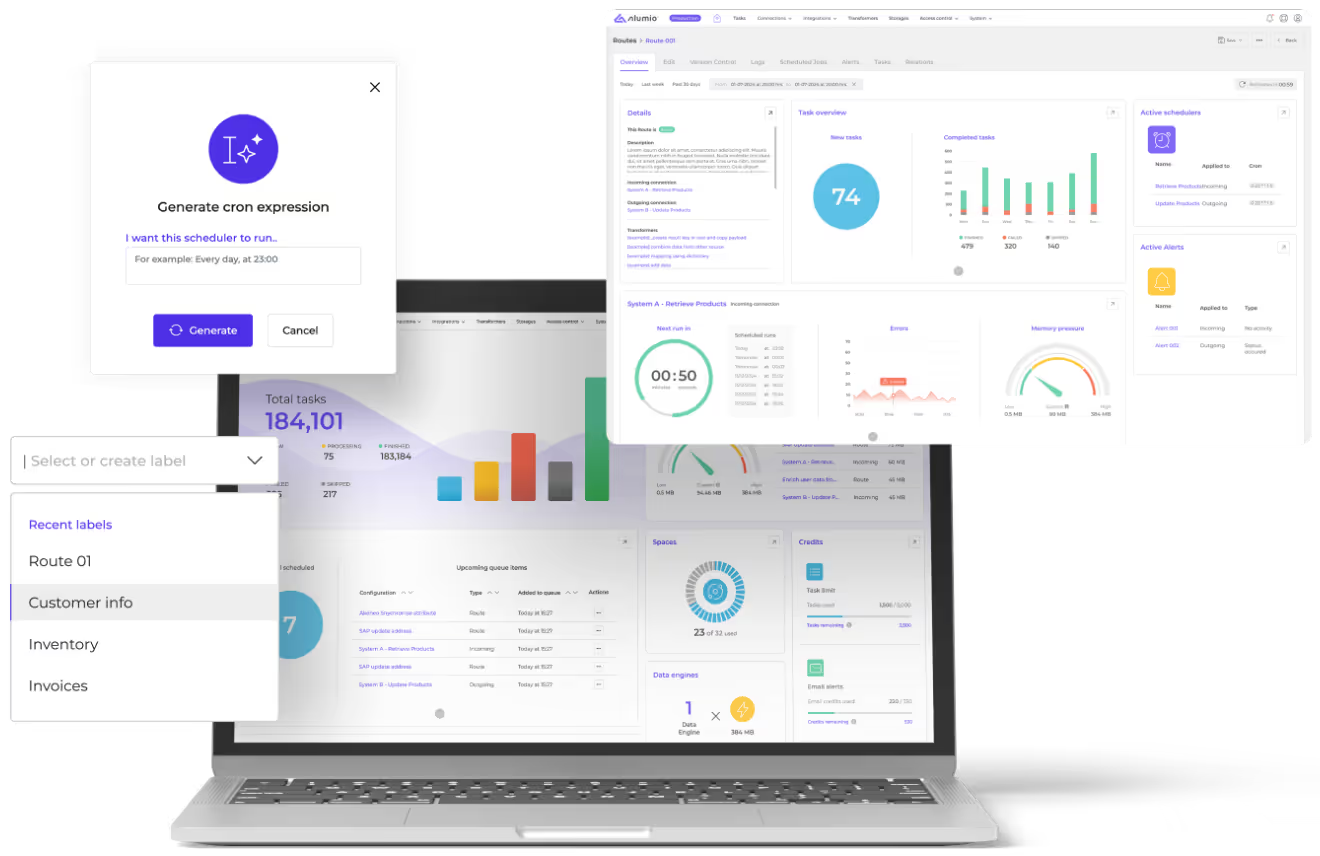
Alumio is a cloud-native, config-first, and API-driven iPaaS built to orchestrate operational systems in real time. Rather than focusing only on pipeline generation, it emphasizes governed application workflows—keeping ERPs, CRMs, PIMs, commerce, and finance platforms in sync with robust storage. Its powerful Transformers help shape, enrich, and filter data into business-ready form, while built-in monitoring and logging make every process auditable. ISO 27001-certified and GDPR-aligned, Alumio provides a secure and scalable integration backbone that turns data into a reliable foundation for automation and AI. Helping orchestrate workflows and ensuring data integrity at every step, Alumio creates traceable data streams that make AI business cases succeed in production.

Choose Alumio if your priority is implementing a governed, intelligent data backbone that powers operational workflows, ensures compliance, and provides contextual data to AI and enterprise apps.


SnapLogic is an AI-powered, low-code integration platform designed to accelerate the creation of data and application pipelines. Delivered as a unified iPaaS, it enables technical and citizen developers to connect systems quickly using its visual designer, generative AI copilots, and library of prebuilt connectors called Snaps. SnapLogic supports a wide range of data integration, API management, and ELT workloads across multi-cloud and hybrid environments. With features like Ultra Tasks for continuous data flow, pipeline monitoring, and automated mapping, it’s optimized for speed and scale in data-driven operations. By simplifying the build process, SnapLogic empowers enterprises to adopt AI faster—though governance and orchestration depth typically require additional configuration or tooling.

Choose SnapLogic if your priority is accelerating integration delivery through AI-assisted, low-code pipeline design, enabling rapid connectivity across data and application ecosystems.

Comparing key integration platform facts: Alumio iPaaS vs. SnapLogic

Pricing model

  • Alumio:
    Task-tiered, quote-based pricing designed for predictable scaling. Plans include Essential (1M tasks/year), Growth (2M tasks), and Custom/Flex tiers, each SLA-backed and inclusive of unlimited users, routes, and standard/generic connectors, plus 1 production + 1 sandbox environment. Alumio’s pricing is designed around usage and governance, not user count, providing consistent cost predictability for growing integration volumes.

  • SnapLogic:
    Bundle-based subscription model built around “unlimited data movement.” Pricing depends on environment count, Snap Packs (connectors), and runtime configurations. Core Snap Packs are included in base plans; Premium Snap Packs—like SAP or Workday—are sold à la carte. Available on AWS, Azure, and Google Cloud marketplaces. AWS Marketplace listings indicate packages around US $125,000/yr, while third-party directories note entry points near US $9,995/yr.

Best for

  • Alumio: Enterprises and mid-market organizations that need governed, reusable integrations across operational systems—ERPs, CRMs, PIMs, commerce, and finance—under strict compliance and audit demands.

  • SnapLogic: Teams seeking AI-assisted, low-code pipeline design that accelerates connectivity for both data and application integration, empowering citizen developers and data engineers alike.

Integration style

  • Alumio: Config-first, API-driven orchestration where integrations are modeled as reusable routes. Storages provide resilience and reusability; transformers handle mapping, enrichment, and filtering; and a JavaScript Code Transformer covers edge cases.

  • SnapLogic: Pipeline-first, AI-led design environment featuring “Snaps”—prebuilt connectors that abstract APIs. The visual designer and AI copilots automate mappings and recommendations, optimized for data movement and pipeline automation.

Industry focus

  • Alumio: Versatile across retail, manufacturing, logistics, finance, and digital commerce—ideal for mixed landscapes combining SaaS, legacy, and emerging AI workloads.

  • SnapLogic: Broad horizontal reach, often adopted by analytics-driven and data-centric enterprises in sectors such as finance, media, and technology that require rapid, scalable data integration.

Governance & compliance

  • Alumio: ISO 27001-certified, GDPR-aligned, SLA-backed. Provides built-in monitoring, logging, audit trails, and federated SSO for enterprise-grade governance.

  • SnapLogic: Offers pipeline-level governance features such as lineage, logging, and API policy controls. Security certifications include SOC 2 Type II and GDPR alignment, but compliance depth depends on customer configuration and included Snap Packs.


Turn AI ambition into action

Get a free demo of the Alumio platform

Strengths and limitations: Alumio vs. SnapLogic

Alumio
Alumio is optimized for governed orchestration and operational resilience—turning integrations into reusable, transparent workflows that keep systems synchronized in real time. Storages ensure replay and uptime; Transformers provide deep control over data shape and context; and integrated monitoring delivers auditability out-of-the-box. For AI initiatives, this architecture guarantees that data feeding machine-learning or automation systems is contextual, traceable, and accurate.

Trade-off: Alumio is optimized for continuous, event-driven integration and governed data exchange rather than heavy, batch-style data-warehouse processing. It’s designed to move and transform operational data as it flows between systems, not just to collect it for analysis.

SnapLogic
SnapLogic excels at speed and accessibility. Its AI copilots, low-code pipeline builder, and library of Snaps make integration approachable for non-developers while maintaining enterprise scalability. Resumable pipelines and Ultra Tasks support continuous or near-real-time data flow, and its hybrid runtime (Snaplex) supports flexible deployment.

Trade-off: Its pipeline-centric model means governance and multi-application orchestration depth can require extra configuration or tooling, especially for compliance-driven or process-heavy environments.

Best use cases: Alumio vs. SnapLogic

By now, it’s clear that Alumio and SnapLogic take distinct routes to solving the same integration challenge. Alumio focuses on governed, real-time orchestration of operational and analytical data across systems, while SnapLogic accelerates the creation of data and application pipelines with AI-assisted, low-code speed. Here’s where each platform fits best in practice:

Where Alumio fits best

  • Enterprises building a governed integration backbone to synchronize ERP, CRM, commerce, and finance platforms in real time, ensuring reliable, compliant data flows across business functions.
  • Organizations deploying AI use cases—such as automated invoice processing, predictive inventory, or personalization—that rely on clean, contextual, and auditable data streams from multiple systems.
  • Enterprises modernizing complex IT landscapes, connecting legacy and SaaS systems without custom code, while maintaining continuous operations and strong compliance controls.
  • Businesses expanding globally or across partners, needing multi-tenant orchestration with built-in monitoring, error handling, and replay to ensure resilience at scale.

Where SnapLogic fits best

  • Data teams prioritizing rapid integration delivery across analytics platforms, data warehouses, and cloud services, with AI copilots accelerating pipeline creation.
  • Organizations consolidating high-volume datasets from SaaS, on-prem, and cloud environments for reporting, BI, and machine learning.
  • Companies enabling citizen developers to build and maintain integrations independently through a visual, low-code interface.
  • Enterprises running hybrid or multi-cloud architectures, leveraging Snaplex (data processing engine) runtimes for flexible deployment and high-throughput data processing.

Final thoughts: Alumio vs. SnapLogic integration platforms

Alumio and SnapLogic represent two distinct philosophies within the modern iPaaS landscape. SnapLogic accelerates integration delivery through AI-assisted, low-code pipelines that simplify data and application connectivity. Alumio, meanwhile, serves as the intelligent data backbone beneath those connections—governing how data moves, transforms, and remains reliable across every system it touches.

SnapLogic brings speed and convenience, helping organizations experiment and deploy integrations quickly. Alumio brings control and endurance, ensuring those integrations can be trusted, audited, and scaled sustainably as they underpin real business processes and AI initiatives. Many enterprises ultimately combine both approaches—using SnapLogic to create pipelines rapidly and Alumio to orchestrate them under compliance and operational governance.

The real question is which iPaaS solution supports the kind of AI-driven growth you want: speed without guardrails or governance that guarantees ROI.


Connect with popular apps!

No items found.

FAQ

Integration Platform-ipaas-slider-right
Is SnapLogic an iPaaS?

Yes. SnapLogic is an integration platform-as-a-service (iPaaS) that supports data and application connectivity, API management, and AI-assisted pipeline design. Its low-code interface and prebuilt Snaps make it especially popular among data teams and citizen developers.

Integration Platform-ipaas-slider-right
Which integration platform is better for AI integrations?

SnapLogic accelerates AI adoption by automating how pipelines are built and deployed. Alumio ensures AI initiatives succeed by providing the governed, contextual, and auditable data that AI systems depend on. In short, SnapLogic helps you build faster; Alumio helps you scale reliably.

Integration Platform-ipaas-slider-right
How does SnapLogic pricing compare to Alumio?

SnapLogic uses a bundle-based subscription model built around “unlimited data movement,” with pricing dependent on environments, Snap Packs, and runtime configurations. Marketplace listings show contracts around US $125,000/year. Alumio offers task-tiered, quote-based plans—Essential (1M tasks/year), Growth (2M), and Custom/Flex tiers—with SLAs, unlimited users, and predictable scaling across integrations.

Integration Platform-ipaas-slider-right
‍Does SnapLogic support hybrid or multi-cloud deployment?

Yes. SnapLogic’s Snaplex architecture enables runtime execution across cloud, on-premise, and hybrid environments, and it’s available for direct purchase through AWS, Azure, and Google Cloud marketplaces.

Integration Platform-ipaas-slider-right

Want to see Alumio in action?