Alumio vs. Talend: Comparison of best integration platforms 2025
Were you looking to implement a popular integration solution and weighing whether your business requires a platform for data integration vs. application integration? Did your search for a strong ETL platform lead you to discover Talend, or perhaps you were looking for a Talend alternative that helps connect popular applications (and custom endpoints) swiftly, enable workflow automation, and build flexible data transformations? The question isn’t which tool is “better,” but which approach fits your business or enterprise’s priorities to build and govern integrations.
TL;DR verdict: Alumio iPaaS vs. Talend
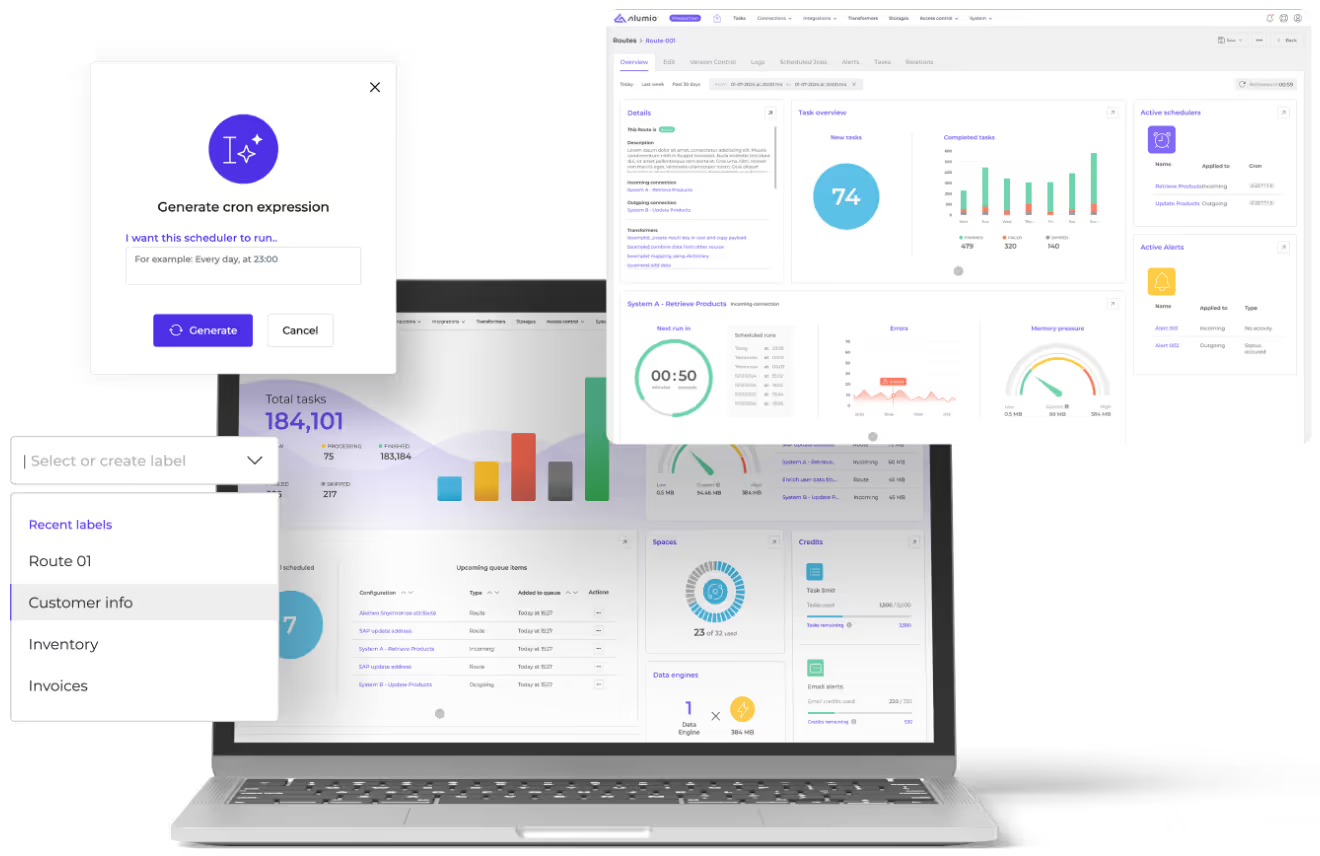
Alumio is a cloud-managed, config-first iPaaS designed to bridge operational systems in real time. Instead of focusing on analytics pipelines, it emphasizes governed application workflows—keeping ERPs, CRMs, PIMs, e-commerce, and finance platforms in sync with storages for reliability. It also provides powerful Transformers to shape, enrich, or filter data flexibly. Enabling unlimited users and integrations via one ISO 27001-certified and GDPR-aligned platform, Alumio provides a secure and scalable integration backbone. By orchestrating workflows and applying transformations in real time, it also produces the structured, consistent data streams required not only for AI-driven processes but also for adopting emerging technologies and adapting to evolving compliance rules.
- Choose Alumio if your priority is orchestrating an integrated ecosystem of data and applications, enabling workflow automation, and scaling integrations under strong compliance controls.
Talend (now part of Qlik) is an enterprise data integration platform with a long-standing heritage in ETL and ELT. Delivered as a Data Fabric, it provides low-code tools for building governed pipelines, ensuring data quality, and enforcing lineage across complex datasets. Talend integrates with major warehouses, lakes, and databases while supporting hybrid deployments across cloud, on-prem, and self-managed environments. Backed by certifications such as ISO 27001, SOC 2, and HIPAA, it helps enterprises enforce compliance while delivering analytics-ready data for reporting and machine learning. By combining transformation, observability, and governance, Talend equips organizations with trusted data pipelines that not only feed BI, ML, and AI workloads but also support long-term regulatory demands and enterprise-wide digital programs.
- Choose Talend if your priority is building trusted, compliant data pipelines at scale for analytics, reporting, and regulatory use, with hybrid deployment flexibility.
Comparing key integration platform facts: Alumio iPaaS vs. Talend
Pricing model
- Alumio: Task-tiered, quote-based pricing (from ~€999/mo, billed annually) plans—Essential (1M tasks/year), Growth (2M), and Custom/flex tiers. SLA on every plan. Base plan (Essential) includes 1 production + 1 sandbox, unlimited users and routes, and all standard/generic connectors.
- Talend: Subscription-based via Qlik Talend Cloud, with four editions (Starter, Standard, Premium, Enterprise). Pricing is quote-based and scales by data volume, job executions, and duration. Talend Open Studio, the free community edition, was retired in January 2024.
Best for
- Alumio: Enterprises and mid-market organizations needing governed, reusable integrations across ERP, CRM, PIM, commerce, finance, and marketplaces. Suited for IT leaders and system integrators who want auditable workflows and operational data to enable automation and AI.
- Talend: Enterprises with large-scale data engineering and compliance needs. Strong fit for regulated industries (finance, healthcare, government) requiring trusted pipelines, lineage, and quality enforcement to feed warehouses, lakes, and ML/AI workloads.
Integration style
- Alumio: Config-first, modeling each connection as a reusable building block. Storages ensure reliable processing and replay. Data flows can be shaped with Transformers for mapping, enrichment, and filtering, while it provides a Code Transformer (JavaScript) covers edge cases.
- Talend: Low-code data integration environment built around ETL/ELT pipelines. Provides extensive connectors for databases, warehouses, SaaS, and file formats, with built-in components for transformation, data quality, and lineage. Application and API integration is possible through Talend’s ESB and microservices tooling, but its core strength remains data engineering and batch processing.
Industry focus
- Alumio: Retail, manufacturing, logistics, finance, and B2B commerce—ideal for mixed landscapes combining legacy systems, modern SaaS, and emerging AI initiatives.
- Talend: Enterprises with heavy data management requirements across finance, healthcare, government, and telecom. Strong adoption in organizations that need to enforce compliance, consolidate multi-source data, and prepare high-quality datasets for analytics and reporting.
Governance & compliance
- Alumio: ISO 27001-certified, GDPR-aligned, SLA-backed. Enterprise governance features include audit trails and federated SSO. Monitoring, logging, and error handling are built into the platform by default, with unlimited users and routes included at all tiers.
- Talend: Enterprise-grade certifications including ISO 27001, ISO 27701, SOC 2 Type II, HIPAA, CSA STAR, and Cyber Essentials Plus. Governance is centered on data pipelines, with role-based access, lineage tracking, audit logs, and features to validate and remediate data quality.
Strengths and limitations of Alumio vs. Talend
Both platforms address integration from different angles—application workflows vs. data pipelines. Here’s where each stands out and where the trade-offs appear.
- Alumio: focuses on data connectivity, automation, transformation, and orchestration. It provides a rich library of connectors for popular apps and the tools to integrate custom endpoints, giving teams the flexibility to connect modern SaaS and legacy systems alike. Storages add resilience and replay, while built-in monitoring and logging make every flow transparent. Transformers and a Code Transformer (JavaScript) reshape data as it moves, keeping integrations consistent without heavy custom code. Alumio’s greatest strength is turning integrations into reusable, governed workflows that can flex with new technologies and compliance demands.
The trade-off: Alumio is optimized for operational connectivity and real-time workflows rather than large-scale data warehousing, so enterprises with deep analytics or data-lake needs often complement it with a dedicated data platform.
- Talend: delivers a mature environment for ETL/ELT, data quality, and governance. Its low-code designer and broad connector library make it strong for consolidating data from diverse sources into warehouses and lakes. With features like lineage, observability, and stewardship, it is trusted by regulated industries to enforce compliance and data trust at scale. Talend’s greatest strength lies in its depth for data engineering and its hybrid deployment options across cloud, self-managed, and on-prem environments.
The trade-off: Application and API integration is possible but heavier, relying on ESB or microservices tooling. Combined with fully quote-based pricing and the retirement of its free Open Studio edition, adoption can feel more complex than a cloud-native iPaaS.
Best use cases: Alumio vs. Talend
By now, it’s clear that Alumio and Talend approach integrations from different perspectives. Alumio is designed for connectivity and orchestration across applications, while Talend is rooted in ETL, data quality, and governance for analytics-driven programs. Here’s where each platform fits best in practice:
Where Alumio fits best
- Digital commerce and retail enterprises synchronizing products, orders, and inventory across ERP, PIM, storefronts, and marketplaces with SLA-backed reliability.
- Manufacturers and distributors connecting legacy systems with modern SaaS platforms through Alumio’s connector library and custom endpoint tools.
- Logistics and service providers orchestrating real-time workflows across partners, tracking systems, and finance applications with built-in monitoring and error handling.
- Enterprises adopting AI or emerging technologies, using Alumio’s storages and transformers to deliver structured, contextualized data streams that make automation and AI enablement easier.
Where Talend fits best
- Enterprises consolidating large datasets from multiple systems into data warehouses or lakes for analytics and BI reporting.
- Regulated industries such as finance, healthcare, and government where data quality, lineage, and compliance must be enforced end-to-end.
- Organizations with hybrid IT estates that need both cloud and on-prem pipelines, supported by Talend’s deployment flexibility.
- Enterprises embedding data stewardship and observability into their data pipelines to ensure trusted datasets for reporting, compliance, or machine learning workloads.
Final thoughts: Alumio vs. Talend integration platforms
Alumio and Talend both solve integration challenges but with very different centers of gravity. Talend comes from the data engineering world, built to consolidate, cleanse, and govern datasets so they can be trusted for analytics and compliance. Alumio comes from the application integration side, providing connectivity, orchestration, and transformations to keep business systems in sync in real time. Many enterprises will use both approaches in tandem: Talend for data pipelines into warehouses and lakes and Alumio for the operational workflows that power commerce, finance, and day-to-day processes. The choice isn’t which is better overall, but which priority—pipelines or workflows—sits at the heart of your integration strategy.
FAQ: Alumio vs. Talend
Is Talend an iPaaS?
Talend is primarily a data integration platform with deep ETL/ELT, data quality, and governance capabilities. It also offers application and API integration through its ESB and microservices tooling, but its core focus is data engineering, not application orchestration.
Which is better for ERP and e-commerce integrations: Alumio or Talend?
Alumio is purpose-built for ERP, PIM, CRM, and commerce workflows, with a library of connectors and tools for custom endpoints. It’s the stronger choice for operational, real-time integrations. Talend is more often used to consolidate ERP or commerce data into warehouses for reporting.
Do Alumio and Talend both support AI use cases?
Yes, but differently. Alumio prepares clean, structured operational data streams that can be consumed by AI tools or agents. Talend focuses on delivering governed datasets into warehouses or lakes, which can then be used for AI/ML training and analytics.
How does pricing compare between Alumio and Talend?
Alumio offers task-tiered, quote-based plans starting with 1M tasks/year, with unlimited users and routes included at every tier. Talend is subscription-based with four editions (Starter, Standard, Premium, and Enterprise), but prices are not public and vary by data volume, executions, and governance features.





.svg)







.svg)
.svg)
.svg)
.svg)
.svg)
.svg)
