

Ready to build your AI-ready data foundation?

See how it works
A Alumio vivid purple arrow pointing to the right, a visual representation of how to access more page material when clicking on it.
Go back

Governing AI decision-making with the iPaaS

By
Saad Merchant
Published on
June 5, 2026
Updated on
June 5, 2026
IN CONVERSATION WITH
Email icon
Email icon

Ask a room of executives whether AI is making real decisions in their business and most hands go up. Ask whether they could explain those decisions to an auditor, and the room goes quiet. Grant Thornton's 2026 AI Impact Survey put a number on it: 78% of business leaders were not strongly confident they could pass an independent AI governance audit within 90 days. The capability has outrun the accountability, and closing that gap is what AI decision governance is for. A model can deny a customer's credit terms, freeze a transaction it reads as fraud, or surface a compliance risk, and the business that deployed it often cannot reconstruct why. Governing those decisions means being able to explain them, trace the data behind them, and reverse them when they are wrong. The catch is that the evidence for any decision is the data the model read, and that data is usually scattered across the systems an AI pulls from. This is why businesses are turning to an integration platform-as-a-service (iPaaS) to route those inputs through one governed layer, where each can be controlled and recorded. With the EU AI Act's enforcement phase arriving in 2026, that shift is moving from good practice toward a requirement.

Why AI decisions break down without a governed data layer

An AI decision is only as accountable as the data behind it. The model's logic can be documented in advance, but the real evidence for any single decision is the data it actually read at that moment. When that data is spread across disconnected systems, no one can say with confidence what the model saw. The decision becomes an output the business cannot check.

This stays manageable while AI only advises, because a person reviews each suggestion before acting on it. It stops being manageable the moment AI acts on its own. A model that approves credit, holds a shipment, or escalates a risk produces consequences someone will later have to defend. "The AI decided" does not satisfy an auditor, a regulator, or a customer, which is the problem AI decision governance has to solve.

What makes an AI decision governable?

A governable AI decision is one the business can explain, trace, and undo. In practice that comes down to four questions it must be able to answer. What data did the model use. Was that data valid and current at the time. Why did it reach the outcome it did. And can the decision be reversed if it proves wrong.

The first two are data questions, not model questions. A model can be fully explainable in isolation and still produce an indefensible decision because it read stale or incorrect data. What most businesses actually need is defensibility, the ability to reconstruct months later exactly what a decision was based on. That reconstruction depends on the data layer, not the algorithm.

How an integration platform supports AI decision governance

An integration platform sits between business systems and manages how data moves between them. For AI decisions, that position is what makes governance enforceable. Every input an AI reads can pass through one layer rather than through a tangle of direct connections, which gives the business a single place to validate, record, and control it.

The Alumio iPaaS routes validated data to AI from a current source, logs every data exchange so each decision carries a traceable record, and stores intermediate data so a past state can be reconstructed and replayed. It also governs what each AI is allowed to read and act on, with access controls and monitoring that surface anomalies before they spread across connected systems.

Heusinkveld, a Dutch manufacturer of racing simulation hardware, built monitoring and logging on this kind of layer that tracks every data exchange between its systems and alerts the team to errors and anomalies in real time. The same record that keeps an integration accountable is what makes an AI decision defensible. When every input is logged and validated in transit, the trail behind a decision exists by default rather than as something pieced together after the fact.


Turn AI ambition into action

Portrait of Leonie Becher Merli, Business Development Manager at Alumio

Get a free assessment of your integration needs and next steps

Portrait of Leonie Becher Merli, Business Development Manager at Alumio

Ensure data governance despite AI-decision making with a scalable integration platform.

Ensure data governance despite AI-decision making with a scalable integration platform.

Can businesses make AI decisions reversible and explainable?

Yes, but only if the data layer is built for it. Reversibility depends on having stored the state that existed before a decision and the inputs that drove it. With that record, a wrong decision can be traced to its cause and rolled back cleanly. Without it, the business is left reconstructing events from memory, which is exactly what fails under audit.

Explainability follows the same logic. Integrations were often built as opaque black boxes, fragile and owned by a single developer, which made the reasoning behind any automated step impossible to inspect. Making that layer visible reduces risk and strengthens governance, and the same shift now applies to AI. A decision the business can see into is one it can defend, correct, and improve. One it cannot see into is a liability whose size it does not yet know.

Governance is what lets businesses trust AI with bigger decisions

AI will keep moving from advising to deciding, and the businesses that benefit will be the ones that can stand behind what their models do. That confidence does not come from a stronger model. It comes from a data foundation that records, validates, and controls every input a decision rests on.

An integration platform like the Alumio iPaaS is what turns AI decision governance from a policy on paper into something enforced where data actually moves. With the EU AI Act's enforcement phase underway in 2026 and auditors starting to ask how decisions get made, that foundation is becoming the difference between AI a business can scale and AI it has to walk back. The payoff is not caution for its own sake. It is the freedom to hand AI bigger decisions, because the evidence behind each one is already there.

No items found.

FAQ

Integration Platform-ipaas-slider-right
What is AI decision governance?

AI decision governance is the practice of making the decisions an AI model produces explainable, traceable, and reversible. It covers knowing what data a decision used, whether that data was valid at the time, why the model reached its outcome, and how to undo the decision if it was wrong. It depends as much on the data feeding the model as on the model itself.

Integration Platform-ipaas-slider-right
What is an iPaaS and how does it relate to AI governance?

An iPaaS, or integration platform-as-a-service, is a cloud-based platform that connects business systems and manages how data moves between them. It relates to AI governance because it is the single layer every AI input can pass through, which is where data can be validated, recorded, and controlled. That makes it the practical place to enforce governance rather than leaving it to each individual AI tool.

Integration Platform-ipaas-slider-right
How does an integration platform create an audit trail for AI decisions?

By routing data through one layer, the platform can log every exchange between systems, recording what data moved, when, and in what state. When an AI reads its inputs through that layer, each decision inherits a traceable record of the data behind it. Stored intermediate data also lets a business reconstruct and replay the exact state a decision was made on.

Integration Platform-ipaas-slider-right
How can businesses make AI decisions reversible?

Reversibility requires storing the state that existed before a decision and the inputs that drove it. With that record in place, a wrong decision can be traced to its cause and rolled back rather than reconstructed from memory. The data layer, not the AI model, is what holds this history and makes rollback possible.

Integration Platform-ipaas-slider-right
Why isn't a better AI model enough for trustworthy decisions?

A model can be fully explainable on its own and still make an indefensible decision if it acted on stale, incomplete, or incorrect data. Trust in a decision rests on the integrity of its inputs, which is a data and integration problem rather than a modeling one. This is why governance has to start at the data layer.

Integration Platform-ipaas-slider-right
When should a business put governance in place for AI decisions?

Before AI moves from recommending to acting without human review. While a person approves each AI suggestion, that review provides accountability. Once AI executes decisions on its own, and with regulations like the EU AI Act raising the bar on defensibility, the data layer has to supply that accountability instead. This means governance should be in place at the point autonomy is granted.

Get a free assessment of your integration needs

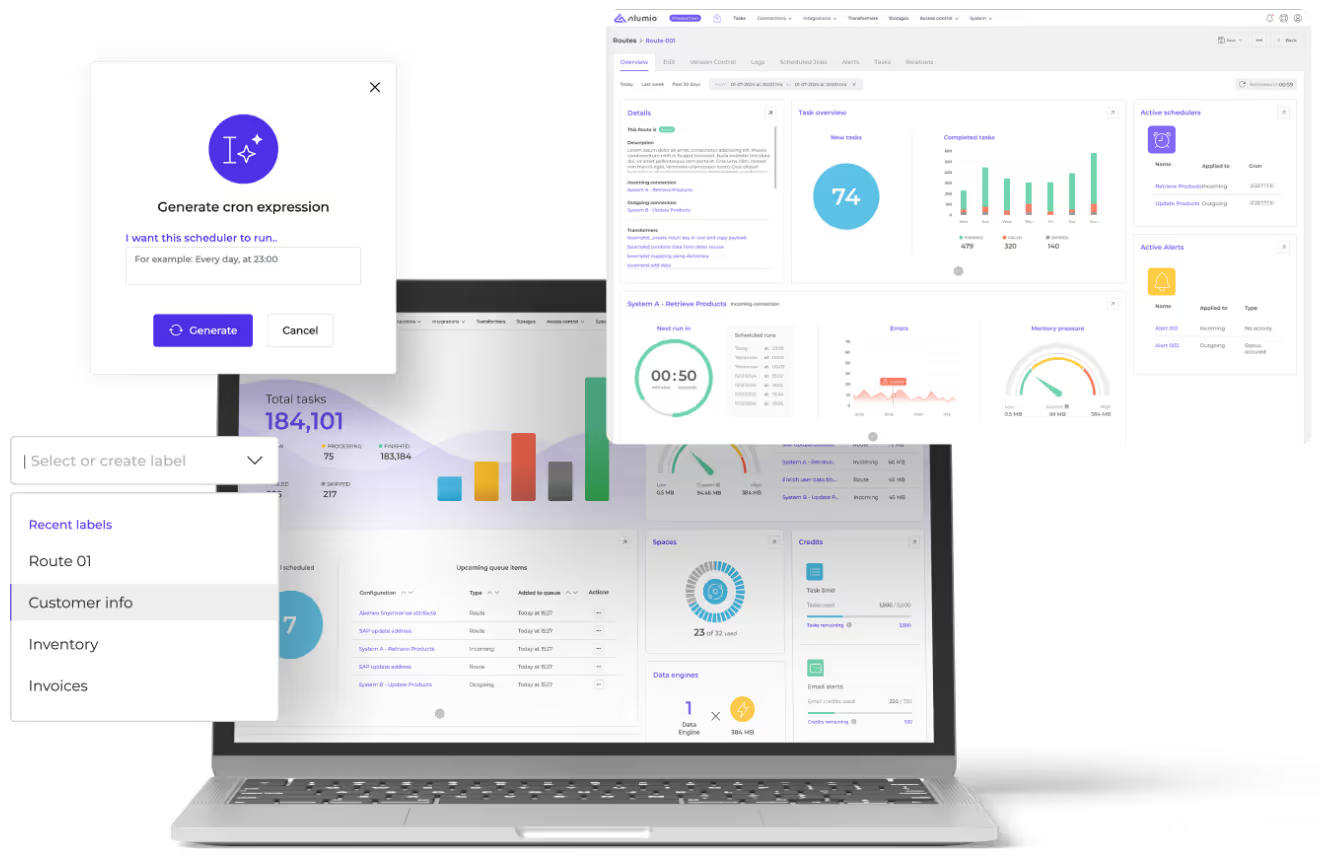
Laptop screen displaying the Alumio iPaaS dashboard, alongside pop-up windows for generating cron expressions, selecting labels and route overview.