Why integration governance matters more as professional services firms grow
In the early stages of a professional services firm's integration practice, governance is relatively simple. A small team builds integrations, everyone knows what is running, and informal oversight is enough to keep things under control. That changes with scale.
As the client portfolio grows, so does the number of people building integrations, the number of environments being managed simultaneously, and the complexity of knowing what is happening across all of them. At some point, informal oversight stops being sufficient. A change made by a junior consultant to a production integration flow, a client asking for a log of every data transfer over the past month, or a security review that requires proof of environment isolation. These situations require actual governance infrastructure, not just good intentions.
The challenge for most professional services firms is that governance feels like overhead. More process, more approvals, more friction. The goal is not governance for its own sake. It is governance that provides control without slowing delivery down.
What governance in integration delivery actually requires
Four things matter most in a professional services integration context.
- Audit trails document who changed what, when, and why. When a client reports that something changed in their data flow, the ability to pull a complete record of configuration changes and pinpoint the exact moment and actor is the difference between a confident explanation and a damaging uncertainty.
- Role-based access control determines who can build, edit, approve, and monitor integrations. In a multi-person delivery team, not everyone should have the same level of access to production environments. Junior team members should be able to configure and test without being able to modify live flows without oversight.
- Client environment separation ensures that integrations, credentials, data flows, and logs for one client are completely isolated from those of another. This is not just a technical preference. For clients operating under GDPR or sector-specific compliance requirements, it is a contractual necessity.
- Centralized monitoring and alerting means the support team knows about a failed data transfer before the client does. Proactive incident response is only possible when all flows are visible from one place rather than scattered across individual environments.
How Alumio supports integration governance for agencies and SIs
Alumio is a cloud-native, low-code integration platform-as-a-service that provides the governance infrastructure professional services firms need without requiring a separate compliance layer to be built and maintained on top.
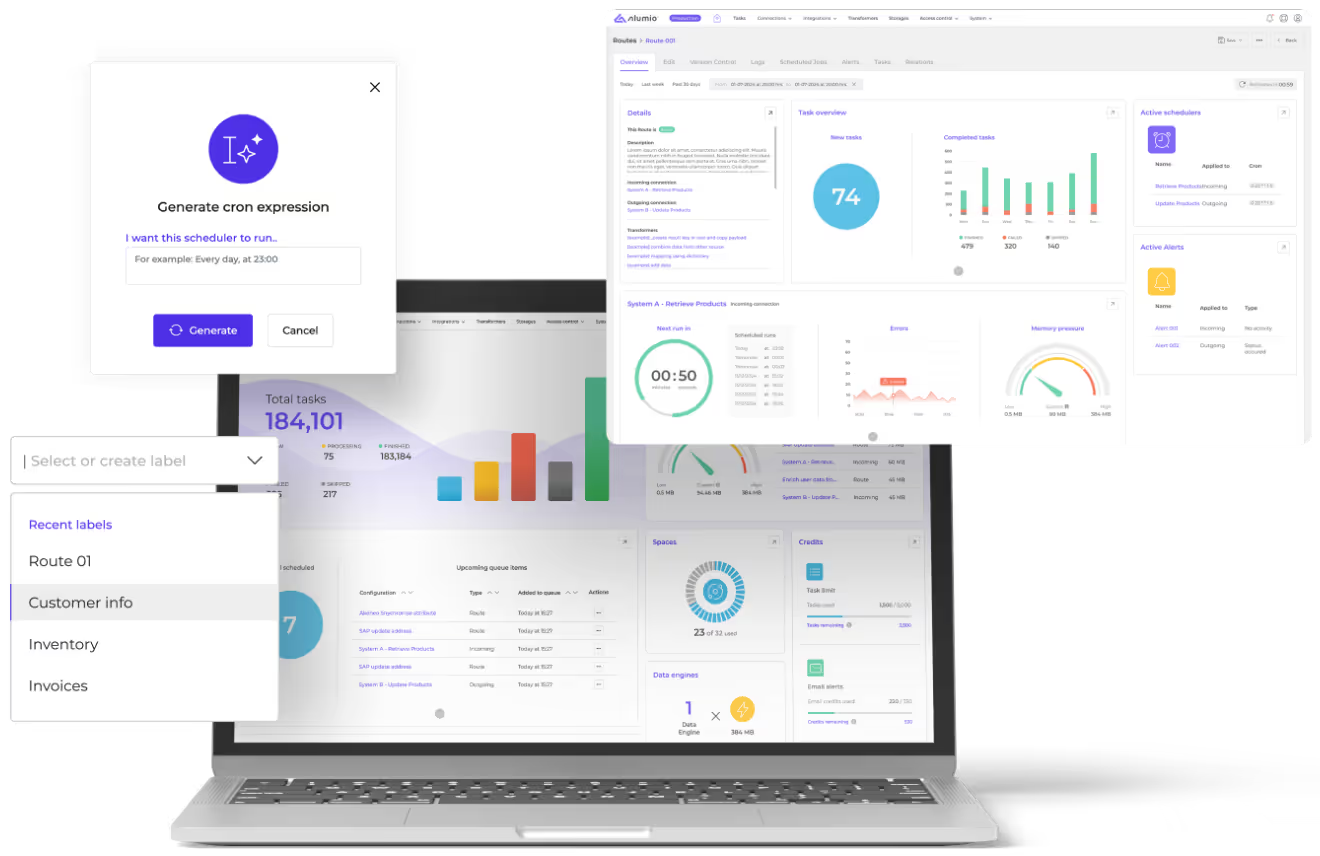
Audit trails in Alumio track all configuration changes with timestamps and user attribution. Every modification to a route, connector, or transformation rule is logged. By default, data is retained for four weeks and can be extended based on client or regulatory requirements. When a client asks what changed and when, the answer is available immediately rather than requiring manual investigation.
Role-based access control is configurable per environment. Team leads can define which users have read, build, or production-level access, ensuring that delivery teams can move quickly on development and testing without the risk of unreviewed changes reaching live client environments. Multi-factor authentication and federated SSO are also supported, which matters when clients require evidence of secure access management as part of procurement or onboarding.
Real-time monitoring and automated alerting surface errors and anomalies as they occur rather than after the fact. The support team receives alerts on failed transfers, API errors, or data inconsistencies before they escalate into client-reported incidents. Combined with full logging of every data transaction, this gives firms the operational visibility to run a credible managed service rather than a reactive one.
Client environment separation at scale with Alumio Spaces
Client environment separation becomes structurally important once a firm is managing five or more active integration landscapes simultaneously. The Alumio integration platform delivers this through a partner-specific service called Alumio Spaces.
Each client gets a dedicated Space within the Alumio platform: a logically isolated environment with its own data flows, credentials, routing logic, and access permissions. No data or configuration bleeds between Spaces. Agencies manage all client Spaces from a single central dashboard, which provides portfolio-level visibility while maintaining strict per-client isolation. For clients in regulated industries or with data residency requirements, this isolation is not optional, and Alumio Spaces is built to support it as a structural feature rather than a manual configuration exercise.
Governance is what separates a delivery firm from a trusted integration partner
The difference between a firm that delivers integrations and one that clients trust with critical data flows and long-term managed services is governance. Clients who hand over access to their ERP, CRM, and payment systems need to know that changes are tracked, access is controlled, their data is isolated, and someone will know when something goes wrong before they do.
That level of trust is not built through individual project delivery. It is built through the infrastructure the firm operates on. The Alumio integration platform provides agencies and systems the automated monitoring, logging, audit trails, access controls, and environment separation (with Alumio Spaces) that professional services firms need to deliver integration work at scale without compromising on accountability or client confidence.





.svg)








.svg)
.svg)
.svg)
.svg)
.svg)
.svg)
