


Integrate your web shops with the latest digital tools

Connect now
A Alumio vivid purple arrow pointing to the right, a visual representation of how to access more page material when clicking on it.
Go back

The hidden costs of legacy e-commerce integrations

By
Saad Merchant
Published on
May 1, 2026
Updated on
May 1, 2026
IN CONVERSATION WITH
Email icon
Email icon

Every e-commerce business carries integration debt it does not fully account for. The custom connector built three years ago to link the webshop to the ERP still works, mostly. The bespoke script synchronizing orders to the WMS runs on a schedule nobody has reviewed in months. Neither appears as a line item on the IT budget. Their cost is distributed invisibly across developer hours, failed orders, delayed projects, and the channels the business could not add because the architecture was not built to absorb them. This blog breaks down where those costs accumulate, why they compound over time, and what a more governed integration architecture looks like in practice.

Why legacy e-commerce integrations result in hidden costs

The visible cost of a custom integration is the development time it took to build. The invisible cost is everything that follows:

  • API updates that break the connection
  • Developer hours spent diagnosing an undocumented data flow
  • Inventory discrepancy that originated in a sync error nobody caught in time,
  • New tools or channels the business evaluated and shelved because integrating it into an already fragile architecture felt too risky.

McKinsey analysis has found that organizations pay a 10 to 20 percent premium on every IT initiative just to navigate legacy code and brittle dependencies. In e-commerce environments where integrations sit at the center of every operational flow, that premium shows up constantly and in ways that rarely trace back to their source.

Developer capacity consumed by integration maintenance

Custom integrations are written by people. When those people leave, the integrations remain, but the understanding of them does not. The next developer inherits a codebase with no documentation, spends time decoding logic, and rebuilds their own undocumented workaround on top of the original. This compounds with each cycle.

The practical result is that a growing share of development capacity goes toward keeping existing integrations functional rather than building new capability. Teams that should be improving checkout conversion, launching new channels, or enabling personalization are instead responding to API failures and data sync errors. The opportunity cost is rarely quantified, but it is one of the most significant drains legacy integrations create.

Integration failure rates and their e-commerce revenue impact

When a sync fails between the webshop and the ERP, the consequences are immediate and operational: inventory counts diverge, orders are accepted for stock that is not available, fulfillment is delayed, and customer service absorbs the fallout. On custom integrations without centralized monitoring, these failures typically surface as customer complaints rather than system alerts.

The cost of each failure extends beyond the developer time to fix the connection. It includes the orders that did not fulfill on time, the customer trust that erodes, and the manual reconciliation work that falls to operations teams who were not hired to do it.

Channel expansion blocked by legacy integration architecture

One of the most commercially significant hidden costs of legacy integrations is the constraint they place on growth. Adding a new sales channel, marketplace, or fulfillment provider to a stack built on point-to-point custom connections is not a simple project. Each new system requires its own custom integrations, each with its own maintenance burden. The more custom connections already in place, the more complex and risky each addition becomes.

Businesses that want to add a new marketplace or enable real-time inventory visibility across channels often find that their integration architecture cannot support it without significant rework. The result is that strategic decisions get made around technical constraints rather than commercial opportunity.


Turn AI ambition into action

Portrait of Leonie Becher Merli, Business Development Manager at Alumio

Get a free assessment of your integration needs and next steps

Portrait of Leonie Becher Merli, Business Development Manager at Alumio

Ready to replace legacy connectors with a modern integration backbone?

Ready to replace legacy connectors with a modern integration backbone?

Key-person dependency in custom integration environments

In most e-commerce environments, at least one critical integration is understood fully by exactly one person. When that person leaves, the integration becomes a black box. Changes to it carry disproportionate risk. Debugging it under pressure is slow and expensive. This is an architecture problem, not a people problem. Integrations embedded in custom code and undocumented scripts create dependencies that are inherently fragile because knowledge of them cannot be distributed across a team.

How legacy integration complexity compounds over time

Legacy integrations do not degrade linearly. Each API update that breaks a connection, each workaround added for a new edge case, and each manual exception built into a data flow adds another layer of complexity. The cost of maintaining any individual connection grows over time, even when the connection itself has not changed, because the surrounding systems have. At a certain point, the maintenance burden consumes enough development capacity that the business cannot modernize without disrupting live operations and cannot stay competitive without modernizing.


Replacing legacy e-commerce integrations with a governed iPaaS architecture

The alternative to accumulating integration debt is building on a centralized integration platform-as-a-service (iPaaS), either from the start or by migrating custom connections as the architecture matures. An iPaaS connects e-commerce platforms, ERPs, WMS, PIM, and marketplace systems through a governed central layer rather than a web of individual custom scripts.

When a vendor updates their API, the update is handled within the integration platform rather than requiring custom code to be rewritten per connection. When a new channel is added, it connects to the integration layer once rather than requiring new bespoke connections to every existing system. Monitoring and error handling are centralized, so failures surface as alerts rather than as customer complaints. Integration logic lives in a platform that any team member can access, not in code that only one person can read.

Alumio connects e-commerce platforms, including Shopify, Adobe Commerce, BigCommerce, and Commercetools, with ERP, WMS, PIM, and marketplace systems through exactly this kind of governed integration layer.

Legacy integration debt compounds without an integration platform

The hidden costs of legacy e-commerce integrations are not dramatic. They accumulate in the background: developer hours absorbed by maintenance, orders affected by sync errors, channels not launched because the architecture could not support them, and strategic decisions deferred because technical risk felt too high.

By the time the full cost is visible, it is usually because something has broken badly enough to force action. The businesses that address integration architecture proactively are the ones that retain the flexibility to grow. Those that wait pay a compounding cost until the intervention is no longer optional.

No items found.

FAQ

Integration Platform-ipaas-slider-right
What are the hidden costs of legacy e-commerce integrations?

Legacy e-commerce integrations carry several costs that rarely appear as line items. Developer time gets absorbed by maintenance and emergency fixes rather than new work. Integration failures cause order errors and inventory discrepancies with direct revenue impact. Channels and tools that could add commercial value get shelved because the architecture cannot absorb new connections. And when integrations are understood only by the people who built them, every change or departure becomes a risk.

Integration Platform-ipaas-slider-right
Why do custom e-commerce integrations become more expensive over time?

Custom integrations are written to a specific state of the systems they connect. As those systems update their APIs, data models, or authentication protocols, the custom code breaks and requires rewriting. Each fix typically adds another layer of undocumented logic, increasing the maintenance burden for future changes. The cost compounds with each cycle rather than staying flat.

Integration Platform-ipaas-slider-right
How do legacy integrations limit e-commerce growth and channel expansion?

Adding new sales channels, marketplaces, or tools to an e-commerce stack built on point-to-point custom connections requires building new custom integrations for each addition. The more existing custom connections there are, the more complex and risky each new addition becomes. Many businesses end up making commercial decisions around what their integration architecture can support rather than what the market requires.

Integration Platform-ipaas-slider-right
What is key-person dependency in e-commerce integration, and why does it matter?

Key-person dependency occurs when a critical integration is understood fully only by the developer who built it. When that person leaves or is unavailable, the integration becomes difficult to modify, debug, or hand over. It is a structural risk created by undocumented custom code rather than a people management problem, and it becomes more acute as the portfolio of custom integrations grows.

Integration Platform-ipaas-slider-right
How does an iPaaS reduce the hidden costs of legacy e-commerce integrations?

An iPaaS replaces individual custom scripts with a governed central layer that all systems connect through. API updates are handled within the platform rather than requiring custom code rewrites per connection. New systems connect once to the integration layer rather than requiring new connections to every existing system. Monitoring and error handling are centralized, so failures surface as alerts rather than downstream operational problems.

Integration Platform-ipaas-slider-right
When should an e-commerce business consider replacing legacy integrations?

Several signals indicate the current approach has become a liability. A meaningful share of development capacity gets spent on maintaining existing integrations rather than building new capabilities. Integration failures are surfacing regularly as customer-facing problems rather than internal alerts. Adding new channels consistently triggers complex technical discussions about feasibility rather than straightforward implementation. And key integrations are understood only by one or two people whose departure would create serious operational risk.

Get a free assessment of your integration needs

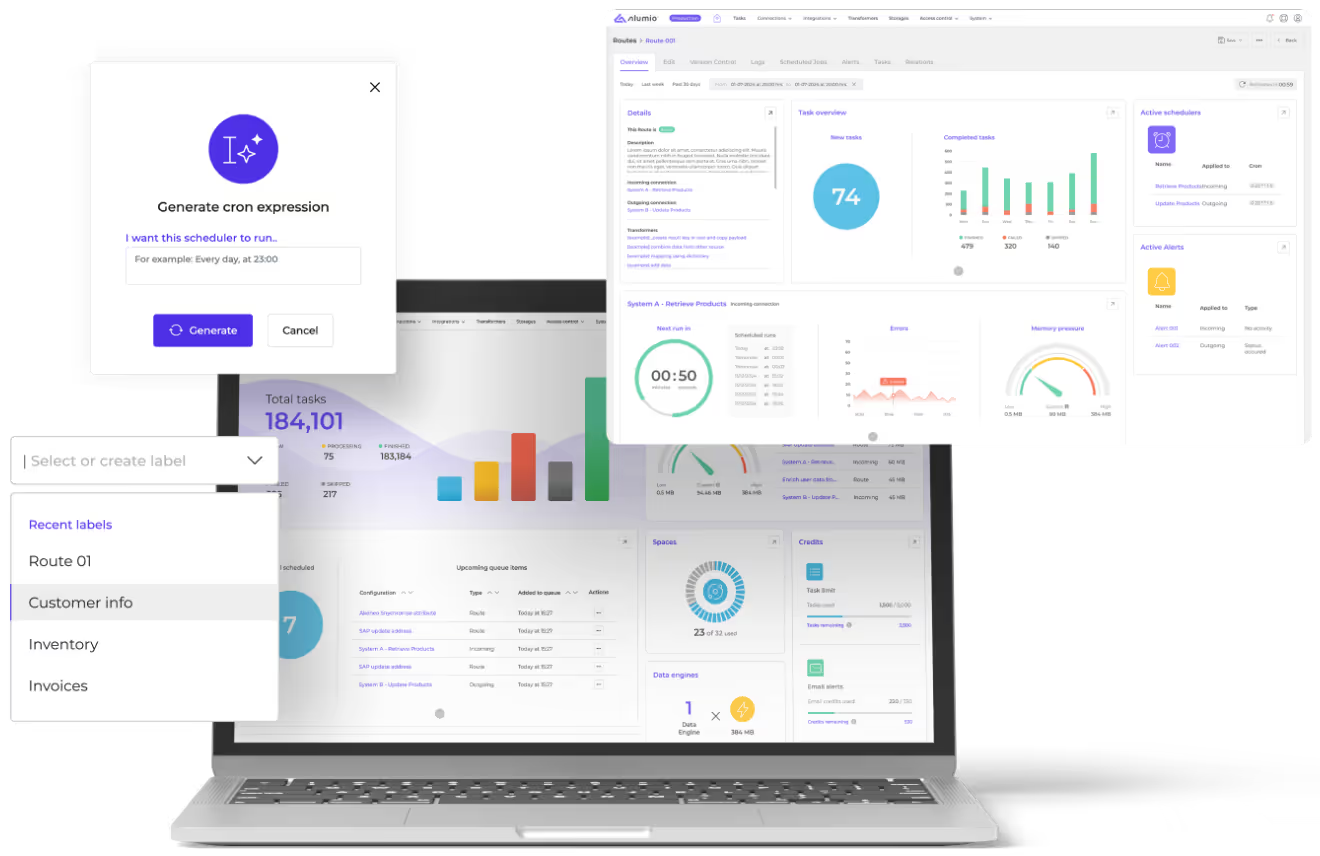
Laptop screen displaying the Alumio iPaaS dashboard, alongside pop-up windows for generating cron expressions, selecting labels and route overview.