


See how Alumio handles data residency and compliance

Get a security overview
A Alumio vivid purple arrow pointing to the right, a visual representation of how to access more page material when clicking on it.
Go back

GDPR data transfer: where your e-commerce data really lives

By
Saad Merchant
Published on
June 26, 2026
Updated on
June 27, 2026
IN CONVERSATION WITH
Email icon
Email icon

When a shopper buys from an EU store, their data rarely stays in the EU. It flows into a payment processor, a marketing tool, an analytics platform, and a support system. Some of those run on servers in the United States or elsewhere. Each of those moves is a cross-border data transfer. Under GDPR, every one needs a legal basis. GDPR data transfer rules govern when personal data can leave the EU and where it is allowed to live, a question most e-commerce teams cannot answer about their own stack. The usual assumption is that the e-commerce platform holds the data, when in practice it is scattered across a dozen connected tools in several countries. That gap is a compliance risk, because a transfer with no valid basis can mean fines and forced changes to how the business runs. The first step out is simply seeing where data goes. That visibility comes from adding an integration layer that connects those tools and keeps a record of every flow. Handled there, GDPR data transfer stops being a guess and becomes something a business can actually account for.

What GDPR data transfer rules actually require

GDPR data transfer rules govern when personal data is allowed to leave the EU and the EEA. The principle is straightforward: personal data can only be sent to another country if that country, or the receiving organization, offers protection equivalent to GDPR. This sits in Chapter V of the regulation, and it applies every time customer data crosses a border, including the routine transfers that happen inside an integrated software stack.

There are a few ways to meet the rule. The EU has judged some countries to provide adequate protection, so transfers to them need no extra step. For the United States, certified companies can rely on the EU-US Data Privacy Framework. Where neither applies, businesses use safeguards such as Standard Contractual Clauses, paired with an assessment of whether the data will really be protected in practice.

Data residency is the related question of where data physically sits. The two travel together, because you cannot choose a lawful transfer path until you know where your data is going. For most e-commerce businesses, that is the hard part. The data is not in one place, and no one has mapped where it ends up.

Where does your e-commerce customer data actually live?

In most cases, no single person can say. A typical store spreads customer data across a dozen systems, and several of them run in different countries. An order places personal data in the e-commerce platform, then sends it to a payment processor, a fraud-check service, a marketing tool, an analytics platform, a help desk, and the ERP. Some of those vendors host in the EU. Others host in the United States, or replicate data across regions the buyer never sees. Each hop is a transfer that GDPR data transfer rules apply to, whether or not anyone planned it that way. The data residency question, where each piece of data actually rests, is answered by the architecture, not by a policy document.

Why cross-border transfers are easy to get wrong in a connected stack

The risk is rarely a deliberate decision to break the rules. It is the quiet accumulation of transfers no one tracked:

  • Vendors that moved or lapsed: a US tool you rely on may not hold an active Data Privacy Framework certification, and certification can lapse without notice, removing the legal basis you assumed was there.
  • Onward transfers you do not see: a tool you send data to may pass it to its own subcontractors in other countries, and you stay responsible for where it ends up.
  • Copies made for convenience: analytics and marketing tools often duplicate customer data into their own environments, creating new transfers separate from the original system.
  • No record of the flow: GDPR expects a business to document where personal data goes, and that record is hard to keep when connections are built one by one with no central view.

Each of these comes back to the same gap, which is that no one can see all the data flows at once. That visibility is what an integration platform-as-a-service (iPaaS) provides, software that routes a business's data through one managed layer instead of dozens of direct connections. This is the same control that makes broader privacy compliance workable across connected systems.


Turn AI ambition into action

Portrait of Leonie Becher Merli, Business Development Manager at Alumio

Get a free assessment of your integration needs and next steps

Portrait of Leonie Becher Merli, Business Development Manager at Alumio

Want a clear view of every GDPR data transfer across your tech stack?

Want a clear view of every GDPR data transfer across your tech stack?

How can a business see and control where its data goes?

By routing data through one layer that records every flow and lets the business decide what goes where. When all connections run through a single platform, the path each piece of data takes becomes visible and governable. The Alumio integration platform is hosted in the European Union by default, with dedicated EU or US-East environments and data residency confirmed before anything goes live, so a business knows where its data sits from the start. Every task, event, and error is logged in full, which gives the record of data movement that GDPR expects and that is otherwise so hard to assemble. Because data passes through one layer, the business can control which systems receive which fields, and minimize or filter personal data before it reaches a tool that does not need all of it. The platform is ISO 27001 certified with GDPR and SOC 2 alignment. Most businesses set it up with a certified integration partner who configures the flows and the residency choices to match their obligations. The same discipline applies when GDPR and AI tools enter the stack, where customer data can otherwise reach a model with no record of the journey.

Turning GDPR data transfer into something you can account for

GDPR data transfer is not really a legal problem first. It is a visibility problem that becomes a legal one. A business cannot choose a lawful path for data it cannot see, and it cannot prove compliance for flows it never recorded.

Seeing the flows is what changes that. Once a business knows where its customer data goes and can control those routes from one place, data residency turns from an open question into a deliberate choice. That is the position worth reaching, where the business decides where its data lives rather than discovering it after the fact.

No items found.

FAQ

Integration Platform-ipaas-slider-right
What is a GDPR data transfer?

A GDPR data transfer is any movement of personal data from the EU or EEA to another country. Under Chapter V of GDPR, each transfer needs a legal basis, such as an adequacy decision, the EU-US Data Privacy Framework, or Standard Contractual Clauses. The rule applies to routine transfers inside connected software, not just deliberate exports.

Integration Platform-ipaas-slider-right
What is data residency?

Data residency is where data is physically stored and processed. It matters for GDPR because the location determines which transfer rules apply. Two businesses running the same tools can end up with different residency outcomes, depending on where each vendor hosts and replicates data.

Integration Platform-ipaas-slider-right
How do I know where my e-commerce customer data is stored?

Start by mapping every system that touches customer data and where each one hosts it, including the tools they pass data to. This is difficult when connections are built separately, which is why routing data through one integration layer helps, since it makes every flow visible in a single place. For a definitive position, confirm hosting and sub-processors with each vendor in writing.

Integration Platform-ipaas-slider-right
Is transferring data to a US tool allowed under GDPR?

It can be, if the US company holds an active EU-US Data Privacy Framework certification, or if you have another safeguard such as Standard Contractual Clauses in place. The certification must be current, because a lapsed one removes the legal basis. The framework survived a legal challenge in 2025 but remains under pressure, so many businesses keep Standard Contractual Clauses as a fallback.

Integration Platform-ipaas-slider-right
Does an integration platform make a business GDPR compliant?

Not on its own. Compliance is a legal and organizational responsibility, not a feature you can buy. What an integration platform does is give the visibility and control that compliance depends on: a record of where data flows, and the ability to decide where it goes. The legal judgment still needs qualified counsel.

Integration Platform-ipaas-slider-right
How does data residency affect choosing integration tools?

It should be a selection criterion, not an afterthought. A tool that hosts in the EU, or lets you choose your region, makes lawful transfers simpler than one that replicates data wherever it likes. For businesses with mostly EU customers, EU-hosted infrastructure reduces the number of cross-border transfers to account for in the first place.

Get a free assessment of your integration needs

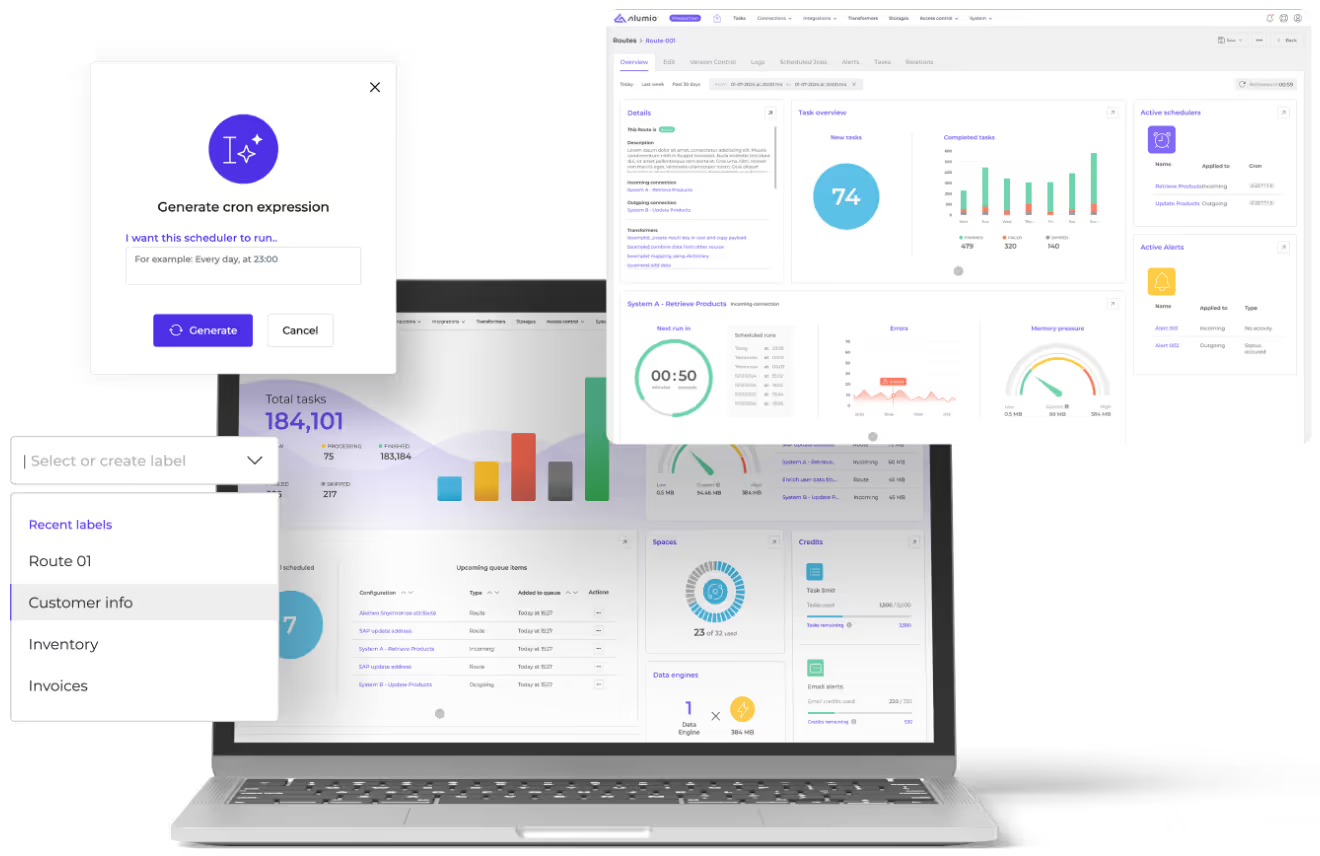
Laptop screen displaying the Alumio iPaaS dashboard, alongside pop-up windows for generating cron expressions, selecting labels and route overview.