


Want to start scaling data exchange across manufacturing plants?

Connect manufacturing systems
A Alumio vivid purple arrow pointing to the right, a visual representation of how to access more page material when clicking on it.
Go back

Why smart factories fail: the missing integration layer

By
Saad Merchant
Published on
June 5, 2026
Updated on
June 5, 2026
IN CONVERSATION WITH
Email icon
Email icon

A single production line gets a smart factory pilot. Sensors feed a dashboard, downtime drops, and the results look strong enough to roll out everywhere. Then the rollout stalls. McKinsey's research on Industry 4.0 found that only about 30 percent of manufacturers manage to scale their pilots across the organization, leaving most stuck in what it calls pilot purgatory, often for more than a year. The technology is usually not the problem. Smart factory scalability fails because each pilot is built as a self-contained island, wired directly to the systems around it, with no shared layer to carry its data across other lines, plants, and enterprise systems. Scaling then means rebuilding those connections site by site, which is slow, costly, and fragile. This is why manufacturers are turning to an integration platform-as-a-service (iPaaS) to provide the one layer that moves machine and system data across the whole operation. Without it, a smart factory program can prove its value in one corner of the plant and still never reach the rest of it.

Why smart factory pilots stall after the proof of concept

A pilot is designed to prove a point, not to scale. It runs on one line or in one plant, with connections built specifically for that setup. The data flows because someone wired it to flow, directly between the sensors, the dashboard, and whatever system needed to consume it. Inside that boundary, it works.

Scaling breaks the model. Every new line and every new site brings different equipment, different protocols, and different existing systems. Extending the pilot means rebuilding those point-to-point connections again and again, with the number of connections growing faster than the number of sites. Most programs run out of time, budget, or patience long before they reach the whole operation. That is pilot purgatory: a proven concept that cannot travel.

What actually blocks smart factory scalability?

The blocker is rarely the technology and almost always the integration architecture beneath it. The sensors, models, and dashboards in a pilot are usually sound. What does not scale is the web of direct connections holding them together.

Manufacturing data also lives in two worlds that were built separately. Shop-floor systems like PLCs, SCADA, and MES speak one set of protocols, while enterprise systems like ERP and planning tools speak another. When a pilot bridges them with custom links, that bridge is specific to the pilot. The same pattern shows up in the core systems, where choosing custom code over a managed integration layer for ERP, MES, and WMS builds technical debt that compounds with every new connection. Reproducing all of it across an operation, each plant with its own machine mix and system landscape, is where scalability quietly dies.

The integration layer that turns pilots into programs

Manufacturers that scale successfully build for it from the start, and they build in layers rather than in connections. Underneath sits a shared integration layer that carries data between machines, plant systems, and enterprise applications, so each new line plugs into something that already exists instead of being wired from scratch.

This is the real difference between a pilot and a program. A pilot connects a few systems once. A program needs one place where machine data is translated into a form business systems can use, validated, and routed wherever it is needed, consistently across every site. Bridging the shop floor and enterprise systems has its own mechanics, from MQTT and the Unified Namespace to the IT-side integration layer, but for scaling the point is simpler: the layer, not the individual connection, is what travels across the operation.


Turn AI ambition into action

Portrait of Leonie Becher Merli, Business Development Manager at Alumio

Get a free assessment of your integration needs and next steps

Portrait of Leonie Becher Merli, Business Development Manager at Alumio

Looking for the smart factory scalability to move beyond pilots?

Looking for the smart factory scalability to move beyond pilots?

How an integration platform scales smart factory data across sites

An integration platform, or iPaaS, scales smart factory data by giving every site and system one shared layer to connect through instead of one-off links. It sits between the shop floor and enterprise systems and manages how data moves between them, so a connection built once can be reused rather than rebuilt.

The Alumio iPaaS connects machine and system data into a single governed flow, translating shop-floor formats into structures that ERP, MES, and analytics tools can consume. A connector or configured route created for one line can be applied to the next without custom development, which is what changes the economics of rolling out across plants. It also provides centralized monitoring across every flow, so a problem on one site surfaces in one place rather than hiding in a local script.

That reusability is what lets specific use cases scale. A predictive maintenance model proven on one asset class depends on a steady flow of machine data to keep working. The same layer that fed the pilot can feed it across the fleet, so the use case scales with the architecture rather than demanding a fresh integration effort every time.

Smart factory scalability is an architecture decision, not a technology one

The manufacturers pulling ahead in Industry 4.0 are not the ones running the most pilots. They are the ones whose pilots were built on a foundation that could carry them across the operation. Smart factory scalability comes down to whether machine and system data can move freely across lines, plants, and enterprise systems, or whether every expansion means starting the wiring over.

Treating the integration layer as the first decision rather than an afterthought is what separates a program that scales from a pilot that stalls. With a platform like the Alumio iPaaS carrying that data across the operation, a result proven on one line becomes something the whole business can build on. The pilots were never the hard part. Making them travel is, and that comes down to the foundation underneath rather than any single technology.

No items found.

FAQ

Integration Platform-ipaas-slider-right
What is pilot purgatory in manufacturing?

Pilot purgatory is the state where a manufacturer's digital or smart factory pilots prove value in isolation but never scale across the wider operation. Companies often run several pilots at once and get stuck running them for a year or more without enterprise-wide rollout. The usual cause is fragmented systems and connections that were built for the pilot and cannot be reused elsewhere.

Integration Platform-ipaas-slider-right
What is smart factory scalability?

Smart factory scalability is the ability to extend a digital manufacturing initiative from one line or plant to the entire operation without rebuilding it each time. It depends less on the sensors or models in the pilot and more on whether machine and system data can flow consistently across every site. A scalable setup reuses one integration layer rather than creating new point-to-point connections for each location.

Integration Platform-ipaas-slider-right
Why do smart factory pilots fail to scale?

They fail because the connections that made the pilot work were built specifically for it. Each new line or site has different equipment, protocols, and systems, so extending the pilot means rebuilding those links repeatedly, with effort that grows faster than the rollout itself. Most programs exhaust their time and budget before reaching the full operation.

Integration Platform-ipaas-slider-right
How does an integration platform help scale smart factory initiatives?

An integration platform, or iPaaS, gives every site and system one shared layer to connect through instead of bespoke links between each pair of systems. It translates shop-floor data into formats enterprise systems can use, routes it where it is needed, and lets a connection built once be reused across plants. That reuse is what turns an isolated pilot into a program that scales.

Integration Platform-ipaas-slider-right
Is the technology or the integration the bigger barrier to scaling Industry 4.0?

For most manufacturers, the integration architecture is the bigger barrier. The sensors, dashboards, and models used in pilots are generally proven, while the custom connections holding them together are what fail to reproduce at scale. Scaling problems are usually data and integration problems rather than limits of the technology itself.

Integration Platform-ipaas-slider-right
When should manufacturers address the integration layer in a smart factory program?

At the start, before the first pilot is treated as a template for the rest. Building a pilot on a shared integration layer from the outset means later sites plug into something that already exists rather than requiring fresh wiring. Leaving the integration layer until scaling begins is what tends to trap programs in pilot purgatory.

Get a free assessment of your integration needs

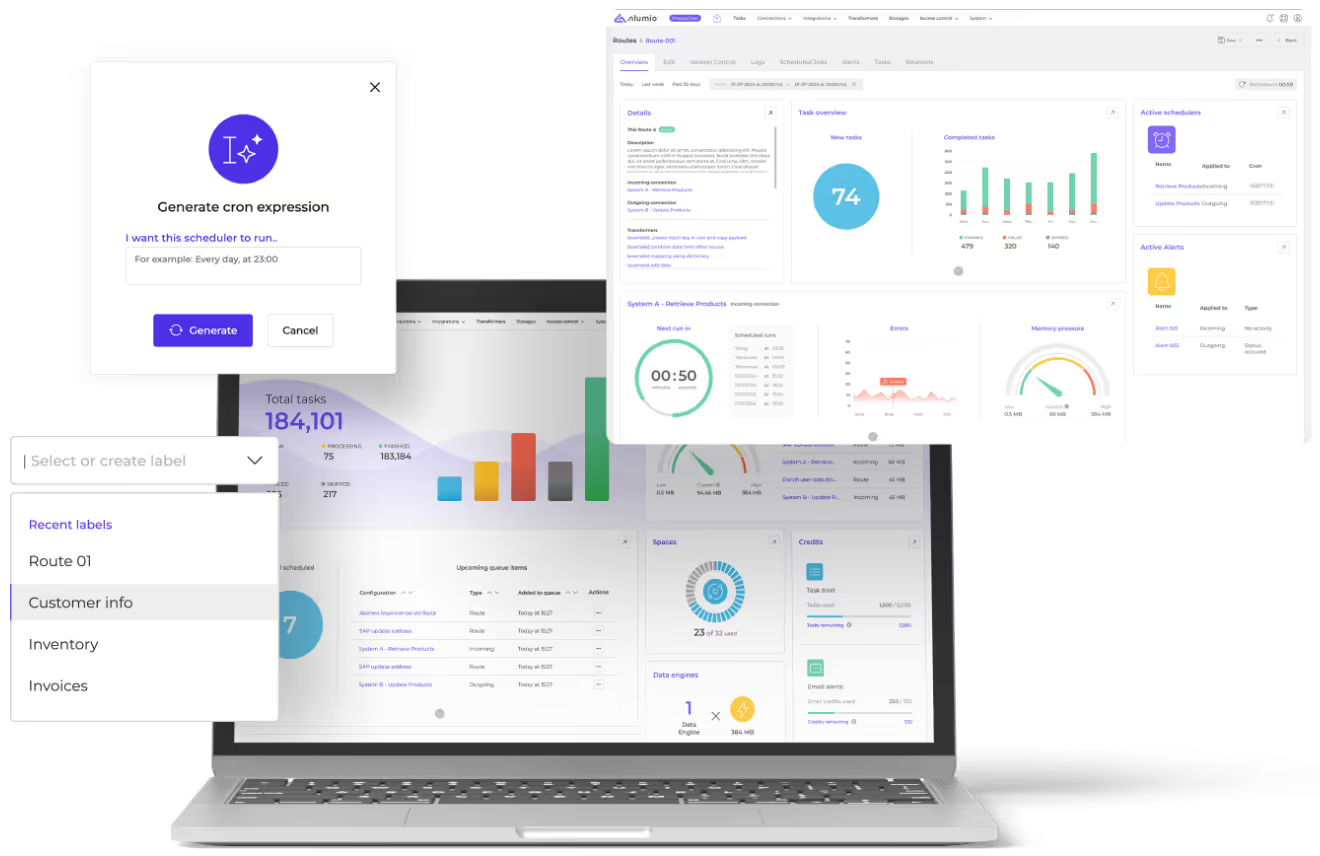
Laptop screen displaying the Alumio iPaaS dashboard, alongside pop-up windows for generating cron expressions, selecting labels and route overview.