The AI landscape is evolving rapidly with AI agents and tools automating all kinds of processes, from customer-support chatbots to predictive alerts, smart home assistants to real-time edge analytics, and more. Key cloud-centric frameworks have emerged to facilitate AI agent collaboration. While there's MCP (Model Context Protocol) that enables AI models to directly connect, interact, and search any apps, there's also the A2A (Agent2Agent) protocol that helps any AI agents collaborate across the cloud. But what about scenarios where AI agents work offline, locally, and more securely? That gap is being filled by the new AI protocol called ACP (Agent Communication Protocol). Designed for real-time, offline AI collaboration, ACP enables AI agents within a local environment to automatically discover and authenticate nearby peers, negotiate quick task handoffs, and establish flexible communication patterns. All this, without relying on remote services and preserving data sovereignty. We interviewed Ray Bogman, Alumio’s Head of Innovation, to explore how ACP pieces together a key part of the AI connectivity puzzle.
Exploring ACP: the future of offline AI agent collaboration
On a factory floor, when a quality-control sensor detects a defect, robotic arms and scheduling bots need to respond in milliseconds — halting production, rerouting tasks, and updating logs instantly. Similarly, in large-scale fulfillment hubs, autonomous forklifts, inventory scanners, and packing stations must work in lockstep to process thousands of orders without a second’s delay. In these fast-moving, high-stakes environments, where even a brief network hiccup can create cascading delays, waiting for cloud-based instructions isn’t the best option. Not anymore, at least.
As enterprises lean more on AI agents to automate critical, time-sensitive operations, there is also a growing need for real-time AI collaboration that’s independent of the cloud. To fill that gap, IBM’s BeeAI team launched the Agent Communication Protocol (ACP) open standard for secure, local-first orchestration of AI agents across any edge environment. To understand how ACP unlocks this new frontier of offline AI automation, we asked our Head of Innovation, Ray Bogman, some critical questions.
What exactly is ACP, and what makes it stand out from other AI protocols?
“ACP, or the Agent Communication Protocol, is an open, local-first standard developed to address scenarios where AI agents must collaborate in real time, without relying on the cloud. Unlike other AI protocols like MCP and A2A, which depend on centralized services for context enrichment or message brokering, ACP enables AI agents to exchange data directly over local networks, preserving uptime, maintaining data sovereignty, and minimizing latency.
Here’s an analogy for ACP vs. other AI protocols: Imagine remote workers versus office workers that work within the same environment. Remote workers are scattered across time zones and rely on video calls for every discussion; office workers are available to solve problems or perform new tasks more immediately. Like the latter, ACP brings that “same-workplace” immediacy to AI agents, allowing them to instantly discover each other and collaborate from the same locale.
As such, what sets ACP apart is its focus on three core principles:
Simplicity: Agents join the network automatically and begin collaborating without manual setup.
Security: All communication stays on-premises, reducing external attack surfaces, and supporting strict compliance.
In environments where every millisecond counts, whether a production line, a hospital floor, or an edge-compute cluster, ACP delivers the resilient, low-overhead AI communication that modern automation demands.”
What are the unique benefits of the ACP AI protocol?
“At its core, ACP’s architecture is built for resilience, responsiveness, and versatility, addressing the shortcomings of cloud-dependent messaging. When your internet or cloud services experience downtime, ACP allows your local AI agents to keep coordinating. Apart from uptime, this results in key business continuity benefits such as:
Real-time task handoff When a quality-control agent on the production line spots an anomaly, it can alert a scheduling AI agent and pause operations in milliseconds, not minutes.
Zero-configuration discovery New agents join the network automatically: they announce their presence, find available services, and begin collaborating immediately. It’s like a universal translator and social coordinator combined.
Flexible communication patterns With ACP, AI agents can autonomously broadcast updates, have private conversations, or form consensus groups, all using the same underlying protocol. This flexibility is crucial because different automation scenarios require different communication styles.”
What are some real-world use cases and target markets for the ACP AI protocol?
“Manufacturing is the obvious starting point for implementing the ACP AI protocol. You have robots, sensors, quality control systems, and logistics agents all needing to coordinate in real-time. But the applications extend far beyond factory floors.
ACP’s impact reaches far beyond industrial settings and is also incredibly useful for:
Smart buildings: HVAC units, security cameras, access controls, and energy-management systems can create self-organizing networks that optimize comfort, safety, and efficiency—without relying on the cloud.
Retail operations: Inventory robots, point-of-sale terminals, customer-service bots, and supply-chain coordinators collaborate locally to deliver seamless shopping experiences, even during network outages.
Healthcare: Medical devices, patient monitors, and administrative assistants exchange critical updates within hospital networks, enhancing care delivery while keeping sensitive data on-premises.
Edge computing: From autonomous vehicles to smart-city sensors, any scenario with multiple AI systems at the edge benefits from ACP’s low-latency, local-first messaging.
The businesses that benefit most are those with complex environments where diverse automated systems must work together reliably, especially when connectivity is intermittent or data sovereignty is non-negotiable.”
“ACP isn't a silver bullet, rather an important piece to the AI connectivity puzzle. Apart from specifically solving the local, real-time coordination, it has inherent limitations when you need broader connectivity or specialized capabilities. Some of these limitations now include:
Geographic scope: ACP works within a local runtime or edge environment. If you require agents in different cities or countries to communicate, you'll need additional protocols or infrastructure.
Integration complexity: While ACP simplifies agent-to-agent communication, integrating with existing enterprise systems or cloud services still requires additional protocols. Or, next-gen middleware solutions like the iPaaS (integration Platform as a Service).
Scalability considerations: There are practical limits to how many agents can effectively coordinate in a single ACP network before performance degrades or management becomes unwieldy.
Limited context sharing: ACP focuses on communication and coordination, not context routing or complex data sharing across diverse systems—that's where other protocols excel.
These limitations don’t diminish ACP’s value—they simply highlight that local coordination is only one part of a much larger challenge. To build truly connected, intelligent systems that span geographies, integrate with enterprise platforms, and share complex context, you need additional layers of communication. This is where it becomes important to understand how ACP fits in with the other key AI protocols, namely MCP and A2A.”
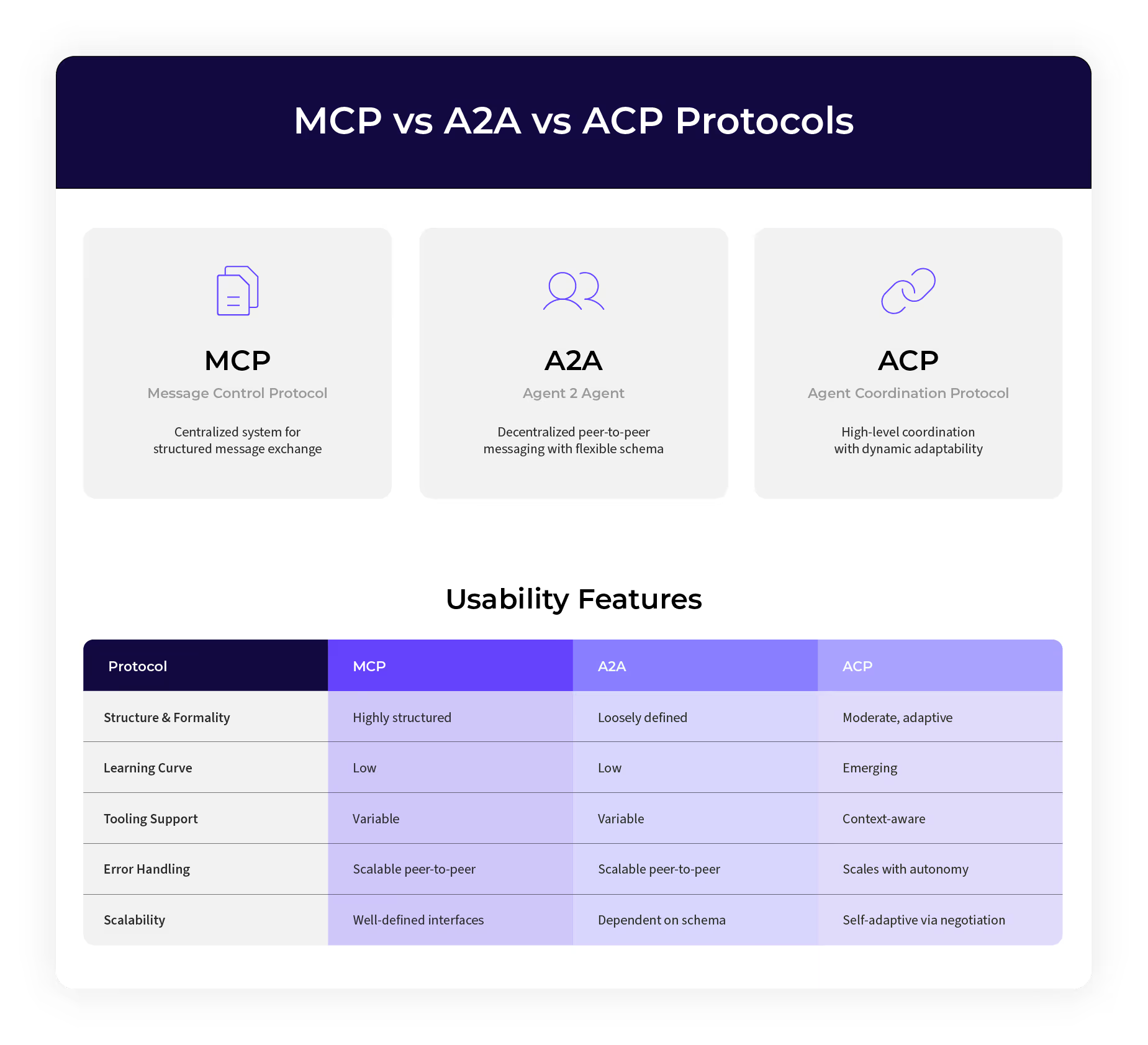
How does ACP differ from A2A and MCP protocols, and how do they work together?
“Think of these protocols as different languages for different conversations. The A2A (Agent2Agent) protocol is like the formal diplomatic language for cloud-based agent negotiations. MCP (Model Context Protocol) is the contextual interpreter that helps agents understand complex, cross-system information. ACP is the rapid-fire local dialect that gets immediate work done.
A2A (Agent-to-Agent): allows AI agents to communicate with each other seamlessly. It focuses on structured, cloud-based communication with formal negotiation and service discovery mechanisms. It's excellent for complex, distributed workflows but introduces latency and cloud dependencies.
MCP (Model Context Protocol): specializes in context routing and information sharing across diverse applications. MCP shines when AI agents need to connect with any application directly and immediately query information from it.
ACP (Agent Communication Protocol) complementary role: A typical enterprise deployment might use ACP for local real-time coordination, A2A for cloud-based orchestration, and MCP for context sharing across the entire ecosystem.
In the near future, we can anticipate sophisticated architectures where local ACP networks handle immediate operational needs, then interface with A2A protocols for broader cloud integration, while MCP ensures all agents have access to the contextual information they need.”
How does ACP work with the Alumio iPaaS (integration platform)?
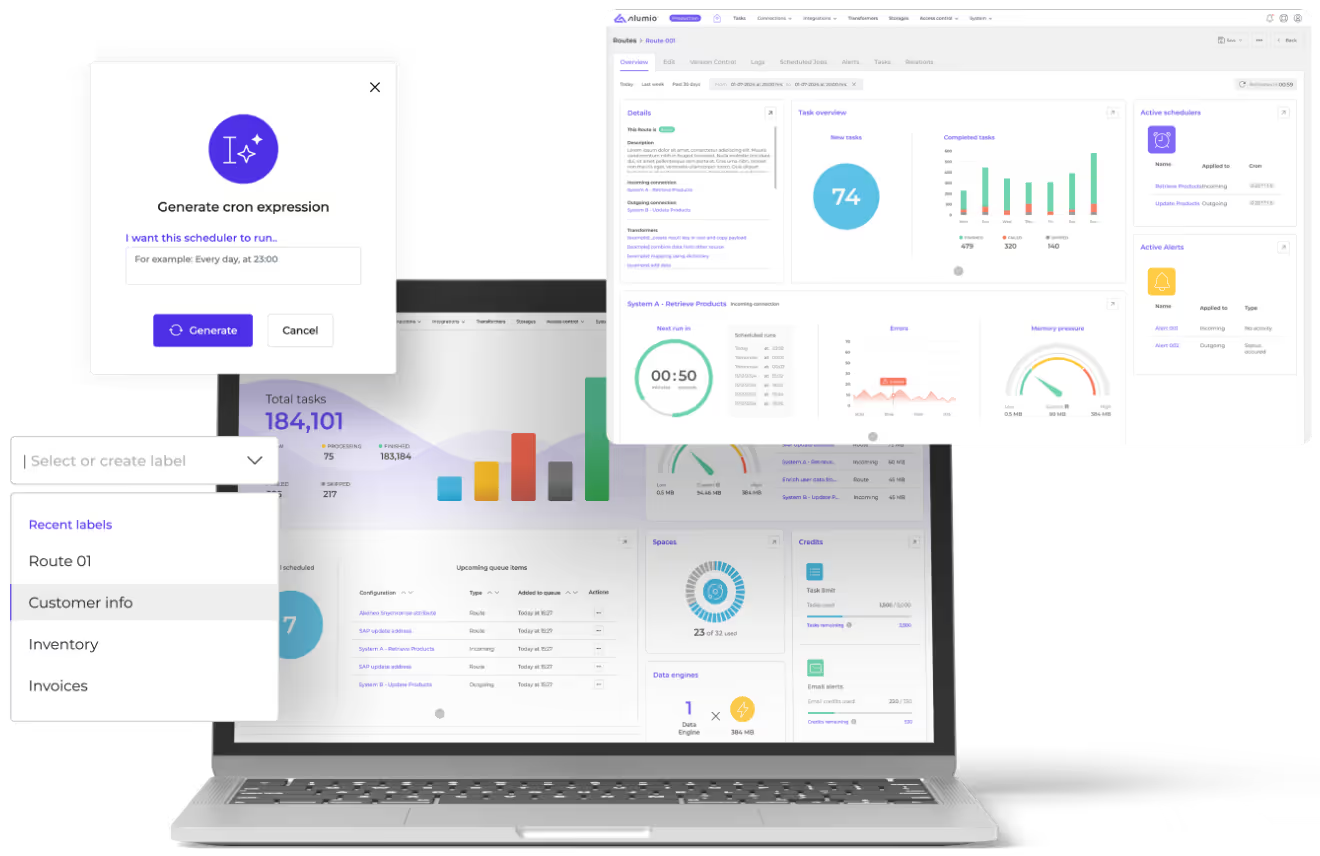
“The Alumio iPaaS (integration Platform as a Service) already excels at connecting cloud applications and data sources through API-driven integrations. Adding ACP support creates a unified platform that bridges local AI agent networks with cloud ecosystems. The integration benefits include:
Seamless agent onboarding: ACP-compatible agents can register with the Alumio platform automatically, immediately gaining access to both local peer agents and cloud-based services through existing integrations.
Unified workflow orchestration: You can design workflows that include local ACP agents, cloud APIs, and traditional data sources, all managed through a single platform. An edge sensor might trigger a local response via ACP and simultaneously update a cloud CRM via traditional APIs.
Consistent security and governance: Rather than managing separate security frameworks for local and cloud communications, Alumio can apply unified policies across the entire hybrid environment.
Simplified monitoring and management: All agent communications, whether local ACP messages or cloud API calls, flow through Alumio's monitoring and analytics infrastructure, providing comprehensive visibility.”
How do you see ACP evolving over time?
“There are three major evolution paths for ACP: enhanced intelligence, broader ecosystem support, and deeper integration capabilities.
Enhanced intelligence: Future ACP versions will likely include more sophisticated coordination mechanisms — think consensus algorithms, load balancing, and adaptive communication patterns that optimize based on network conditions and agent capabilities.
Ecosystem expansion: We're already seeing interest from IoT device manufacturers, robotics companies, and edge computing vendors. As more platforms adopt ACP, the network effects will create increasingly powerful local agent ecosystems.
Cloud-native hybrid: The line between local and cloud will continue to blur. ACP networks that can dynamically extend into cloud environments when needed, will create elastic agent clusters that span from edge to cloud seamlessly.
As ACP gains adoption, we'll see industry-specific extensions and standards bodies providing guidance for implementation in regulated industries like healthcare and finance.
Long-term vision: Ultimately, ACP may become the foundation for truly autonomous operational environments — factories, buildings, and cities where hundreds of specialized agents coordinate seamlessly to optimize everything from energy usage to human comfort, all while maintaining the reliability and responsiveness that only local-first communication can provide.
The bottom line: Taking AI beyond the cloud with ACP
It's clear that ACP represents more than just another communication protocol—it's a foundational technology for the next generation of AI-driven automation. By prioritizing local-first communication, real-time coordination, and seamless integration with existing platforms like the Alumio iPaaS, ACP addresses critical gaps in today's agent communication landscape. For organizations looking to build more resilient and responsive automated systems, ACP offers a compelling path forward for local, immediate, and integrated AI agent communication.
We're not just connecting agents—we're creating the nervous system for intelligent automation."
Saad has a decade's worth of experience in writing all kinds of content for digital marketing mediums. At Alumio, he became fascinated with the idea of application integrations. He now enjoys "integrating" all his marketing experience to explain how Alumio works in a way that's fun, inventive, and easy to understand. On a personal level, he's busy attempting to integrate his passion for philosophy, anime, gaming, fiction, cinema, food, and the art of good conversation.
Saad Merchant
Copywriter at Alumio
Saad has a decade's worth of experience in writing all kinds of content for digital marketing mediums. At Alumio, he became fascinated with the idea of application integrations. He now enjoys "integrating" all his marketing experience to explain how Alumio works in a way that's fun, inventive, and easy to understand. On a personal level, he's busy attempting to integrate his passion for philosophy, anime, gaming, fiction, cinema, food, and the art of good conversation.
The Agent Collaboration Protocol (ACP) is an emerging standard designed to enable AI agents to collaborate and share context even when operating offline or in disconnected environments, complementing cloud-centric frameworks like MCP (Model Context Protocol). It matters because as AI agents are deployed across edge environments, IoT systems, and air-gapped infrastructure, they need a reliable way to coordinate and pass context without depending on a continuous cloud connection.
MCP (Model Context Protocol) enables AI models to connect directly to tools, data sources, and services in real time over cloud infrastructure. ACP is designed for scenarios where that continuous cloud connectivity is unavailable or undesirable, such as edge deployments, industrial IoT environments, or privacy-sensitive operations. ACP allows agents to cache context, queue tasks, and synchronize state asynchronously when connectivity is restored, rather than requiring a live connection for every interaction.
Practical use cases include: manufacturing shop floor AI agents that process sensor data and make decisions without relying on a cloud round-trip, retail AI agents that operate on in-store hardware and synchronize decisions with back-end systems when connectivity is available, logistics AI agents that process route and delivery data in low-connectivity environments, and any application where latency, bandwidth costs, or data residency requirements make continuous cloud connectivity impractical.
Integration infrastructure is the layer that determines what data AI agents can access and act on. For AI agents to collaborate effectively whether online or offline, the data they work with must be synchronized, consistent, and governed. An integration platform like Alumio ensures that the business data AI agents depend on (orders, inventory, customer records, product information) flows reliably from source systems to wherever the agents are deployed, whether that is a cloud environment or an edge device with intermittent connectivity.
Businesses deploying AI agents in offline or edge environments should consider: how the agent's context will be initialized and updated when connectivity is available, what decisions the agent is authorized to make independently versus which require cloud confirmation, how local decisions will be synchronized and reconciled with central systems when connectivity is restored, and whether the data the agent depends on is current enough for the decisions it needs to make. These are fundamentally integration architecture questions as much as AI deployment questions.
As AI agents take on more consequential actions (placing orders, adjusting prices, routing fulfillment), the governance of the data they access and act on becomes critical. An agent that works from stale or inconsistent data can make decisions that cause financial or operational harm. Governing AI agent data access through a secure, auditable integration layer ensures that agents always work from current, authorized data, and that every action an agent takes based on integrated data is traceable for compliance and accountability purposes.




.svg)









.svg)
.svg)
.svg)
.svg)
.svg)
.svg)
