




.svg)


What is the new A2A (Agent2Agent) protocol?
A2A, or Agent2Agent, is an open protocol that enables and simplifies collaboration between AI assistants. Think of it like a universal translator and coordination framework that enables AI agents to discover one another, exchange structured messages, and coordinate complex workflows that no single agent could tackle alone, effectively enough.
Imagine planning a corporate event: you wouldn’t have one person handle every detail. You’d assign specialists for catering, venue logistics, invitations, etc., who would work with one another to ensure everything runs smoothly. Similarly, A2A enables inventory agents, pricing agents, customer‑service agents, and more, to seamlessly collaborate as a dynamic, self‑organizing team.
Much like the advent of APIs standardized application-to-application collaboration, A2A now helps avoid the siloed usage of AI assistants by enabling Agent2Agent:
- Discovery: Agents can find and collaborate with other AI agents with complementary skills.
- Exchange: Structured messages let agents share results, requests, and status updates.
- Coordination: Agents can negotiate task handoffs, manage dependencies, and adapt on the fly.
What are the key business benefits of A2A?
By investing in an agent-to-agent ecosystem, organizations can unlock transformative advantages:
- Scalability and flexibility: Agents can be deployed, scaled, or retired based on demand. Organizations can adapt quickly to changing business needs without rebuilding entire systems.
- Specialization and expertise: Instead of building one agent that's mediocre at everything, organizations can benefit from specialized agents (that excel in their domains) collaborating.
- Resilience and reliability: Multi-agent systems can handle failures seamlessly, with other agents compensating when individual components have issues.
- Continuous optimization: Agent networks can learn and improve over time, optimizing processes based on real-world performance and changing conditions.
Major challenges of A2A Adoption
While A2A offers significant upside, organizations must navigate new complexities and standards in the early adoption phase:
- Protocol adoption & standardization: The ecosystem is nascent with multiple specifications vying for dominance.
- Complexity management: Orchestrating, monitoring, and recovering multi‑agent workflows demands specialized tools and skills.
- Security & governance: Peer‑to‑peer communication requires robust identity management, access controls, and audit trails.
- Integration overhead: Building and validating an agent network often involves higher upfront investment than single‑agent solutions.
Despite these challenging hurdles, A2A represents a fundamental shift in how intelligent systems are designed, moving from centralized, monolithic agents to decentralized networks of specialized collaborators. This isn’t just a technical enhancement; it’s a new architectural paradigm.
The shift is very similar to how microservices revolutionized software development, replacing the need for one massive monolithic application with an integrated ecosystem of smaller, specialized services working together.
On that note, it’s important to state that the A2A protocol is part of a new wave of communication standards emerging to support this kind of AI collaboration. Another key protocol in this landscape is MCP (Model Context Protocol), which serves another significant aspect of AI assistant collaboration. Let’s explore how A2A and MCP compare.
What are the differences between the A2A and MCP protocol?
While both MCP and A2A are foundational within AI ecosystems, they solve distinct problems:
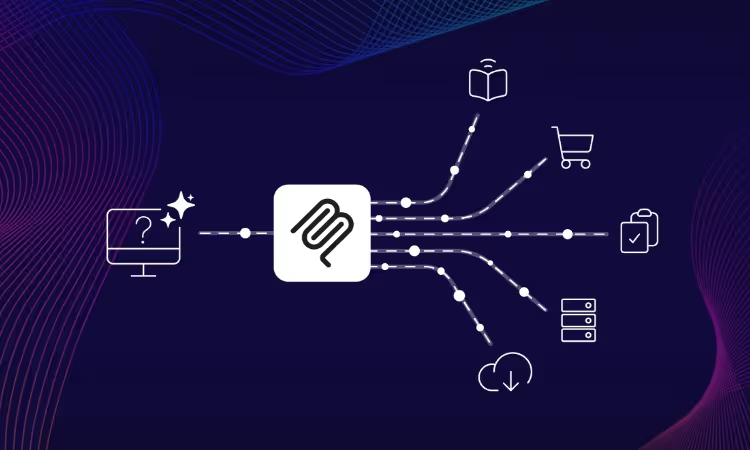
MCP (Model Context Protocol) is a universal standard that connects a single AI agent to multiple applications, digital tools, and data sources. Think of it as giving an AI agent a well-organized toolbox that standardizes how agents access databases, APIs, file systems, and other external resources. MCP involves vertical integration, connecting an agent downward to the capabilities and data of other applications.
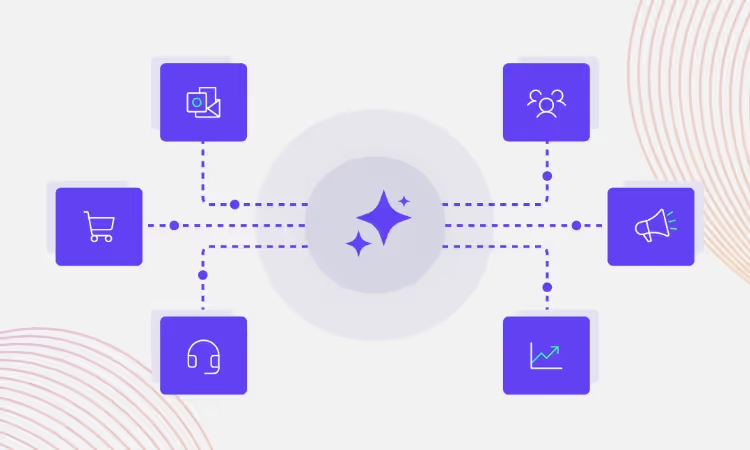
A2A (Agent-to-Agent) protocol, which is about connecting multiple AI assistants to each other, involves horizontal integration, which enables agents to collaborate as peers. A2A defines how agents discover each other, communicate intent, share results, and coordinate complex workflows.
Here's a practical example: In an e-commerce scenario, MCP would allow an inventory agent to connect to warehouse databases, pricing APIs, and supplier systems. A2A would allow that inventory agent to collaborate with a demand forecasting agent, a customer service agent, and a logistics agent to collectively optimize the entire supply chain.
MCP gives each AI agent its specialized capabilities, while A2A lets those agents form agile, resilient networks to coordinate actions in real time to solve multi‑step challenges.
When does A2A work better than MCP?
A2A is ideal for workflows that require coordination between specialized agents, especially in dynamic, multistep, or cross-domain scenarios. For example:
- Insurance claims: AI agents handle document analysis, fraud checks, and customer updates.
- Supply chain: Inventory, logistics, and pricing agents respond in real time to demand changes.
- System resilience: Agents reroute tasks automatically if one fails.
- Customer experience: Marketing, sales, and support agents collaborate across domains.
- Medical diagnosis: Specialized agents combine insights from radiology, pathology, and symptoms.
In other words, while MCP connects individual AI agents to various tools and apps, A2A empowers teams of specialized agents to collaborate on complex, adaptive workflows.
How can MCP and A2A complement each other in a tech stack?
Far from rivals, MCP and A2A complement each other beautifully in a modern tech stack, wherein:
- MCP acts as the foundation layer: Each agent uses MCP to connect to specialized tools, apps, and data sources. This gives agents their core capabilities and context.
- A2A acts as the collaboration layer: Agents use A2A to discover other AI agents and coordinate their MCP-enabled capabilities toward shared goals.
In a modern AI-enabled tech stack, you might see the following structure:
- Data layer: Databases, APIs, file systems.
- MCP layer: Standardized agent-to-tool connections.
- Agent layer: Specialized AI agents with specific capabilities.
- A2A layer: Inter-agent communication and coordination.
- Orchestration layer: Dashboards, human interfaces, governance tools, iPaaS solutions.
For example, here’s how this AI-enabled tech stack will work in a customer support scenario:
- A customer inquiry agent uses MCP to access knowledge bases and ticket systems.
- A technical diagnostics agent uses MCP to connect to monitoring tools and logs.
- A resolution agent uses MCP to access remediation systems.
- All three MCP-enabled agents use A2A to share context, escalate issues, and coordinate actions and responses.
This creates a more resilient, scalable, and adaptable AI-driven digital ecosystem, which either protocol couldn’t fully achieve without working together.




.svg)
.svg)
.svg)
.svg)
.svg)
.svg)
