




.svg)



Enabling future-proof integration flexibility
Many enterprise businesses still rely on legacy technology. These businesses may have connected their business systems and applications in a point-to-point fashion with custom code, or may also implement new SaaS solutions or cloud apps in a scattered and disconnected fashion, which often leads to data silos. At the same time, businesses may also attempt implementing traditional middleware solutions to integrate applications, which lack the flexibility and scalability required to be future-proof.
To meet the integration demands of a rapidly evolving cloud-based business landscape, many such businesses are forced to start all over at the beginning of a very long queue to rebuild a more integration-friendly IT infrastructure. Is there a “Skip-the-Line Pass” for such enterprises to get ahead in integrating new technologies? Yes! It’s incidentally called the Alumio iPaaS (integration Platform as a Service) and it provides businesses with all the integration flexibility they need to be future-proof.
Different kinds of integration flexibility the Alumio iPaaS provides
What is the Alumio iPaaS?
The Alumio iPaaS (integration Platform as a Service) is a low-code, cloud-based middleware that enables businesses to connect multiple systems, SaaS, cloud apps, and data sources, across on-premises and cloud environments. As an API-driven solution, it provides a user-friendly web interface to create, manage, and monitor all integrations and data flows without the need for custom code. Unlike other integration platforms, the Alumio iPaaS is designed to provide integration flexibility with every feature, enabling both big enterprises and growing businesses alike to build fast, scalable, and future-proof integrations. Some of the essential benefits that it provides businesses, includes:
1. Flexibly integrating multiple systems vs. building point-to-point integrations
Many businesses traditionally connect two or three applications and systems using point-to-point integrations. This usually involves writing custom code to integrate an ERP system with an e-commerce platform, or a CRM system. Building these custom code connections is time-consuming, expensive, and difficult to maintain. Adding new integrations and modifications to such connections can amount to starting entirely new integration projects.
As an API-first solution, the Alumio iPaaS helps businesses build integrations via their APIs instead of with custom code. It also enables real-time data exchange and data synchronization between all integrated systems, preventing data silos, duplication errors, and reducing inefficiency. Providing special connectors (pre-configured integrations), Alumio enables businesses to integrate with a wider range of applications and systems, including e-commerce, ERP, CRM, PIM, WMS, POS, channel marketing software, and other cloud apps. Additionally, the platform also helps build complex workflows to automate business processes across all integrated systems.
Read our case study on how Verfwinkel.nl, a leading paint and supplies retailer in the Netherlands, used the Alumio iPaaS to seamlessly integrate four systems (ERP, E-commerce, PIM, and WMS).
2. Flexible low-code integrations vs. simple no-code integrations
While there are no-code iPaaS solutions that are designed to be user-friendly for citizen developers and non-technical users, the Alumio low-code iPaaS is designed for both developers and business users. Favoring flexibility while providing simplicity, the Alumio iPaaS is designed to give business users a clear visual overview and control of all their integrations and data flows. At the same time, it provides developers with easy-to-use, Click-and-Configure options to flexibly build and customize integrations, along with other integration benefits such as:
Advanced integration tools
The Alumio iPaaS provides several features to benefit developers and system integrators such as advanced mappers and transformers. Apart from enabling data enrichment and data validation, the platform also enables business process automation, helps integrate custom APIs, and provides unique connectors to integrate legacy systems. The Alumio iPaaS also enables event-driven integrations that automate processes by triggering actions or workflows based on specific events or conditions. As a low-code iPaaS solution, Alumio also helps businesses schedule more complex workflows than regular no-code solutions, in order to automate business processes and eliminate manual data entry.
Robust real-time monitoring and logging
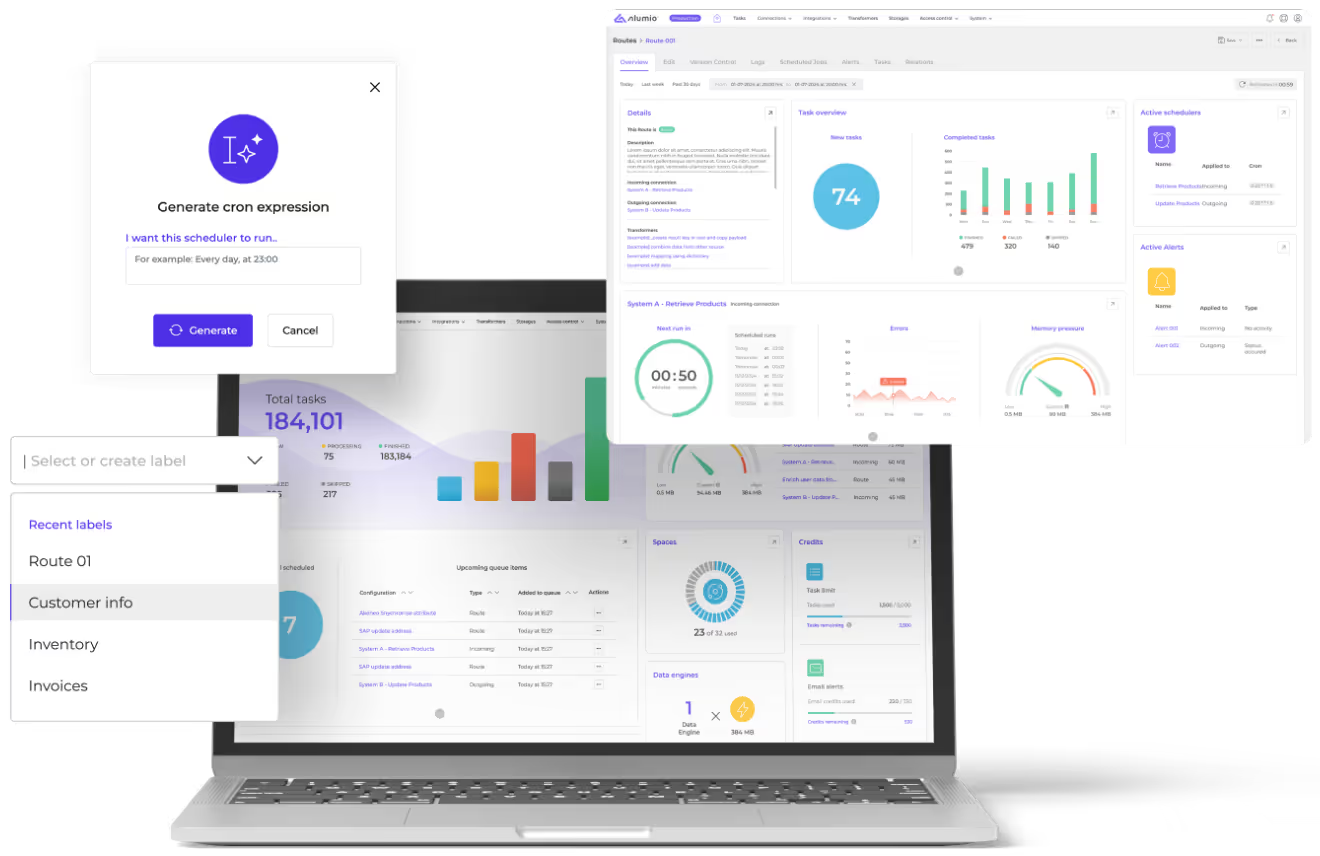
For business users, the Alumio iPaaS provides a clear visual overview and a user-friendly dashboard to govern and monitor integrations and data flows. Providing automated monitoring and logging, Alumio enables real-time error detection with the ability to set up monitoring alerts, which helps businesses resolve and retry integrations swiftly from the dashboard. This helps prevent black box issues between developers and business users, enabling them to collaborate on improving integrations effectively while being on the same page (quite literally).
Read our case study about how Heusinkveld, developers of cutting-edge sim racing products, used the Alumio iPaaS to build a custom Odoo (ERP) to WooCommerce (e-commerce) integration to flexibly synchronize how their product stock appears on their webshop.
3. Flexible integration interchangeability
Apart from enabling businesses to integrate a wide range of systems, SaaS, and cloud apps, the Alumio iPaaS also enables flexible interchangeability. This means that with Alumio businesses can freely replace any integrated system(s) or outdated ones with any new application without loss of data integrity.
So, for instance, let’s assume an enterprise uses the Alumio iPaaS to successfully integrate its e-commerce platform with an ERP (like SAP or Microsoft Dynamics 365), a PIM system (like Akeneo and Pimcore), a CRM (like Salesforce and Hubspot), and a Channel Marketing Software (like ChannelEngine and Channable). However, a year later the enterprise wishes to modify these integrated systems by replacing their e-commerce platform with Big Commerce. The Alumio iPaaS allows them to flexibly replace the integrated system without causing compatibility issues or without breaking the overall integration flow between the other 4 connected systems.
Integration interchangeability is often achieved through the use of standardized protocols, formats, and interfaces that facilitate interoperability. The flexible integration architecture of the Alumio iPaaS enables this and also modular integrations to take place, wherein businesses connect and compose only the best components or services of a software solution that they need. This modular, best-of-breed development approach is called Composable Commerce and is enabled by the Alumio integration platform.
Read this blog to find out if your business is ready for Composable Commerce ->
4. Flexibly integrate legacy systems and on-premises systems
Despite being a completely cloud-based integration platform, the Alumio iPaaS offers hybrid integration capabilities. The platform also provides unique connectors and adapters to seamlessly integrate legacy systems with newer, cloud-native solutions, across on-premises and cloud environments.
The Alumio API plugin solution
Popular ERP systems like SAP, Microsoft Dynamics 365, and Exact Globe don’t have the essential B2C & B2B API points (web services) required to effectively integrate with e-commerce, PIM, CRM, WMS, and other applications. Custom building these API points is time-consuming, expensive, and error-prone.
Productizing decades of experience in integrating ERP systems, Alumio provides unique API Plugins that help install these lacking B2B & B2C API points in ERP systems. This makes it easier to integrate them rapidly and seamlessly with any software for digital commerce.
Alumio provides API plugins to enhance integrations with the following systems:
How does a flexible integration solution help future-proof businesses?
By enabling businesses with the flexibility to integrate multiple new applications as well as legacy systems, Alumio provides a next-gen integration solution that helps businesses jumpstart their digital growth. This way the Alumio iPaaS helps businesses reap the benefit of moving to the cloud. It also provides the integration interchangeability required for businesses to experiment with connecting new software solutions or cloud apps, without the loss of data integrity.
Centralizing all integrations on one dedicated cloud space, the Alumio iPaaS also provides flexible data transformation and process automation features. In this regard, it provides businesses with the flexible tools, features, and environment they need for both internal and external digital growth.





.svg)
.svg)
.svg)
.svg)
.svg)
.svg)
