


A Alumio vivid purple arrow pointing to the right, a visual representation of how to access more page material when clicking on it.
Go back

WooCommerce's integrations: streamline your e-commerce business

By
Published on
July 30, 2023
Updated on
June 24, 2026
IN CONVERSATION WITH
Email icon
Email icon

If you're running an e-commerce business using WooCommerce, you're likely familiar with the importance of seamless integrations to streamline your operations and maximize efficiency. In this article, we will explore the key aspects of WooCommerce integrations, providing valuable insights and guidance to help you optimize your online store. We'll also discuss how Alumio, a leading integration platform, can assist you in achieving a seamless WooCommerce integration. Let's dive in!

What is WooCommerce?

WooCommerce is a popular e-commerce plugin for WordPress, empowering businesses to build and manage their online stores effectively. It offers a wide range of features, including product management, order processing, payment gateways, and shipping options, making it a versatile platform for online retailers. With its user-friendly interface and extensive customization options, WooCommerce has become the go-to choice for many e-commerce entrepreneurs.


Why are integrations important for WooCommerce?

Integrations play a crucial role in enhancing the functionality and efficiency of your WooCommerce store. By seamlessly connecting WooCommerce with other essential tools and platforms, you can automate tasks, improve data accuracy, and streamline your business processes. Let's explore some key reasons why integrations are important for WooCommerce:


Smooth order processing:

Integrations with shipping and fulfillment services enable automated order processing, label generation, and shipment tracking. This eliminates manual data entry, reduces errors, and accelerates the fulfillment process, ensuring timely deliveries and customer satisfaction.


Efficient payment solutions:

Integrating WooCommerce with payment gateways offers customers a variety of secure and convenient payment options. Whether it's credit cards, digital wallets, or bank transfers, seamless payment integrations facilitate smooth transactions, boosting customer trust and conversion rates.


Marketing and analytics integration:

Connecting WooCommerce with marketing automation tools and analytics platforms allows you to gain valuable insights into customer behavior, track sales performance, and implement targeted marketing campaigns. By leveraging data-driven strategies, you can optimize your marketing efforts and drive revenue growth.


Third-Party platform integrations:

WooCommerce integrates with a vast ecosystem of third-party extensions and plugins, offering additional functionalities to enhance your store's capabilities. Whether it's integrating with CRM systems, email marketing platforms, or customer support tools, these integrations empower you to create a seamless customer journey.

How can Alumio help with WooCommerce integration?

Alumio, a leading integration platform, offers robust solutions to simplify and enhance your WooCommerce integrations. With Alumio, you can:


Connect WooCommerce with any system:

Alumio provides a flexible and scalable integration platform that allows you to connect WooCommerce with any system, whether it's an ERP, CRM, inventory management tool, or marketing automation platform. This enables seamless data flow between different systems, ensuring accurate and up-to-date information across your entire e-commerce ecosystem.

  • Automate workflows
    By leveraging Alumio's automation capabilities, you can automate various tasks and workflows related to yourWooCommerce store. From order processing and inventory updates to customer data synchronization, Alumio enables you to streamline your operations and reduce manual effort, improving overall efficiency.
  • Customize integrations
    Alumio's integration platform offers extensive customization options, allowing you to tailor your WooCommerce integrations to fit your specific business needs. Whether it's mapping data fields, defining business rules, or implementing complex workflows, Alumio provides the flexibility to adapt the integration process to your unique requirements.
  • Ensure data accuracy and security
    Alumio prioritizes data accuracy and security, providing robust data validation and encryption measures to safeguard your sensitive information. With Alumio, you can ensure that your WooCommerce integrations maintain data integrity, comply with regulatory standards, and protect customer privacy.


In conclusion

WooCommerce integrations are vital for optimizing your e-commerce business and achieving seamless operations. By connecting your store with inventory management systems, payment gateways, shipping services, and other essential tools, you can enhance efficiency, improve customer experience, and drive growth. Alumio, with its powerful integration platform, offers complete solutions to simplify and enhance your WooCommerce integrations. Leverage the power of WooCommerce integrations and Alumio to unlock the full potential of your online store!


Turn AI ambition into action

Portrait of Leonie Becher Merli, Business Development Manager at Alumio

Get a free assessment of your integration needs and next steps

Portrait of Leonie Becher Merli, Business Development Manager at Alumio

No items found.
Topics in this blog:
No items found.

FAQ

Integration Platform-ipaas-slider-right
What are WooCommerce integrations and why are they important?

WooCommerce integrations are connections between a WooCommerce store and other business systems or services, enabling automated data exchange between the store and tools like payment gateways, shipping carriers, marketing platforms, ERP systems, and CRM tools. They are important because a standalone WooCommerce store handles only the storefront; the systems managing inventory, fulfillment, finance, and customer relationships all require integration to avoid manual data transfer and the errors that come with it.

Integration Platform-ipaas-slider-right
What are the most important WooCommerce integrations for e-commerce businesses?

The most important WooCommerce integrations are: payment gateways (Stripe, Mollie, PayPal) for checkout; shipping carriers and fulfillment platforms for order processing; email marketing tools (Klaviyo, Mailchimp) for customer communications; ERP systems (QuickBooks, NetSuite, SAP) for financial and inventory management; CRM platforms for customer data; and PIM systems for catalog sync. The priority order depends on where the most manual effort or error risk exists in current operations.

Integration Platform-ipaas-slider-right
How does Alumio integrate with WooCommerce?

Alumio connects to WooCommerce via its REST API, enabling bidirectional data flows between WooCommerce and other business systems. Orders placed in WooCommerce can be automatically routed to an ERP or WMS for fulfillment; product and inventory data from an ERP or PIM can be pushed to WooCommerce to keep the storefront accurate. Alumio's config-first approach means these flows are configured rather than coded, and all data exchanges are logged and monitored centrally from one platform.

Integration Platform-ipaas-slider-right
When should a WooCommerce store move from plugin-based integrations to an iPaaS?

The right time to move to an iPaaS is when plugin integrations are breaking under platform updates, when multiple systems need to connect to WooCommerce simultaneously (ERP, PIM, WMS, CRM), or when data flow failures are causing operational errors like missed orders, wrong inventory, or reconciliation gaps in finance. An iPaaS provides a stable API-to-API connection independent of the WooCommerce plugin framework, with centralized monitoring for all data flows as the system landscape grows.

Integration Platform-ipaas-slider-right
Can WooCommerce be integrated with enterprise systems like SAP or Microsoft Dynamics?

Yes. WooCommerce can be integrated with SAP, Microsoft Dynamics 365, and other enterprise ERP systems via an integration platform that handles API communication, data transformation, and monitoring. Alumio provides prebuilt connector templates for both WooCommerce and major ERP systems, and the config-first approach means the data mapping between WooCommerce's order schema and the ERP's data model is configured in the platform rather than coded. For growing WooCommerce stores that have outgrown plugin-level ERP integration, this is the practical path to a stable and scalable connection.

Integration Platform-ipaas-slider-right
What WooCommerce integration challenges do businesses commonly face?

Common challenges are: WooCommerce plugin-based integrations that break when WooCommerce or WordPress releases an update, inventory discrepancies when stock updates do not sync fast enough between WooCommerce and the ERP or WMS, order data format mismatches between WooCommerce's schema and the receiving system, and the difficulty of monitoring multiple separate plugin-based integrations without centralized logging. An integration platform addresses these by managing all WooCommerce connections through a single governed layer with consistent error handling.

Get a free assessment of your integration needs

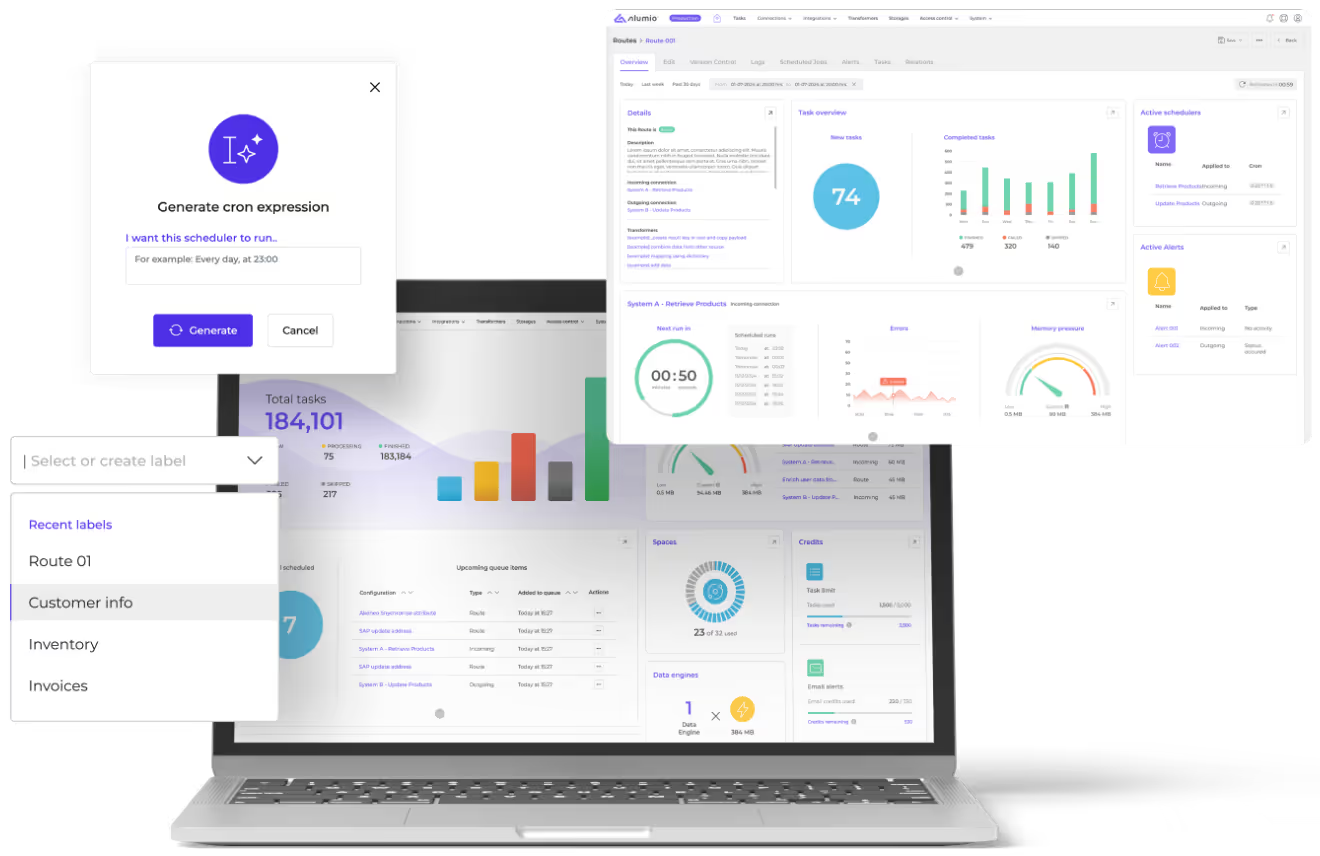
Laptop screen displaying the Alumio iPaaS dashboard, alongside pop-up windows for generating cron expressions, selecting labels and route overview.