

A Alumio vivid purple arrow pointing to the right, a visual representation of how to access more page material when clicking on it.
Go back

RAML explained: The key to effective API design

By
Carla Hetherington
Published on
May 13, 2024
Updated on
June 24, 2026
IN CONVERSATION WITH
Email icon
Email icon

When it comes to efficient software development practices, creating robust and efficient APIs is essential for success as APIs play a central role in enabling seamless communication between applications. Enter RAML, the RESTful API Modeling Language—a powerful specification language designed to describe RESTful APIs in a human-readable format. With its structured and standardized approach, RAML provides developers with a clear and intuitive syntax to define APIs, including endpoints, methods, parameters, request and response formats, and more. In this blog, we discuss what RAML is, why it's crucial for modeling APIs, and how it can revolutionize development processes.

What is RAML?

RAML, or RESTful API Modeling Language, is a powerful specification language used to describe RESTful APIs in a human-readable format. It provides a structured and standardized way to define APIs, including endpoints, methods, parameters, request and response formats, and more. RAML employs a simple and intuitive syntax, making it easy for developers to understand and work with.

Why should you model APIs with RAML?

Clarity and consistency: RAML allows developers to precisely define the structure and behavior of their APIs, ensuring clarity and consistency across the development team. With RAML, everyone has a clear understanding of how the API should function and what data it should accept and return.

Efficiency and enhanced productivity: By modeling APIs with RAML, developers can accelerate the development process. RAML enables rapid prototyping, allowing developers to iterate on API designs quickly and efficiently. It also promotes code reuse and automation, reducing development time and effort.

Enhanced collaboration: RAML serves as a common language for communication between developers, designers, testers, and other stakeholders involved in the API development process. It fosters collaboration and alignment, ensuring that everyone is on the same page regarding API specifications and requirements.

Documentation and testing: RAML provides a foundation for comprehensive API documentation and testing. With RAML, developers can generate interactive API documentation automatically, making it easier for users to understand how to interact with the API. Additionally, RAML-based testing tools enable automated testing of APIs, ensuring reliability and quality.

How does RAML elevate API development?

RAML is the key to efficient API development and design, resulting in more reliable and scalable APIs. Here are a few ways in which this is reflected:

Streamlined development process

RAML streamlines the API development process, from design to implementation, by providing a clear and structured approach to API modeling.

Enhanced developer experience

RAML improves the developer experience by simplifying API design, documentation, and testing, leading to faster development cycles and higher-quality APIs.

Scalability and flexibility

RAML facilitates the creation of scalable and flexible APIs that can evolve and adapt to changing business requirements and technological landscapes.

Interoperability and Integration

RAML makes integration easier by providing a standardized format for describing APIs. This standardized format allows developers to clearly define the structure and behavior of their APIs, making it easier for different systems and services to communicate and integrate with each other. Additionally, RAML promotes consistency and clarity in API design, documentation, and testing, facilitating seamless integration between diverse applications and platforms.

Conclusion

RAML is a game-changer for API development, there is simply no doubt about it. By providing a standardized and structured approach to API modeling, RAML enhances clarity, consistency, efficiency, and collaboration throughout the development process. Whether you're building APIs for web applications, mobile apps, or IoT devices, RAML empowers you to create robust, scalable, and interoperable APIs that drive innovation and success. It comes as no surprise then, that many organizations are embracing the power of RAML to take their API development to new heights.


Turn AI ambition into action

Portrait of Leonie Becher Merli, Business Development Manager at Alumio

Get a free assessment of your integration needs and next steps

Portrait of Leonie Becher Merli, Business Development Manager at Alumio

No items found.
Topics in this blog:

FAQ

Integration Platform-ipaas-slider-right
What is RAML and why does it matter for API design?

RAML (RESTful API Modeling Language) is a YAML-based specification language designed to describe RESTful APIs in a human-readable, machine-parsable format. It matters for API design because it enables API-first development: teams design the API contract in RAML before writing implementation code, allowing parallel development of API client and server, automatic generation of documentation and mock services from the specification, and early validation that the API meets consumer needs before it is built. Well-designed RAML specifications produce APIs that are more consistent, better documented, and easier to integrate with.

Integration Platform-ipaas-slider-right
What are the key benefits of using RAML for API specification?

The key benefits of RAML are: human-readable syntax that makes API contracts accessible to both developers and business stakeholders, reusable data type definitions that enforce consistency across multiple endpoints, automatic documentation generation from the specification, mock server generation for front-end and integration development before the backend is complete, validation tools that check implementations against the specification, and version management that makes breaking change detection systematic. For integration teams, well-documented RAML specifications significantly reduce the time required to understand and connect to an API.

Integration Platform-ipaas-slider-right
How does RAML differ from other API specification formats like OpenAPI (Swagger)?

RAML and OpenAPI (Swagger) are both API specification languages with similar goals but different approaches. OpenAPI uses JSON or YAML with a specific schema format and has broader ecosystem adoption (more tooling, wider vendor support). RAML uses a more concise YAML format with stronger support for reusable type definitions and resource type patterns. OpenAPI 3.0 has largely converged the two formats' capabilities, and the choice between them is often driven by existing tooling in the organization rather than inherent technical superiority. For integration platform purposes, well-documented APIs in either format are significantly easier to connect to than APIs with poor or no specification documentation.

Integration Platform-ipaas-slider-right
How does API documentation quality affect integration platform development?

API documentation quality directly affects how quickly and reliably integration connectors can be built. thorough RAML or OpenAPI specifications allow integration platform developers to build connectors that cover all API endpoints, understand data type requirements and validation rules, implement correct error handling for the specific error codes the API returns, and support all authentication methods the API provides. Poor documentation (incomplete endpoint descriptions, missing schema definitions, undocumented error codes) requires reverse engineering the API through trial and error, which increases build time and the probability of edge cases that cause production failures.

Integration Platform-ipaas-slider-right
What role does API design play in making systems integration-friendly?

Good API design is the foundation of system integration-friendliness: well-designed APIs are predictable (consistent naming and behavior), stable (versioning prevents breaking changes from silently affecting integrations), well-documented (integration builders can understand capabilities without contacting the vendor), and complete (all the data and operations the integration needs are exposed). Systems with poor API design create disproportionate integration development and maintenance effort, which is why API quality is increasingly evaluated as a purchasing criterion when selecting systems that must integrate with an organization's existing landscape.

Integration Platform-ipaas-slider-right
How does Alumio handle API connections for systems with varying documentation quality?

Alumio handles varying API documentation quality through its connector development model: prebuilt connector templates for well-documented, widely-used systems (Shopify, SAP, Akeneo) are built and tested by Alumio's team, so integration teams benefit from that research without repeating it. For custom or less-documented systems, Alumio's PHP-based development environment and REST connector framework provide the tools to build connectors even for APIs that require reverse engineering, and the resulting connector is maintained in the governed platform rather than as undocumented custom code. The platform's request inspection and logging capabilities also help diagnose API behavior during the connector development process.

Other blogs you might be interested in

No items found.

Get a free assessment of your integration needs

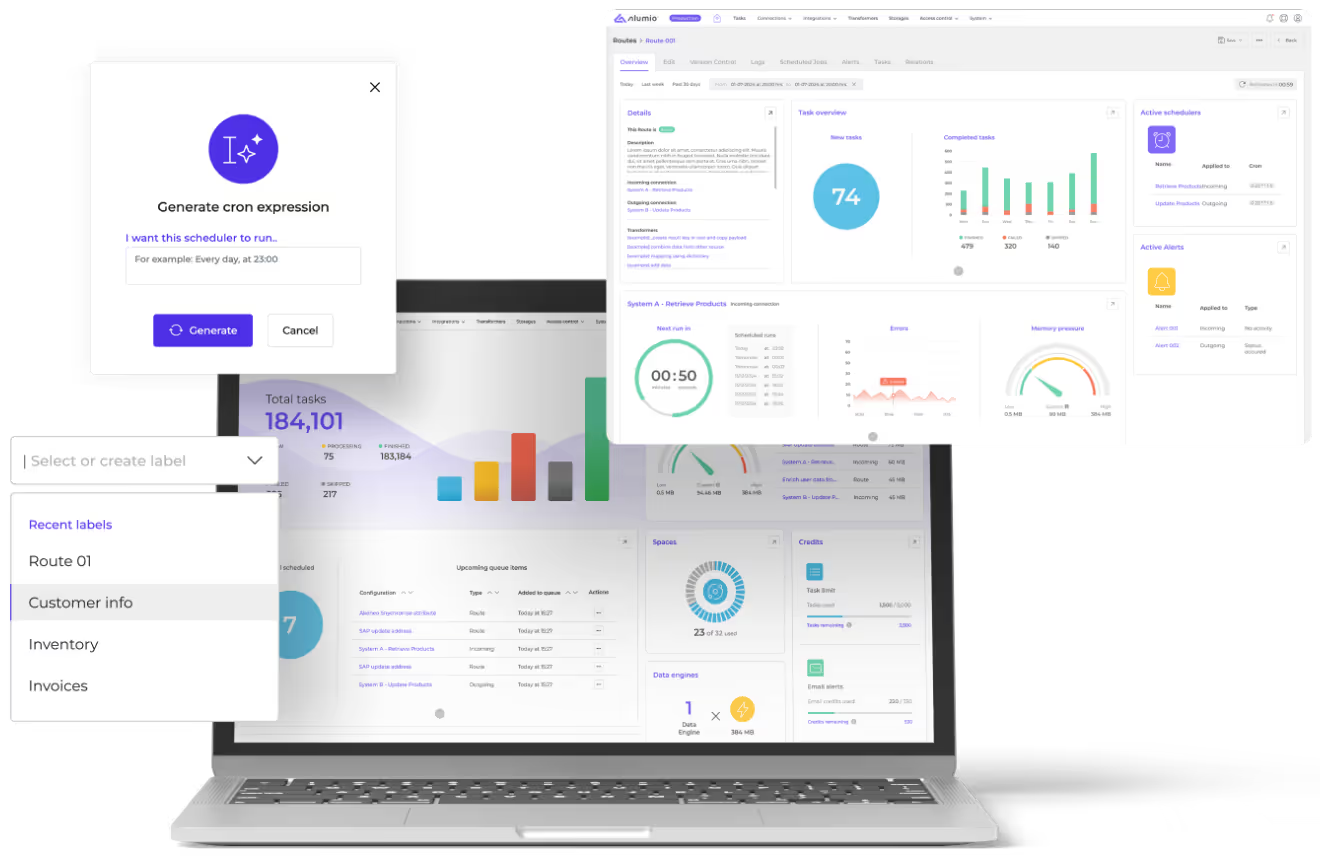
Laptop screen displaying the Alumio iPaaS dashboard, alongside pop-up windows for generating cron expressions, selecting labels and route overview.