
A Alumio vivid purple arrow pointing to the right, a visual representation of how to access more page material when clicking on it.
Go back

The future of integrations: Powering business growth with AI

By
Koen de Vrij
Published on
September 19, 2025
Updated on
June 24, 2026
IN CONVERSATION WITH
Email icon
Email icon

When I joined Alumio, I knew we were building something different. Integration wasn’t going to remain “IT plumbing” forever, it was going to become a board-level conversation about speed, scalability, and transformation. My role as Chief Revenue Officer is about making sure Alumio is not only part of that conversation but two steps ahead of it.

A day in the life as Alumio’s CRO

My day-to-day is a mix of strategy and execution. Some hours I’m with customers and partners, listening to their needs and spotting new opportunities. Other hours I’m aligning with our sales, marketing, and partner teams to ensure we’re delivering the right outcomes and growing sustainably. And then there’s the forward-looking part: keeping an eye on where the market is heading and how Alumio can anticipate those shifts before anyone else.

At the highest level, my responsibilities boil down to three things: growing revenue, ensuring customer success, and scaling partnerships. That also makes me the “voice of the customer” inside Alumio, making sure our roadmap, our operations, and our execution reflect what clients truly need from us.

The positive business impact of integrations

The best part of my job is seeing the impact our platform has. When a manufacturer tells our Customer Success team we’ve cut their project times in half, or a retailer explains how we’ve reduced costs and unlocked new revenue streams, that’s what makes it worth it. I also love the partnerships we’ve built along the way. Working side by side with ecosystem players to bring real value to customers is one of the most rewarding aspects of this journey.

The rapid evolution of the integration landscape

In just the last five years, the integration landscape has shifted dramatically. What used to be seen as technical middleware is now business-critical. Leaders don’t just want systems connected, they want integration that accelerates time-to-market, reduces TCO, and lays the foundation for AI and automation.

Customer expectations have evolved too. They want faster deployment, global scalability, and insights beyond basic data movement. They expect strategic guidance, not just technical delivery. Security, compliance, and AI-readiness are now the baseline.

One of the biggest surprises for me has been how quickly AI has moved to the center of the integration conversation. Just a year ago, it was an afterthought. Now, every CIO asks how integrated data can fuel AI initiatives. And it’s not only Fortune 500 companies driving this, mid-market businesses are often leading the way.

From building trust to proving scalable integration success

In Alumio’s early days, sales conversations were about trust and vision. We had to prove we could deliver faster, more flexibly, and more affordably than legacy vendors. We leaned on references and our hands-on approach to win that trust.

Today, the conversation has changed. Alumio is proven. With a global customer base, ISO 27001 certification, a thriving partner ecosystem, and a product that scales, customers don’t ask if we can deliver, they ask how fast.

Strategic partnerships that drive Alumio’s growth

Our growth story has always been intertwined with partnerships. Collaborating with system integrators, agencies, and ecosystem players has allowed us to scale far faster than we could alone. Partners extend our reach, deepen our vertical expertise, and build trust in new markets. Alumio Spaces is a great example, empowering partners to embed Alumio directly into their offerings.

The future of integrations: AI, ecosystems, and industry leadership

The next three years hold huge opportunities for Alumio.

  • AI-powered data intelligence: positioning Alumio as the intelligent backbone for enterprise AI.
  • Partner ecosystem: scaling further with ISVs, resellers, and system integrators.
  • Vertical dominance: becoming the go-to integration backbone for manufacturing, retail, and wholesale.

I see the future of integrations as autonomous and intelligent. Systems will connect dynamically, governed by AI, enriched by context, and secured by design. Alumio’s role is to be the scalable, secure backbone that makes this future possible.

The biggest challenge ahead? Meeting rising expectations. Customers want faster ROI and more innovation. Partners want stronger enablement and differentiation. Our job is to keep innovating while never losing the trust and personal support that define Alumio.

OVERDRIVE: A new era

That’s why OVERDRIVE is so important. For Alumio, it’s our flagship stage to show we’re not just an iPaaS vendor, but the integration backbone of the future.

For attendees, I want it to be a spark of inspiration, a chance to see how integration drives business growth, how peers are succeeding, and how they themselves can accelerate their digital journey.

If someone leaves OVERDRIVE saying, “I finally understand how integration drives growth. Alumio isn’t just middleware, it’s the backbone of digital transformation”, then we’ve succeeded.


Turn AI ambition into action

Portrait of Leonie Becher Merli, Business Development Manager at Alumio

Get a free assessment of your integration needs and next steps

Portrait of Leonie Becher Merli, Business Development Manager at Alumio

No items found.
Topics in this blog:

FAQ

Integration Platform-ipaas-slider-right
How is AI transforming the future of system integration?

AI is transforming integration in three distinct ways: AI is making integration platforms smarter (embedded AI assists with mapping suggestions, anomaly detection, and natural language configuration), AI is creating new integration requirements (AI agents and tools need governed data access through integration infrastructure), and AI is elevating integration's strategic importance (as organizations realize that AI outputs are only as good as the data infrastructure that feeds them, integration governance becomes a board-level conversation about digital competitiveness). Integration is transitioning from IT plumbing to strategic infrastructure that determines how fast organizations can harness AI and new digital capabilities.

Integration Platform-ipaas-slider-right
What does it mean for integration to become a board-level conversation?

Integration becoming a board-level conversation means executives recognize that their organization's speed of digital transformation, AI adoption capability, and digital competitive positioning are directly determined by the quality of their integration infrastructure. A CTO presenting to the board on AI adoption capability must explain whether the data infrastructure (integration backbone) is in place to support reliable AI deployments. A CEO discussing digital market expansion must account for the integration investment required to connect new channels to existing systems. When integration is invisible in the boardroom, digital initiatives consistently underdeliver, making integration visibility a strategic governance requirement, not just a technical discussion.

Integration Platform-ipaas-slider-right
What does the role of Chief Revenue Officer look like at an integration platform company?

The CRO at an integration platform company focuses on communicating the business value of integration infrastructure to decision-makers who think in commercial and strategic rather than technical terms. This means translating integration quality metrics (Route success rate, time-to-connect new systems, maintenance cost reduction) into business outcomes (faster digital initiative delivery, reduced operational cost, AI investment ROI multiplier), developing go-to-market strategies that reach both technical evaluators and business decision-makers in enterprise buying processes, and building the partner ecosystem that delivers the platform's value to customers through trusted implementation advisors.

Integration Platform-ipaas-slider-right
How does Alumio's vision for AI-native integration translate into platform capabilities?

Alumio's AI-native integration vision translates into: the OpenAI connector that embeds AI processing as a step within integration Routes, AI-assisted mapping suggestions that reduce configuration effort for new integrations, support for Model Context Protocol (MCP) that enables AI agents to access business system data through the governed Alumio backbone, and the monitoring and audit infrastructure that makes AI data access accountable. The vision is that integration platforms become the governed access layer for AI in the enterprise, ensuring AI tools work from current, accurate, authorized data rather than through ungoverned direct system access.

Integration Platform-ipaas-slider-right
What does integration leadership look like in organizations that are ahead of the curve?

Integration leadership in advanced organizations means: treating the integration platform as a strategic shared service with a clear owner and governance model (not a collection of IT projects), measuring integration quality in business terms (time-to-market for new capabilities, operational error rate, AI tool performance improvement from better data), proactively connecting new digital capabilities to the integration backbone rather than waiting for operational problems to force integration investment, and using integration architecture as a competitive differentiator: able to adopt and deploy new technologies faster than competitors still managing each connection as a custom project.

Integration Platform-ipaas-slider-right
What should businesses do to prepare their integration infrastructure for the AI era?

To prepare integration infrastructure for the AI era, businesses should: audit their current integration landscape for data quality issues (AI tools amplify existing data quality problems), establish a governed integration backbone if one is not in place (AI tools connected to fragmented, ungoverned data produce unreliable outputs), define data classification policies for AI tool access (which data may be processed by external AI APIs, which requires on-premise processing), instrument their integration platform with audit logging that covers AI data flows alongside operational flows, and treat the integration backbone as the AI data governance layer: the controlled access point through which AI tools receive the current, accurate data they need to function reliably.

Get a free assessment of your integration needs

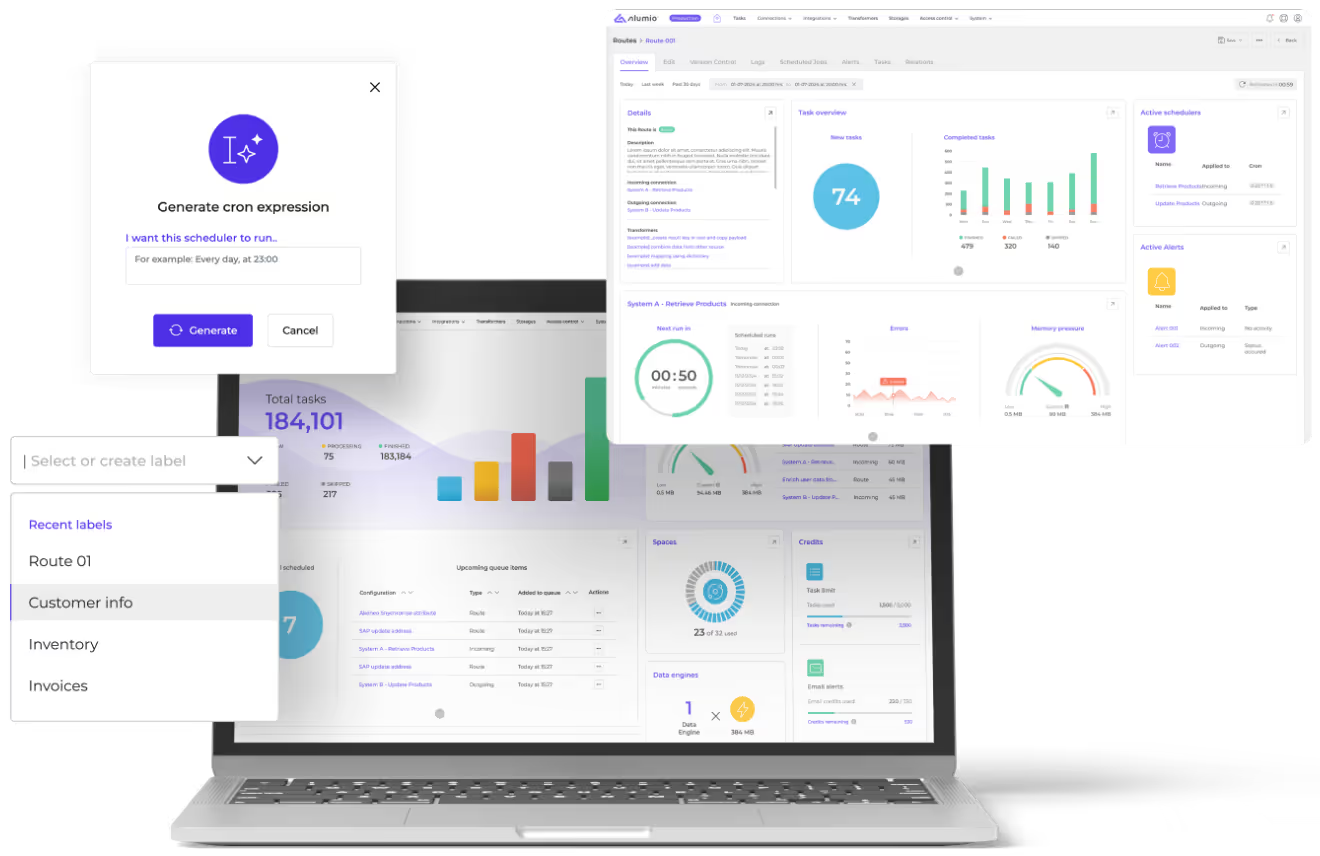
Laptop screen displaying the Alumio iPaaS dashboard, alongside pop-up windows for generating cron expressions, selecting labels and route overview.