Ready to implement AI?

Download the AI Playbok
A Alumio vivid purple arrow pointing to the right, a visual representation of how to access more page material when clicking on it.
Go back

Inside Alumio’s innovation journey: Redefining the integration landscape

By
Ray Bogman
Published on
October 27, 2025
Updated on
June 24, 2026
IN CONVERSATION WITH
Email icon
Email icon

When you join a company that’s only five years old and it already feels like a classic, you pay attention. In my first months at Alumio, two things stood out immediately: the people (a rare mix of hungry talent and steady senior leadership), and the passion for sharpening the product, every single day. I’ve seen a lot of teams in my career; this one is remarkable.

A week in innovation: From playground to production

There’s a rhythm to my week. I create and share ideas via Alumio Pulse, talk with partners across the ecosystem, and, crucially, get hands-on with new tech. It’s not enough to read about a tool; you have to break it, shape it, and see where it actually helps customers.

Alongside the experiments are leadership sessions on strategy, enablement, and education, including a brand-new Certification Program we built from scratch. Watching people jump in, learn, and get certified has been a highlight.

Best part of the job? The variety. I get to be curious, creative, and practical, often in the same hour. The constant in that journey? Relentless product innovation.

What’s changing integration right now

One acronym is quietly redefining how integration gets done: MCP (Model Context Protocol). Together with AI, it’s opening a new path where intelligent agents can “understand” systems, orchestrate tasks, and accelerate the work that used to take weeks. This isn’t a gimmick, it’s a new integration operating model.

Our innovation motto: Useful beats shiny

We all love shiny. But the right question is: does it matter on Monday morning? At Alumio, we listen first, to customers, partners, and the reality of production. We build where it counts, not where it merely demos well. There’s something very cool in the works (I’m genuinely stoked), born directly from those conversations. You’ll see it soon, and you’ll be able to use it.

What “innovation” means to us

For me, innovation is creativity with consequences. It’s only real if it improves someone’s day-to-day: clearer data, faster delivery, lower risk, better outcomes. That’s the bar we set for everything that ships.

Turn AI ambition into action

Portrait of Leonie Becher Merli, Business Development Manager at Alumio

Get a free assessment of your integration needs and next steps

Portrait of Leonie Becher Merli, Business Development Manager at Alumio

Two ambitious bets I’m excited about

  • AI + MCP inside Alumio: Think agent-powered assistance that helps design, monitor, and optimize integrations with context, not just code.
  • A visual flow builder (low-code): Building routes across systems should be intuitive. We’re crafting a clear, visual way to connect apps, transform data, and orchestrate workflows without friction.

How we choose what’s next

Our roadmap already leans into AI, workflow automation, and composable architectures. We also think beyond a single vertical; retailers, manufacturers, fintech players, and travel tech all share the same need: a backbone that scales with them. We don’t own a crystal ball, but we do have a bias toward delivering the “latest and greatest” when it’s production-ready.

The future of integrations: Agentic, adaptive, effortless

Agentic AI, multiple agents collaborating, will mature from intriguing to indispensable. Imagine prompting an integration into existence: agents scan schemas, infer mappings, set up routes, clean data, and even propose reporting. Not as a one-off trick, but as a reliable, governed capability. That’s where the industry is heading.

My ideal future? An integration backbone that self-assembles. You point Alumio at your data and systems; it interprets, designs, and stands up the first cut, then keeps optimizing as your business evolves. Less time “building,” more time becoming.

OVERDRIVE: Where speed meets substance

On November 20, we’ll bring this to life at OVERDRIVE. Expect energy and honesty: what works, what’s next, and how we’ll get there together. Bring your stories, your constraints, your wish lists. Innovation is a team sport, and the best ideas often start in conversations between practitioners.

Ready to swap theory for traction? Join us at OVERDRIVE: alumio.com/overdrive

No items found.
Topics in this blog:

FAQ

Integration Platform-ipaas-slider-right
What is Alumio's approach to product innovation in integration?

Alumio's approach to product innovation centers on making integrations progressively simpler to build, own, and evolve without specialist middleware expertise. This translates into: a growing prebuilt connector library that reduces time-to-first-integration for common system combinations, platform features (like the Inspection Tool and maintenance window management) that reduce the operational overhead of running a live integration landscape, AI-augmented capabilities that reduce the configuration effort for routine mapping tasks, and developer tooling that makes custom component development consistent and version-controlled rather than ad-hoc.

Integration Platform-ipaas-slider-right
What distinguishes Alumio's culture of continuous platform improvement?

Alumio's culture of continuous platform improvement is shaped by a combination of deep technical product expertise and direct customer and partner feedback loops. The team's proximity to implementation partners (who bring integration challenges from real projects) and to customers (through customer success engagements) means product investments address genuinely painful operational problems rather than theoretically interesting capabilities. The five-year track record of consistent platform evolution, from the initial data distribution focus to an AI-ready integration backbone with enterprise security certification, reflects sustained commitment to making the platform more valuable with each iteration.

Integration Platform-ipaas-slider-right
How has the integration landscape changed since Alumio was founded, and how has Alumio responded?

Since Alumio's founding in 2020, the integration landscape has seen: explosive SaaS adoption (more systems to connect), the rise of composable commerce (increasing integration surface area), the emergence of AI tools that require governed data access, and growing regulatory requirements (GDPR enforcement maturity, DPP on the horizon). Alumio has responded with: an expanded connector library for new platforms and AI services (OpenAI, DeepSeek), ISO 27001:2022 certification for enterprise trust, improved monitoring and observability for larger integration landscapes, and platform features specifically designed to reduce IT dependency for routine integration management.

Integration Platform-ipaas-slider-right
What does Alumio's innovation pipeline focus on for the near future?

Alumio's near-future innovation focus is on: AI-native integration capabilities (embedded AI processing within Routes, AI-assisted configuration for faster integration setup), expanding support for AI agent protocols (MCP integration that allows AI agents to access business data through the governed Alumio backbone), deeper analytics and observability for integration health management, and features that extend integration ownership to non-technical team members without reducing governance quality. Each of these reflects the convergence of AI adoption and integration infrastructure as the defining enterprise IT challenge of the next several years.

Integration Platform-ipaas-slider-right
How does Alumio balance platform stability with continuous innovation?

Alumio balances stability with innovation through version-controlled Routes (existing integrations are not affected by platform updates), backward-compatible connector updates (new API versions are added alongside existing ones rather than replacing them), and a staged rollout approach for platform features (new capabilities are tested with early-adopter partners before general availability). This means customers benefit from platform improvements without the risk of their production integrations breaking on each release: the governance model that makes continuous innovation compatible with enterprise reliability requirements.

Integration Platform-ipaas-slider-right
What makes Alumio's team and talent approach distinctive in the integration market?

Alumio's team approach is distinctive for combining hungry early-career talent with experienced senior leadership in a compact team that punches above its size. The Groningen headquarters and Amsterdam presence allow access to both Dutch technical talent and the broader European digital commerce ecosystem. The emphasis on both platform product depth (integration architecture, connector development) and customer-facing domain expertise (e-commerce, manufacturing, wholesale) means the team can translate complex integration challenges into platform solutions rather than custom project work, which is what makes Alumio a scalable platform business rather than a managed services provider.

Get a free assessment of your integration needs

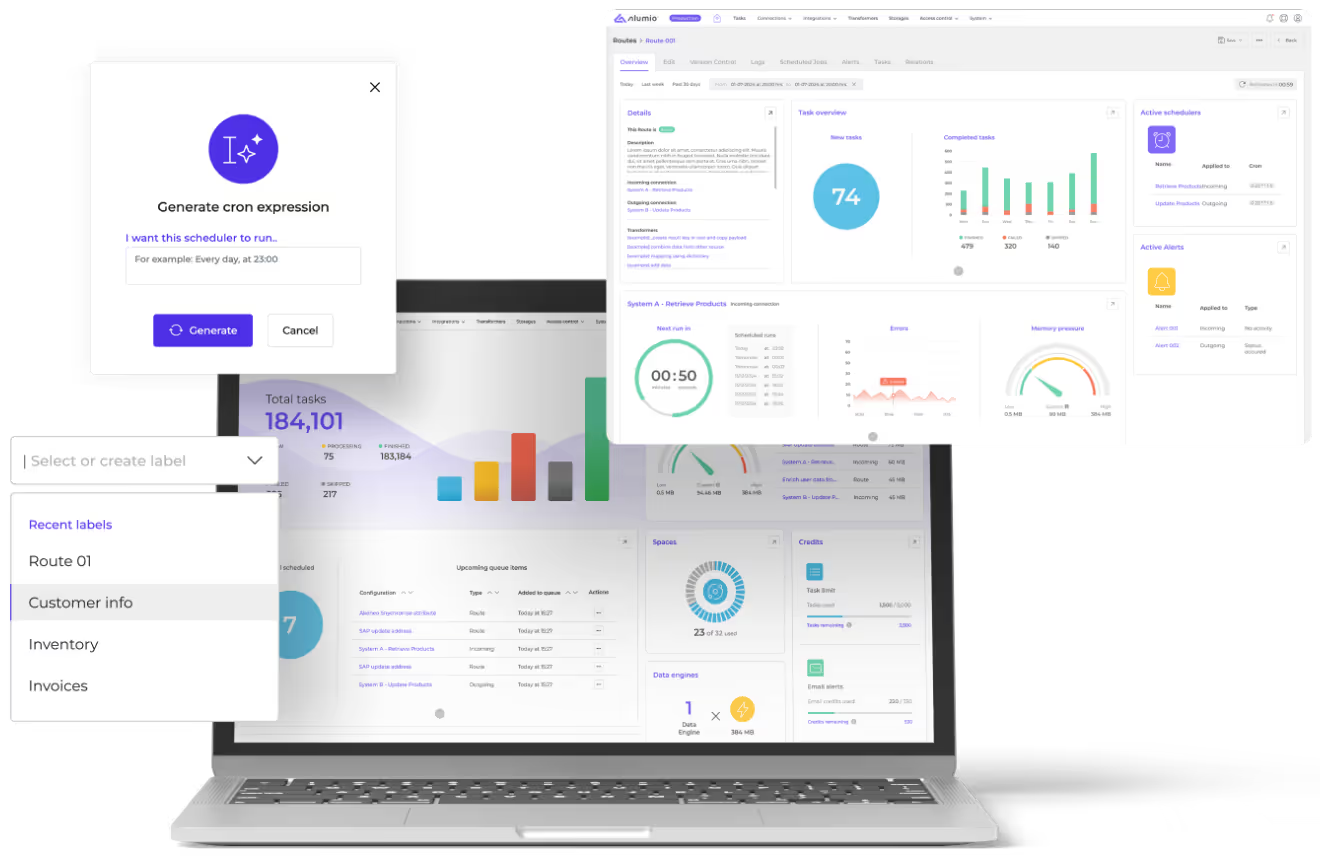
Laptop screen displaying the Alumio iPaaS dashboard, alongside pop-up windows for generating cron expressions, selecting labels and route overview.