




.svg)



Why most production monitoring dashboards aren't actually real-time
The conversation around production monitoring tends to fixate on dashboards. Which KPI visualization tool, which OEE template, which screens go on the plant floor. Those choices are real, but they sit on top of decisions made one layer down that determine whether the dashboards show useful information or stale numbers wearing a fresh interface.
The architectural decision worth making first is how production data flows from the shop floor into the systems that consume it. Most existing setups use polling: dashboards or aggregators that ask SCADA, MES, or ERP for current state at scheduled intervals. Polling works when the production pace is measured in shifts. It breaks when the production pace is measured in cycles per minute, which describes most modern manufacturing operations. Real-time production monitoring needs event-driven data flows underneath, with the dashboard as the visible top layer rather than the primary engineering investment.
Why do most production monitoring dashboards show stale data?
Most production monitoring dashboards show stale data because the data pipeline behind them was built for batch reporting, not for real-time observation. The pipeline runs roughly like this: PLCs and machine controllers generate operational data, SCADA aggregates it locally, MES pulls from SCADA on a schedule, ERP receives MES data through nightly or hourly batches, and the BI dashboard pulls from ERP. By the time the dashboard refreshes, the data has passed through three or four systems, each with its own update cycle.
This architecture made sense when production reporting was a daily exercise. It doesn't fit the current expectation that managers should see what's happening on the line within seconds, not at the next refresh cycle.
The hidden cost is decision lag. A line stoppage at 9:14 AM that propagates through the data layer doesn't reach the dashboard until 9:30 or later, depending on which batch cycles it crosses. By the time someone looks, the line has either restarted or run out the rest of the shift on degraded output. The dashboard becomes a historical record of what happened, not a decision support tool for what's happening.
What does real-time production monitoring actually require?
Real-time production monitoring requires four things from the data layer underneath: event-driven flows from the OT layer, computed metrics close to the source, exception-based alerting, and observability across the whole pipeline.
The four requirements:
- Event-driven data flows: Machine state changes, cycle completions, anomalies, and faults broadcast as events the moment they happen, rather than waiting for the next polling cycle
- Computed metrics at the edge or in the integration layer: OEE, throughput, yield, and quality metrics calculated as the data flows rather than aggregated after the fact in BI tools
- Exception-based alerting: notifications triggered by deviations from expected state, sent to the systems and people who can act on them, instead of dashboards waiting to be checked
- Observability across the pipeline: trace-back capability when the dashboard shows something unexpected, so the team can quickly verify whether the issue is on the line or in the data flow
These four requirements together change the dashboard's role. Instead of being the primary monitoring tool, it becomes the visible summary of an event-driven layer that's already doing the monitoring work continuously.
How an integration platform supports real-time production monitoring
An integration platform-as-a-service (iPaaS) handles the event-driven connectivity, transformation, and observability that real-time production monitoring depends on. Rather than building one-off bridges between each OT system and each downstream consumer, an iPaaS centralizes the integration layer and routes events across the production stack.
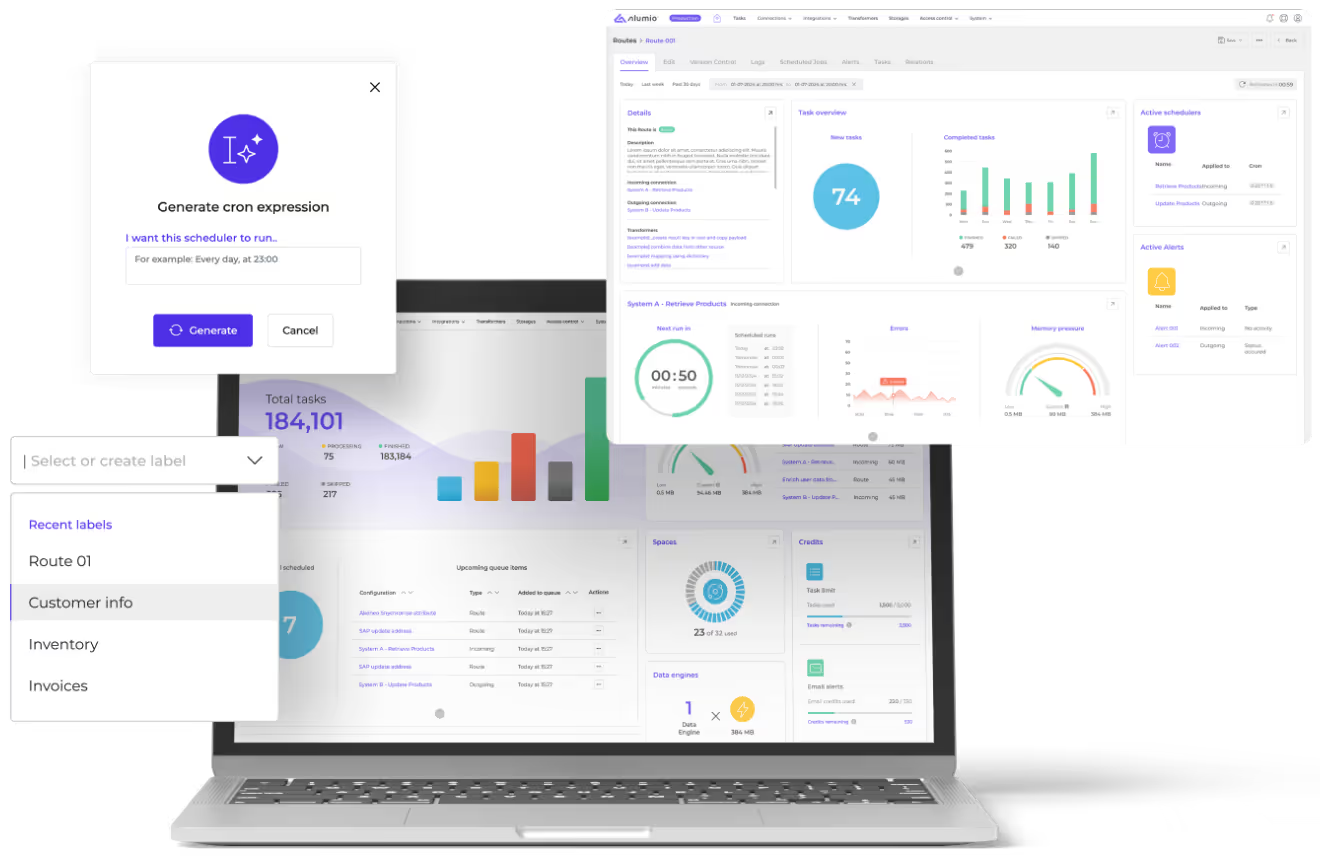
The Alumio iPaaS supports this pattern by bridging the OT and IT layers that hold production data. On the OT side, it connects to industrial gateways, sensor brokers, and unified namespace layers. On the IT side, it connects to MES, ERP, BI tools, and asset management systems. Routes orchestrate event-driven flows so production events propagate in seconds rather than overnight. Transformers and Mappers compute OEE, throughput, and yield metrics in the integration layer rather than waiting for downstream BI tools to aggregate them. The Inspection Tool provides observability across every event, so when something looks wrong on the dashboard, the team can trace back to the originating machine event.
The integration layer is where real-time monitoring stops being a dashboard project and becomes architecture. The dashboard renders what the integration layer produces, and the integration layer produces what the OT and IT systems generate as events. Each layer has a clear role, and the whole pipeline works at the pace the production floor demands.
This is the same integration foundation that connects machine data to enterprise systems in modern manufacturing operations. Real-time production monitoring is one of the use cases that becomes possible once that foundation is in place.




.svg)
.svg)
.svg)
.svg)
.svg)
.svg)
