


A Alumio vivid purple arrow pointing to the right, a visual representation of how to access more page material when clicking on it.
Go back

iPaaS vs dPaaS vs DPaaS

By
Saad Merchant
Published on
May 26, 2023
Updated on
June 24, 2026
IN CONVERSATION WITH
Email icon
Email icon

Big data, the cloud, ERP systems, SaaS, e-commerce solutions, the growing number of cloud-based applications, and the pre-dominant on-premises systems are compelling businesses to reconsider data management strategies. Eliminating data silos, ensuring data security, and data integration are key challenges that businesses are looking to streamline their business and overcome with cloud technology. When it comes to application integration and data management, the iPaaS (integration Platform as a Service) is a next-gen solution that most modern businesses are starting to implement. On the other hand, for businesses looking to simply manage and organize their data, minus the integration, there is a solution called dPaaS (Data Platform as a Service). However, when comparing these two solutions, it’s important to not confuse them with another DPaaS with a capital D that stands for “Data Protection as a Service”, which as its name indicates - exclusively focuses on data security. Let’s untangle the differences between these three similar-sounding cloud-based solutions that are helping businesses leverage and secure their data.

iPaaS vs dPaaS vs DPaaS

Comparing cloud-based integration solutions for data management

The common element between these three cloud-based platforms is data management, security, and insight. The “Data Platform as a Service (dPaaS)” focuses on data management. Data Protection as a Service (DPaaS) focuses on data security. And the iPaaS (integration Platform as a Service) helps connect various systems, applications, and data sources while providing real-time data exchange, security, governance, and insights.

What is the iPaaS?

Fast, flexible, and scalable integrations

The “integration Platform as a Service (iPaaS)” is either a low-code or no-code, cloud-based integration platform. As an API-driven solution, it helps connect two or multiple systems, SaaS, cloud apps, and data sources from one user-friendly web interface, across on-premises and cloud environments. Apart from helping create, monitor, and manage all integrations from one intuitive dashboard that visualizes all data flows, the iPaaS also provides flexible data transformation tools and the ability to automate workflows.

Key features of an iPaaS

  • Centralization of data and integrations: The iPaaS enables businesses to integrate multiple systems, applications, and data sources on one cloud-based environment.
  • Real-time data exchange and synchronization: The iPaaS utilizes APIs, connectors, and adapters to ensure that the most up-to-date data is constantly updated across all connected systems, in real-time. This ensures data accuracy, eliminating duplications and inconsistencies.
  • Data transformation: The iPaaS provides transformers and mappers that help define and customize the structure and format of data exchanged between connected systems in real-time.
  • Scalability: The iPaaS offers a scalable infrastructure that can accommodate growing data volumes and expanding integration needs

Read more about how an iPaaS solution benefits businesses with seamless data synchronization.

What is dPaaS (Data Platform as a Service)?

Empowering Data-Driven Insights

The “data Platform as a Service (dPaaS)” is a cloud-based solution that provides organizations with a centralized and scalable environment to manage and analyze all their data. Designed to help businesses make data-driven decisions, the dPaaS offers a centralized repository for storing and organizing data, while providing tools and frameworks for data analysis, visualization, and reporting, enabling organizations to derive valuable insight. Some other offerings that some dPaaS solutions provide incorporate data lakes, data warehouses, and machine learning capabilities.

Key Features of dPaaS

  1. Data Storage and Management: dPaaS offers secure and scalable storage options for structured and unstructured data. It allows businesses to organize, manage, and access data efficiently while ensuring data governance and compliance.
  2. Data Analytics and Visualization: dPaaS provides tools and frameworks for data analysis, visualization, and reporting. Businesses can leverage these capabilities to extract meaningful insights from their data, identify patterns, and make data-driven decisions.
  3. Data Governance and Compliance: dPaaS incorporates robust security measures and compliance frameworks to protect sensitive data and ensure regulatory compliance. Features such as data encryption, access controls, and audit trails help organizations maintain data privacy and meet industry-specific regulations.

What is DPaaS (Data Protection as a Service)?

Safeguarding Your Data Assets

Data Protection as a Service (DPaaS) is a cloud-based solution that focuses on providing data security, network security, and disaster recovery capabilities. It offers a comprehensive set of services designed to safeguard sensitive data, ensure confidentiality, integrity, and availability, and protect against data loss or breaches. It incorporates robust security measures and compliance frameworks to protect sensitive data and meet regulatory requirements. And it implements data encryption mechanisms and disaster recovery services, to minimize downtime and ensure business continuity.

Key Features of DPaaS

  1. Backup and Recovery: DPaaS automates regular and secure data backups, enabling businesses to immediately restore their data in the event of data loss or system failure.
  2. Data Encryption: DPaaS incorporates encryption mechanisms to secure data at rest and in transit. It ensures sensitive information remains encrypted and protected from unauthorized access, reducing the risk of data breaches.
  3. Disaster Recovery: DPaaS offers disaster recovery services to minimize the impact of disruptive events such as natural disasters or cyber-attacks.


Turn AI ambition into action

Portrait of Leonie Becher Merli, Business Development Manager at Alumio

Get a free assessment of your integration needs and next steps

Portrait of Leonie Becher Merli, Business Development Manager at Alumio

iPaaS solutions with dPaaS and data protection features


While iPaaS solutions are primarily meant for application and data integration, there are some iPaaS solutions that offer more data management features than others. For instance, iPaaS solutions like the Alumio iPaaS provide data security, backup, recovery, and data transfer features.

Centralizing all integrations and data on a cloud-native environment, the Alumio iPaaS helps eliminate data silos, provides data security on all levels, and enables compliance with data protection regulations. While the user-friendly web interface of the Alumio iPaaS helps create, manage, and monitor integrations with multiple systems, cloud apps, and data sources, it also provides a visual overview of all data flows for analysis.

DPaaS and dPaaS features that the Alumio iPaaS provides

Here are some similarities that the Alumio iPaaS shares with both - Data Platform as a Service (dPaas) and Data Protection as a Service (DPaaS) solutions, when it comes to data management:

1. Compliance with data protection regulations

The Alumio iPaaS complies with GDPR and comes with GDPR-reporting capabilities. It also complies with other key privacy legislation like SOC2, CCPA, FERPA, HIPAA, and more.

2. Data security and business continuity

The Alumio iPaaS also provides caching capabilities, data buffering, and reactivation procedures for all connected systems and data sources, to reduce system downtime and ensure business continuity.

3. Data analysis and reporting

The Alumio iPaaS provides 360-degree data insights for all connected systems, provides reporting tools, and visualization of all data flows on one intuitive dashboard.

4. Build data lakes for AI, ML, and BI

The Alumio iPaaS provides a centralized approach to data management, enabling organizations to connect and aggregate data from disparate systems, applications, and databases, into a unified and comprehensive data repository.

In addition to the similar data management benefits that the Alumio iPaaS shares with dPaaS and DPaaS, here are some additional advantages that it offers:

1. Data migration

Providing ETL (Extract, Transfer, Load), the Alumio iPaaS helps migrate data sources, custom fields and custom objects.

2. Automated monitoring and logging

The Alumio iPaaS provides real-time error detection with alerts for data errors, API conflicts, or faulty integrations, which can be swiftly resolved from one intuitive dashboard.

3. Workflow automation

The Alumio iPaaS helps significantly reduce manual data entry work with workflow automation, enabling standardized and scheduled data sharing between all connected systems in real-time.

Concluding thoughts on iPaaS vs dPaaS vs DPaaS

For businesses that are looking to simply manage, organize, and secure all their data sources, both the Data Platform as a Service (dPaaS) and the Data Protection as a Service (DPaaS) solutions are effective solutions. However, for businesses looking for a more holistic to integrate not just their data sources, but also applications, SaaS solutions, and on-premises systems, while ensuring data security, they are better served employing an iPaaS solution. In essence, while the dPaaS and DPaaS are about data management to ensure business continuity and efficiency, the iPaaS is all about data integration and management to also ensure digital growth.


To get a first-hand experience of the Alumio iPaaS and its data management capabilities, feel free to book a demo or get in touch with an Alumio regional representative.

No items found.
Topics in this blog:
No items found.

FAQ

Integration Platform-ipaas-slider-right
What are the differences between iPaaS, dPaaS, and DPaaS?

iPaaS (Integration Platform as a Service) manages application integration: connecting ERP, CRM, e-commerce, and PIM systems through governed data flows. dPaaS (Data Platform as a Service) provides cloud-hosted database and data storage infrastructure as a managed service. DPaaS (Data Processing as a Service) is a broader term covering managed services for large-scale data processing, batch analytics, and stream processing: including services like AWS EMR, Azure HDInsight, or Google Dataflow. Each addresses a different layer of the data infrastructure stack: iPaaS manages application-level data exchange, dPaaS manages data storage infrastructure, and DPaaS manages large-scale data computation. Most data-mature organizations use all three layers.

Integration Platform-ipaas-slider-right
How does iPaaS relate to data management and data governance?

iPaaS is the operational layer of data governance: it determines how data flows between systems, which system is authoritative for each data type, what transformation is applied before data reaches each destination, and which data exchanges are logged for audit purposes. Data governance frameworks that define data ownership, quality standards, and access policies are operationalized through iPaaS configuration: the authoritative source for each data type is the system from which iPaaS Routes flow, and data quality rules are enforced in Transformer validation logic before records reach destination systems. Good iPaaS governance is a prerequisite for effective data governance at the organizational level.

Integration Platform-ipaas-slider-right
What is the role of cloud computing in enabling modern data management?

Cloud computing enables modern data management by providing: elastic storage and compute resources that scale with data volumes without capital investment, managed database services that eliminate database administration overhead, data warehouse platforms (Snowflake, BigQuery, Redshift) that make analytical data management accessible to organizations of all sizes, and the API-first SaaS applications that generate the data flows iPaaS manages. Cloud computing has also democratized integration: cloud-native iPaaS like Alumio is accessible to mid-market organizations without the infrastructure investment that on-premise middleware required, bringing enterprise-grade integration governance to a much broader range of organizations than could previously justify it.

Integration Platform-ipaas-slider-right
How do data silos affect each layer of the data infrastructure stack?

Data silos affect each layer differently: at the iPaaS layer, silos result from missing integration routes between systems that should exchange data; at the dPaaS/database layer, silos result from separate data stores with no shared schema or access layer; at the DPaaS/analytics layer, silos result in incomplete analytical data sets that cannot reflect the full business picture. Each layer's silos compound the others: an iPaaS silo creates a database silo which creates an analytical silo. Addressing silos at the iPaaS layer is the most effective starting point because it creates the governed data flows that populate all downstream data stores consistently: fixing the root cause rather than patching symptoms at the analytical layer.

Integration Platform-ipaas-slider-right
How should businesses structure their data infrastructure across iPaaS, dPaaS, and DPaaS?

A well-structured data infrastructure separates concerns clearly: iPaaS governs operational data flows between live business systems (real-time or near-real-time), ensuring each system receives current, accurate data from authoritative sources. dPaaS hosts the databases and data stores that operational applications use, managed as cloud services rather than on-premise databases. DPaaS processes analytical workloads (batch analytics, ML model training, large-scale data transformations) against data extracted from operational systems. The integration between these layers (how iPaaS-governed data flows populate dPaaS stores, and how DPaaS analytics extract from those stores) should be designed as part of the overall data architecture rather than added ad hoc as each layer is adopted.

Integration Platform-ipaas-slider-right
What is the future of data platform management as cloud and AI capabilities evolve?

The future of data platform management involves increasing convergence: AI tools that need real-time operational data from iPaaS-governed sources for inference, analytical models trained on DPaaS-processed historical data enriched by iPaaS operational records, and data governance that spans all layers with consistent lineage and access controls. The iPaaS backbone becomes more strategically central as AI adoption grows: the governed data access layer through which AI tools receive the current, complete operational data they require. Organizations that invest in iPaaS governance as foundational infrastructure position themselves to adopt AI tools reliably as the AI layer matures, rather than discovering data quality problems after AI investment is made.

Get a free assessment of your integration needs

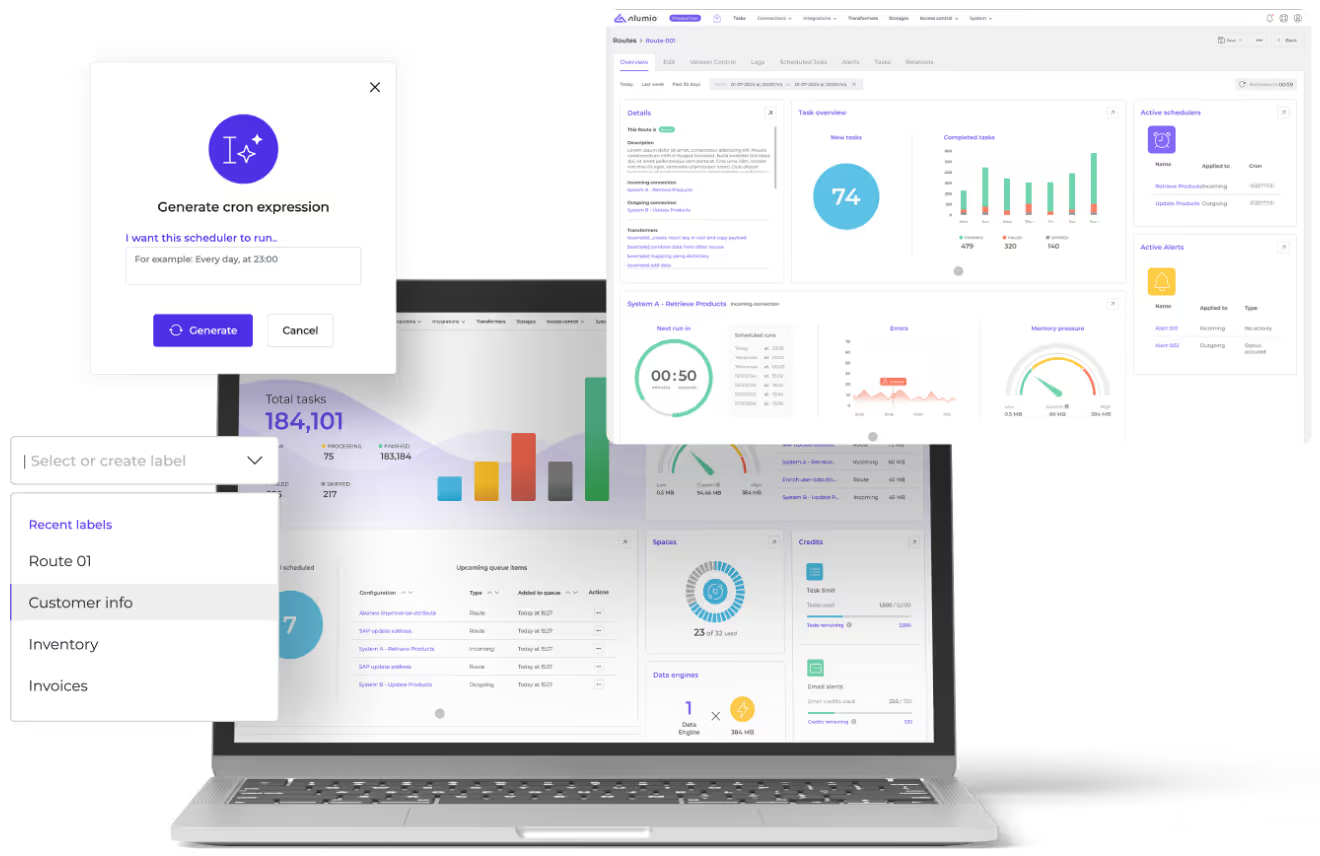
Laptop screen displaying the Alumio iPaaS dashboard, alongside pop-up windows for generating cron expressions, selecting labels and route overview.