Integrate Compano PIM to scale product data efficiency
When managing tens of thousands of SKUs, each with varying specifications, categories, and compliance requirements, spreadsheets and siloed systems break down quickly. For technical wholesalers, B2B suppliers, and installation professionals, a centralized, structured, and easily accessible source of truth for product information isn’t a luxury — it’s essential infrastructure.
Solutions like Compano PIM help ensure product data is enriched, accurate, and consistently available, supporting faster decision-making and improving customer experiences across both digital and offline channels. But while Compano excels at optimizing product data, its true value emerges when that data can move freely across your entire IT landscape. Let’s take a closer look at what Compano PIM offers, before we dive into the benefits of combining it with an integration platform.
What is Compano PIM?
Compano PIM is a specialized product information management system designed for technical wholesalers, particularly those in industries like electrical, HVAC, or industrial supplies. It centralizes product data, ensuring consistency across catalogs, webshops, and ERP systems while supporting compliance with standards like ETIM (European Technical Information Model). Unlike generic PIM platforms, Compano is tailored to handle the intricate attributes and classifications common in technical sectors, making it a go-to for businesses managing complex product portfolios.
What makes Compano PIM stand out is its domain-specific flexibility. It understands how technical wholesalers structure their catalogs, handle supplier data, and prepare product information for industry exchanges, ERPs, and webshops. Unlike generic PIM platforms, Compano is tailored to handle the intricate attributes and classifications common in technical sectors, making it a go-to for businesses managing complex product portfolios.
Unique advantages of Compano PIM
Compano PIM stands out for its ability to streamline product data management in complex, high-volume environments, delivering platform benefits such as:
- Industry-ready classification support: Built with ETIM and other technical standards in mind, Compano ensures that product data is structured for compliance and compatibility across industry platforms, which is essential for secure B2B transactions.
- Efficient supplier onboarding: Designed to handle large-scale imports, Compano simplifies the integration of supplier data, reducing manual effort and the risk of inconsistencies.
- Flexible data modeling: Highly configurable catalog structures and attribute sets allow businesses to tailor product data to their exact needs without workarounds or custom development.
- Technical depth and precision: Whether it's voltage specifications, material types, or installation requirements, Compano is built to manage detailed, domain-specific attributes with accuracy.
These capabilities position Compano PIM as a robust foundation for enriching and managing complex product data. But its real impact is realized when the data it enriches can flow seamlessly across systems, fueling everything from project-specific procurement portals and distributor platforms, to ERP-driven logistics and on-site installation planning. In such environments, integration becomes not just a technical step, but a strategic necessity.
The value of integrating Compano PIM with the Alumio iPaaS
While Compano PIM offers robust product management features, its standard API presents some limitations when it comes to integration. Challenges such as the lack of pagination support or reliable delta export capabilities can create performance bottlenecks and lead to unnecessary data transfers, especially in large-scale environments. It also results in higher licensing costs and unnecessary complexity during integrations.
This is why B2B integration specialists like Innovadis, who have extensive experience with the ETIM standard and integrating Compano PIM, prefer using next-gen middleware solutions like the Alumio iPaaS (integration Platform as a Service). It delivers a scalable and flexible API-driven, low-code integration solution that helps swiftly connect Compano PIM with ERP systems, ETIM data processors, supplier portals, external PIM or data services systems, webshops like Adobe Commerce (Magento), Shopify, etc.
Leveraging the Alumio iPaaS to integrate Compano PIM helps overcome the aforementioned limitations of its API and integration challenges it presents, with advantages such as:
- Partner support: Accessing Alumio’s integration partner support, where agencies like Innovadis already specialize in integrating Compano PIM using the Alumio iPaaS, helps sidestep common hurdles and reduce support overhead.
- Pagination support: Alumio adds support for paginated data exchanges, preventing bulk data overloads. This significantly reduces the volume of data transferred during sync processes, resulting in better system performance and lower operational costs.
- Delta support: Instead of transferring full datasets repeatedly, Alumio enables delta-based synchronization. Only updated or new records are exchanged, reducing processing time and enhancing data freshness across connected systems.
- Avoid costly custom solutions: Using pre-built Connectors and flexible data transformers that Alumio provides to customize data exchange flexibly, helps businesses avoid the cost and hassles of building custom middleware or bespoke integrations.
- Faster implementation: The low-code interface of the Alumio iPaaS makes it easier for IT teams to deploy, monitor, and update integrations without needing extensive development resources. This accelerates time-to-value and simplifies changes.
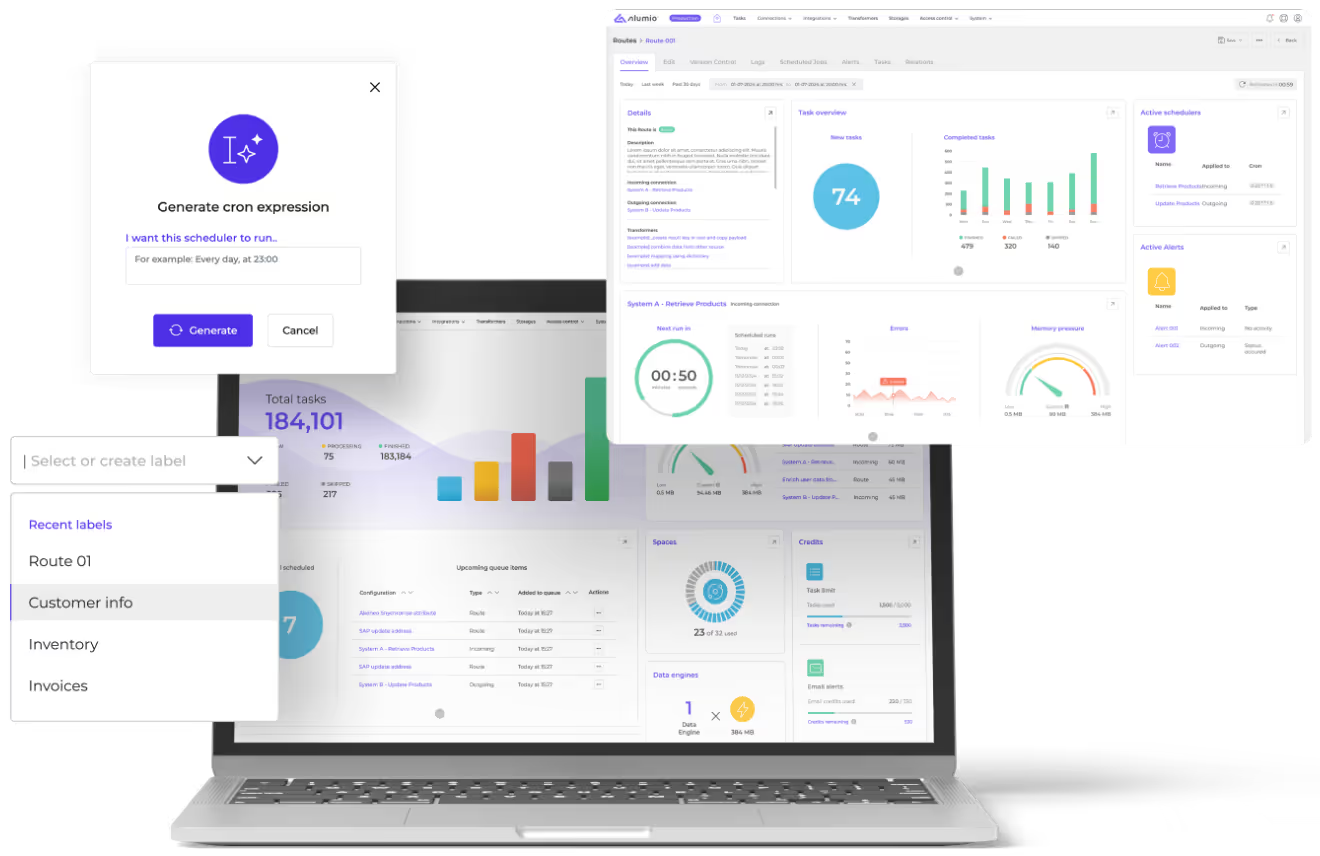
- Fully deployable via the Alumio iPaaS: Centralize and manage all your Compano PIM integrations via one user-friendly cloud-based interface. Get visibility into all your data flows, version control, logging of every action, and the flexibility to evolve as your digital ecosystem expands.
Maximizing Compano PIM’s capabilities with the Alumio iPaaS
Combining Compano PIM with the Alumio iPaaS, helps technical wholesalers lay the groundwork for scalable, synchronized product data flows. It’s more than just linking systems, it’s about enabling data to move precisely and reliably, across webshops, ERP platforms, and supplier networks, without the delays or risks of manual intervention.
While Compano PIM delivers domain-specific control and depth in product information, integration is what turns that strength into larger operational impact. Alumio bridges this gap with a flexible, low-code platform that simplifies complex integrations, minimizing custom development, improving maintainability, and supporting evolving digital strategies. Working with experienced partners like Innovadis brings additional value, as they bring their understanding of both Compano’s structure and Alumio’s capabilities, helping businesses accelerate implementation without reinventing the wheel.
For businesses dealing with complex catalogs and fast-changing product lines, the long-term value lies not just in managing product data, but in moving it with precision, reliability, and speed. A robust PIM like Compano provides the foundation, but its real strength is unlocked when it becomes part of a connected ecosystem.





.svg)









.svg)
.svg)
.svg)
.svg)
.svg)
.svg)
