





.svg)



Enabling industrial workflow automation with Claude AI for manufacturers
While Industry 4.0 promised connected factories, many manufacturers still struggle with fragmented systems, manual processes, and automation that breaks under the weight of real‑world complexity. Traditional automation tools—RPA bots, hard‑coded scripts, even basic ETL — often falter due to:
- Siloed systems: ERP, MES, PIM, and CRM rarely exchange information or communicate without custom connectors or manual interventions.
- Error‑prone updates: A single BOM update might require touching five different systems with different data format and validation rules, or an error in customer‑specific pricing logic can introduce costly mistakes.
- Missing or inaccurate data: Product specifications get trapped in PDF documents when they should be driven through automated workflows.
- Compliance bottlenecks: Compliance requirements turn into massive manual documentation exercises instead of systematic, auditable processes.
By contrast, implementing Gen AI solutions like Claude AI for manufacturers injects real‑time automation into every step of the process. It can parse sensor data to predict equipment failures, analyze batch records to flag deviations, and dynamically adjust workflows when bills of materials change. When you integrate Claude with your business systems using an iPaaS for manufacturing, those AI‑driven insights instantly become cross‑system actions — triggering preventive maintenance orders in your MES, updating part specifications in ERP and PIM, and auto‑publishing compliance reports, without human hand‑offs.
This results in effective, automated industrial workflow automation, where Claude AI brings the intelligence and the iPaaS provides connectivity. This type of manufacturing automation with AI self‑corrects, self‑documents, and scales across multiple systems — even in highly regulated environments.
How manufacturers can use Claude AI for smarter workflows
Manufacturing doesn't need an AI that can generate creative content. It requires an AI that can consistently follow complex procedures, parse structured documents, and generate outputs that meet regulatory standards. As mentioned earlier, this is precisely where using Claude AI for manufacturing works as a natural fit to build industrial AI workflows.
Ideal for manufacturing data enrichment AI and capable of working as a rule-based AI for ERP automation, Claude’s capabilities stem from its Constitutional AI framework, which prioritizes:
- Rule‑following precision
Unlike models optimized for creative tasks, Claude excels at following complex, multi-step procedure while adhering to user‑defined rules and corporate policies, making it ideal for rule‑based industrial workflow automation. - Explainable outputs
Every response can include the logic or citations behind its recommendations, perfect for audit trails and compliance reviews. - Structured document handling
Manufacturing lives in specifications, BOMs, work instructions, and compliance documents, and Claude's text analysis capabilities excel at extracting and organizing such data. - Privacy‑first design
Claude does not train on your prompts by default and starts each session without persistent memory — minimizing data leakage risks in highly confidential industrial AI workflows. - Reduced hallucinations
While no AI is infallible, Claude’s safety‑first approach and Constitutional AI guardrails significantly lower the chance of “making things up,” which is critical when accuracy is crucial.
In contrast, more “creative” models like ChatGPT or Gemini may excel at open‑ended brainstorming, but can be less predictable in structured, rules‑driven manufacturing scenarios.
Want to learn more about the differences between Claude vs. ChatGPT for manufacturing? Read our blog comparing how both popular solutions work as AI automation tools →
Benefits of combining Claude with iPaaS in industrial environments
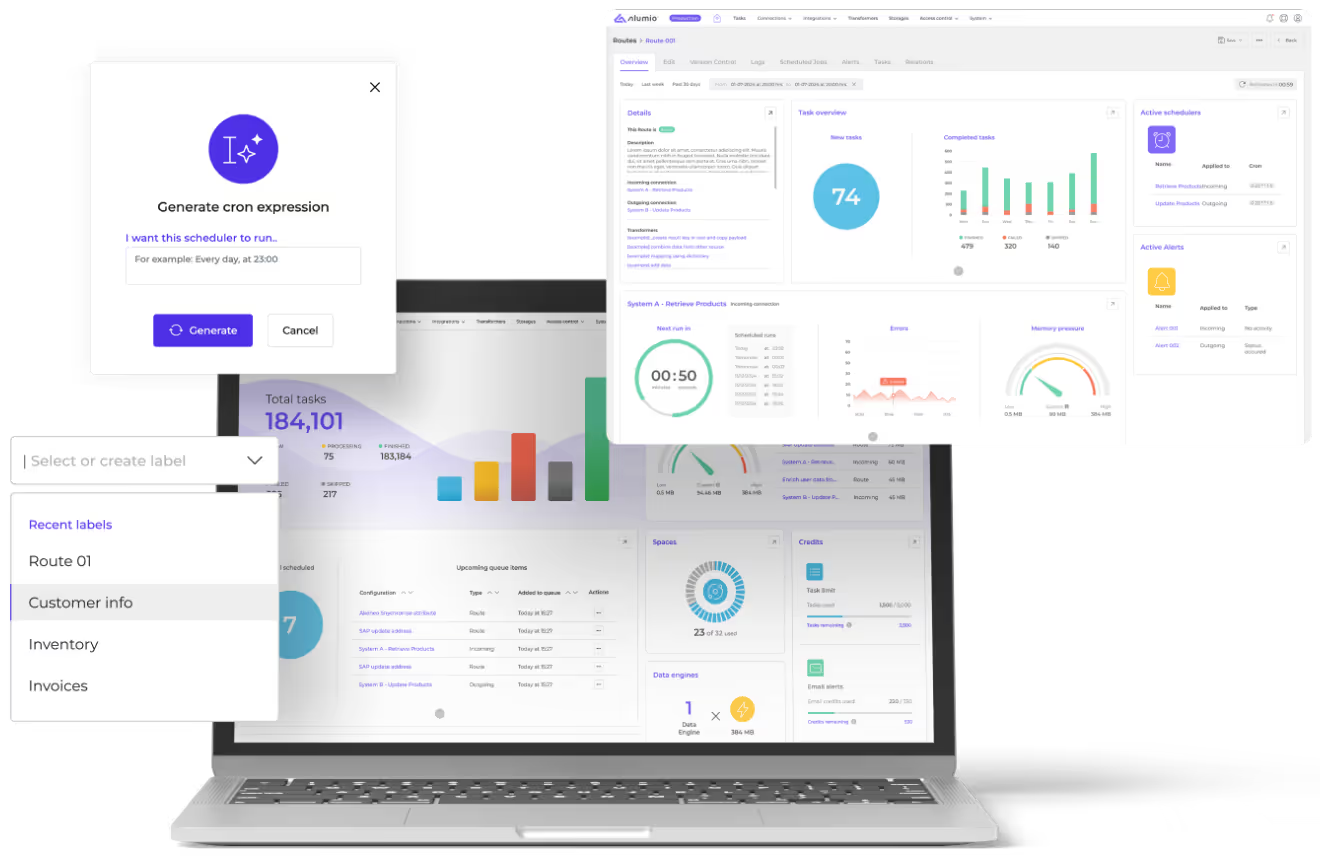
The true power behind most Claude AI use cases in manufacturing emerges when intelligent processing meets seamless system integration. Integrating Claude AI with ERP, PIM, and MES systems with an iPaaS (integration Platform as a Service) solution like Alumio is a game-changer for manufacturers.
Claude adds the “brain” that enables advanced, rules‑based AI that transforms raw data into actionable insights and content. Alumio provides the “nervous system,” seamlessly routing those AI-generated insights or content to the right applications, databases, and teams. Together, they turn isolated tasks into end‑to‑end automated processes that are accurate and fully auditable, driving significant gains in efficiency, compliance, and responsiveness across the factory floor and beyond.
Here are some essential use cases of Claude in the manufacturing industry that are already deploying these combined capabilities:
1. Enabling BOM standardization
Claude ingests messy, unstructured BOM (Bill of Materials) data (spreadsheets, PDFs, emails) and outputs a clean, normalized format. Using an iPaaS like Alumio you can map and sync this to your ERP or PLM, automatically flagging mismatches or missing parts.
2. Product data sheet generation
Using raw technical specifications, Claude drafts detailed product datasheets. You can then use the Alumio iPaaS to push these docs directly into your PIM, CMS, or distributor portals, keeping all channels up to date.
3. Compliance automation
Claude parses regulatory frameworks (RoHS, REACH, ISO 9001), generates compliance reports, and alerts stakeholders when SKUs fall out of spec. Alumio distributes these updates across ERP, MES, and CRM, ensuring no system is left behind.
4. Smart customer service workflows
When an RFQ arrives, Alumio enriches Claude’s prompt with real‑time ERP or CRM data. Claude drafts precise responses (pricing, lead times, spec clarifications) which Alumio then routes back to your support portal, all within minutes.
These aren’t just hypothetical scenarios; they are blueprints for manufacturing automation with AI that mid-size and enterprise players can put to work today.






.svg)
.svg)
.svg)
.svg)
.svg)
.svg)
