Why legacy factory equipment stays disconnected
A brownfield factory is an existing facility built around equipment and systems that predate modern connectivity. A greenfield plant, by contrast, is designed digital from day one. Nearly every manufacturer operates brownfield, because production equipment is bought to run for decades, not upgrade cycles.
The machines themselves are the obstacle. Older PLCs communicate over serial connections and proprietary protocols, with no Ethernet port in sight. Documentation and source code for 20-year-old equipment are often missing, and the original supplier may no longer exist. Reprogramming a controller that runs a production-critical line is a risk most operations teams refuse to take, and reasonably so.
Replacement is rarely the answer either. A hydraulic press from the 1990s can still hold its tolerances shift after shift. The constraint is not mechanical performance. It is that the machine has no way to tell anyone what it is doing.
What is IIoT retrofitting?
IIoT retrofitting is the practice of adding connectivity to existing machines through external sensors, edge gateways, and signal taps rather than replacing the equipment. It gives a pre-digital machine a way to report its condition and output to the systems around it.
In practice, three approaches cover most situations. External sensor kits measure vibration, temperature, or current draw from outside the machine, without touching its control logic. Edge gateways, small industrial computers mounted near the equipment, read signals from existing PLCs and translate protocols such as Modbus or proprietary serial formats into modern standards like OPC UA or MQTT. For the oldest equipment, simple signal-level monitoring of stack lights or power consumption can establish basic run-state visibility when nothing else is accessible.
Retrofitting is not always the right call. Equipment near end-of-life, dependent on obsolete spare parts, or unable to hold required tolerances is usually better replaced. The decision should weigh retrofit cost against the machine's remaining useful life, line by line and in phases, not as one factory-wide bet.
Why does legacy machine monitoring stall at the dashboard?
Because most retrofit projects connect machines to a monitoring application and stop there, creating a new silo on top of the old ones. The sensors work, the gateway streams data, and a dashboard shows live machine status. Then nothing downstream changes.
Maintenance may see vibration alerts, but the ERP still plans production against assumed capacity. The MES has no live machine status to schedule around. Finance still allocates downtime costs from manually kept logs. The data exists, yet every decision that could use it runs on the same stale inputs as before.
This is a business problem, not an IT inconvenience. Unplanned downtime keeps surprising planners, and the gap between actual and assumed capacity flows straight into missed delivery dates. It is the same pattern that explains why smart factories fail: the technology gets installed, and the connections that make it useful never follow.
Connecting retrofit data to business systems
The structural fix is treating machine connectivity as part of a composable landscape: best-fit systems connected through a shared layer, rather than one monolithic suite or a web of point-to-point links. Gateway output is just another data source in that landscape. It should reach every system that benefits from it, not one dashboard.
This is why manufacturers route retrofit data through an integration platform-as-a-service (iPaaS), a cloud platform that connects systems through one central hub instead of one-off custom connections. The gateway exposes machine data through an API, a database, or file drops. The platform picks it up, validates and reshapes it, and delivers it to the ERP, MES, and analytics tools in the format each expects.
Many manufacturers organize machine data at the edge first, through an IT/OT integration layer built on MQTT and a unified namespace. Brownfield integration then becomes a routing question: the shop floor publishes once, and the platform distributes everywhere.
Routing retrofit machine data with the Alumio iPaaS
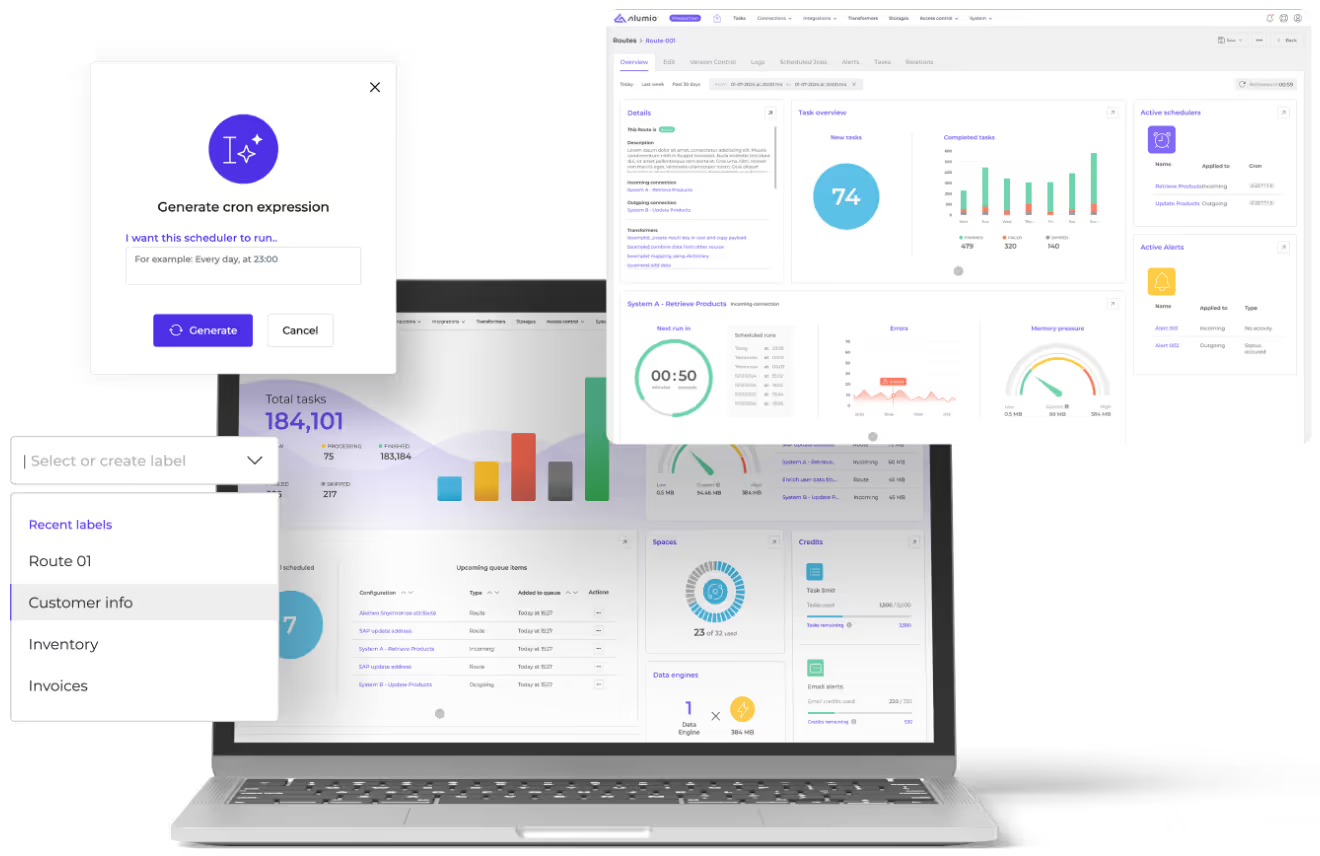
In an IIoT retrofitting setup, the Alumio iPaaS sits between the gateway layer and the business systems. It collects machine data through REST APIs, direct database connections, or file-based exchange. Configurable transformations then validate readings and map them into the structures each receiving system expects, without custom code.
Routes handle both flow types a retrofit produces. Event-driven routes react the moment something happens: a vibration threshold from a retrofitted press can trigger a maintenance order in Microsoft Dynamics 365 and update line status in the MES within the same flow. Scheduled routes aggregate sensor readings into hourly or daily loads for BI and planning tools.
Every message is visible along the way. Dashboards, error logs, and audit trails show IT teams exactly what flowed where, which matters when machine data starts driving real decisions. Most deployments run through certified system integrators, who handle the OT side of the retrofit while the integration layer is configured in parallel.
Making brownfield digital transformation deliver
The hardware half of a retrofit is the easy half. Sensors and edge gateways are mature, affordable, and installable without halting production. Whether the investment delivers is decided after the gateway: machine data either reaches the systems where planning, maintenance, and costing decisions are made, or it joins the dashboards nobody acts on.
Once that route exists, the payoff compounds. Planners schedule against actual capacity instead of assumptions. Maintenance shifts from fixed schedules to actual machine condition. The production history that accumulates becomes the data foundation every analytics and AI initiative depends on.
Brownfield digital transformation is a sequence, not a leap: instrument the machines that matter most, route their data into business systems, and expand line by line. Each newly connected machine becomes a configuration task instead of a project. The factories that pull ahead will not be the ones with the newest equipment, but the ones whose old equipment finally takes part in the decisions.




.svg)








.svg)
.svg)
.svg)
.svg)
.svg)
.svg)
