


A Alumio vivid purple arrow pointing to the right, a visual representation of how to access more page material when clicking on it.
Go back

Alumio and CloudSuite integration

By
Published on
May 13, 2020
Updated on
June 24, 2026
IN CONVERSATION WITH
Email icon
Email icon

Alumio and CloudSuite Integration

Alumio offers various integrations that can be used to set up connections between different systems as quickly as possible. Alumio offers extensive integration capabilities between CloudSuite, a popular E-commerce platform for B2B and B2C.

About CloudSuite

CloudSuite is a state-of-the-art platform for complex B2B and B2C environments with the right solution for your commerce strategy.

CloudSuite adds tremendous values through Business intelligence for businesses, channels, currencies, languages, brands and complete integration with back-office-systems. Because of this organizations can work efficiently and effectively on there e-commerce platform.

Clients currently using the CloudSuite platform with succes are: Goossens Wonen & Slapen, Paardekooper, Van Gelder and many more.

Services that CloudSuite provides

  • Content Management System (CMS)
  • Storytelling, inspiration, and content marketing are the go-to ways to address your online customer. They developed a user-friendly and responsive design with endless opportunities.
  • Product Information Management (PIM)
  • With the CloudSuite PIM, they provide products with collected data, which is essential for a successful e-commerce environment.
  • Digital Asset Management (DAM)
  • With the CloudSuite DAM, they offer a unique way to upload imagery within the CMS which will automatically be optimized in the webshop.
  • Order Management System (OMS)
  • With the CloudSuite Order Management System (OMS), you can organize all your sales, quotations, returns and related integrations with ERP. This module allows you to track all online and offline products.

Benefits CloudSuite Wholesale

B2B e-commerce for wholesalers embodies and extends the world in which they do business.

  • Customer-specific prices and the assortment
  • Quick ordering with order lists
  • Additional sales channels with marketplaces
  • Integration with IT landscape
  • Re-ordering from the order history
  • Users roles, Authorization & budgets
  • OCI links

Benefits CloudSuite Brand Manufactures

Brand manufacturers are expected to give the next large growth impulse to e-commerce. With CloudSuite, you are positioned to take advantage of this next wave of expansion, and future-proof your brand.

  • Headless e-commerce
  • Omni-channel functionalities
  • Customize designs & front-end
  • Combine content with e-commerce
  • Social integration
  • Blogs & inspiration
  • Multiple-shop tool

Why Alumio?

As an alternative to using the traditional way of connecting systems, using a module or a custom-made integration, merchants can choose to connect the systems by using Alumio. Alumio has a standardized connection that uses the API of both applications. The advantage of the API is that it is available within CloudSuite by default. No development or additional actions are required, which results in faster time-to-market.

Another clear advantage of using one of our standard connectors is the fact that our connectors are comprehensively tested by a specialized testing company. This way you are ensured that you never lose an opportunity to engage your customers in promoting your brand.
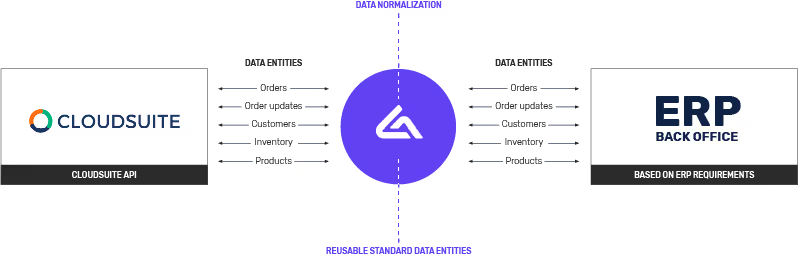
The Combined Power of CloudSuite & Alumio

Merchants have the tremendous opportunity to choose from a wide range of services from CloudSuite. Services that are of vital importance to run a merchant’s business and to stay competitive. Services tend to use similar data that needs to be synced in order to offer an optimal business process. Alumio offers standardized API integrations and a robust data integration platform to handle complex integrations. With the combination of CloudSuite services and Alumio, clients can remain flexible while profiting from standardized solutions.


Turn AI ambition into action

Portrait of Leonie Becher Merli, Business Development Manager at Alumio

Get a free assessment of your integration needs and next steps

Portrait of Leonie Becher Merli, Business Development Manager at Alumio

No items found.
Topics in this blog:
No items found.

FAQ

Integration Platform-ipaas-slider-right
What is the Alumio and CloudSuite integration?

The Alumio and CloudSuite integration connects CloudSuite's B2B and B2C e-commerce platform with other business systems using Alumio's config-first iPaaS and a prebuilt connector template. Alumio acts as the integration backbone between CloudSuite and systems like ERP, PIM, WMS, and CRM, handling data transformation, routing, and monitoring so that commerce data flows reliably without custom middleware development.

Integration Platform-ipaas-slider-right
What systems can be connected to CloudSuite via Alumio?

Via Alumio, CloudSuite can be connected to ERP systems, PIM platforms, warehouse management systems, CRM tools, marketplaces, and other SaaS or cloud applications. Alumio's API-driven architecture means any system with an open API can be integrated with CloudSuite as part of the same governed integration backbone, without building separate point-to-point connectors for each new system.

Integration Platform-ipaas-slider-right
How does Alumio's connector template for CloudSuite work?

Alumio's CloudSuite connector template provides a standardized, pretested connection to CloudSuite's API as a starting point. The template handles the authentication and API communication layer, so implementation teams configure data mapping and transformation logic for their specific use case rather than rebuilding the connection from scratch. Because the connector evolves alongside the CloudSuite API, customers benefit from updates without maintaining custom integration code.

Integration Platform-ipaas-slider-right
What are the advantages of using Alumio over a direct module for CloudSuite integration?

A direct module creates a point-to-point dependency that can break with platform updates and provides limited visibility into data flows. Alumio centralizes the integration so all data exchanges are logged, monitored, and replayable from one place. When CloudSuite is one of several connected systems alongside ERP, PIM, and logistics, the Alumio backbone manages all of them consistently rather than requiring separate connectors with separate failure modes.

Integration Platform-ipaas-slider-right
Which businesses benefit most from the Alumio and CloudSuite integration?

B2B and B2C businesses running CloudSuite as their commerce platform that need to keep it in sync with an ERP, PIM, or WMS benefit most. It is particularly well suited to organizations managing large product catalogs, high order volumes, or complex pricing and inventory logic that must flow reliably between CloudSuite and back-office systems without manual reconciliation.

Integration Platform-ipaas-slider-right
How quickly can an Alumio and CloudSuite integration be set up?

With Alumio's prebuilt CloudSuite connector template, the API connection is established as a starting point, significantly reducing time compared to a fully custom build. Actual implementation time depends on the complexity of data flows, the number of systems being connected, and the transformation logic required. Alumio Solutions Engineering is involved on every business-critical project to scope and sequence the implementation.

Get a free assessment of your integration needs

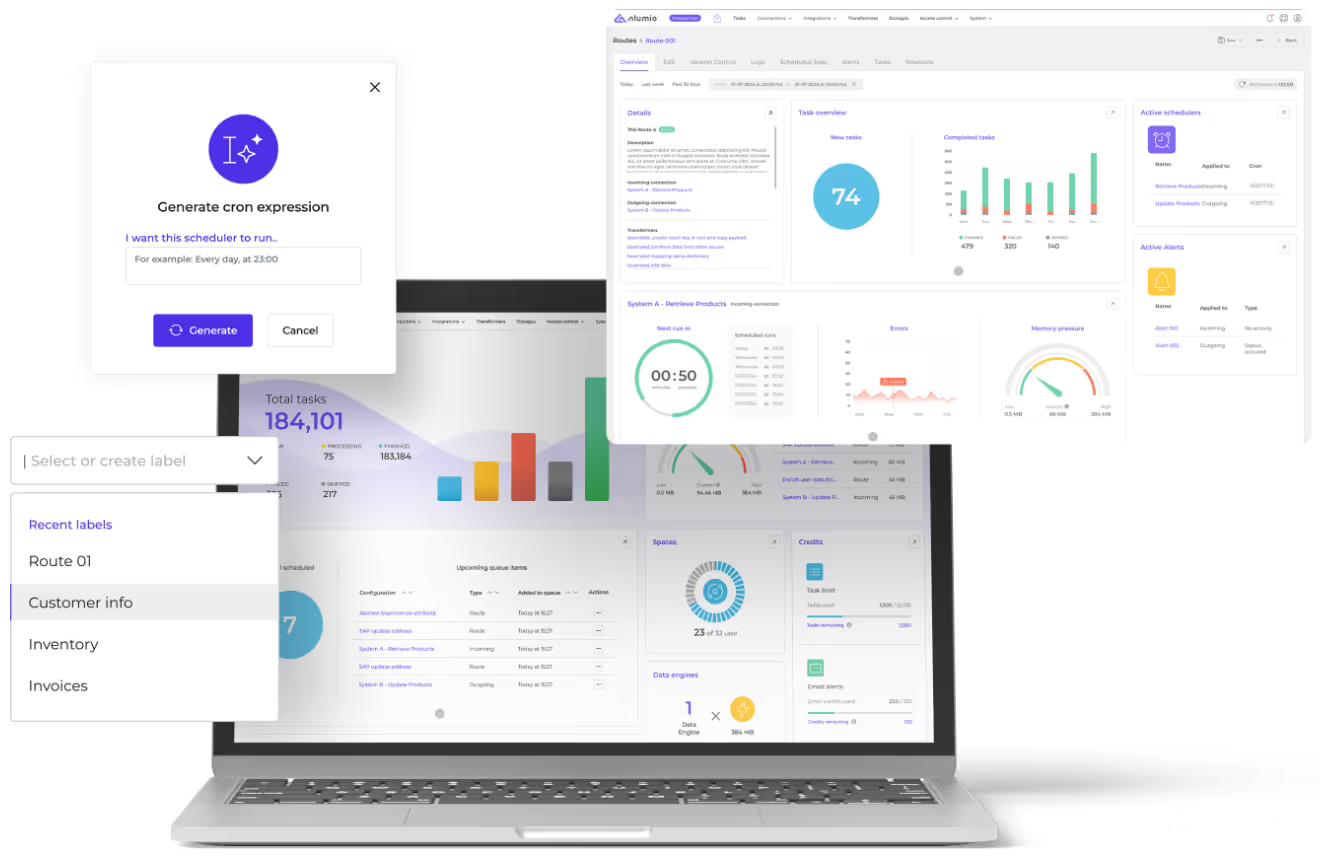
Laptop screen displaying the Alumio iPaaS dashboard, alongside pop-up windows for generating cron expressions, selecting labels and route overview.